Blackwater aquarium: how to set one up, and which fish want it
By Curtis W. · Updated Oct 20, 2026 · 8 min read

Blackwater rivers such as the Rio Negro run the color of strong tea. Humic and fulvic acids from fallen leaves and wood give them most of that color, and tannins add to it. The water holds almost no minerals, and its pH runs from 3.0 to 5.5. Acid water like that pulls salts from a fish's gills, but the dissolved organic matter in it helps the fish living there hold on to those salts.
A blackwater aquarium copies that stain and softness at a milder pH, around 6.0 to 6.5, with leaves, alder cones and driftwood to make the tea. You'll need soft water first, because hard tap water cancels the acids they release. The filter also has to finish cycling before the pH comes down, since its bacteria slow as the water turns acid.
Start with soft water
Test your tap water's KH and GH before you buy a single leaf, since hard water neutralizes the acid from the leaves. KH is the carbonate that holds the pH steady, so if your tap water reads above about 3 dKH, botanicals will tint the water without moving the pH for long.
RO water, short for reverse osmosis water, is tap water with nearly all its minerals filtered out. Fresh RO water carries next to no KH, and it reads about pH 6.5 to 6.8 from the carbon dioxide dissolved in it. Blend it with a little tap water or a remineralizer, and keep the GH at 4 dGH or less.
A household water softener isn't a substitute, because it trades calcium and magnesium for sodium. It adds about 8 ppm of sodium for each grain of hardness it removes, while RO takes the minerals out instead of swapping them.
Since a TDS pen reads everything dissolved in the water, it's the quickest check on a blend. TankBud's blackwater profile calls 100 ppm or less safe, while wild blackwater reads under 70 ppm.
- pH
- 4.8 to 6.8
- Ammonia
- up to 0.02 ppm
- Nitrite
- up to 0.02 ppm
- Nitrate
- up to 20 ppm
- Temperature
- 76 to 86°F (24.4 to 30°C)
- GH
- up to 4 dGH
- KH
- up to 3 dKH
- Phosphate
- up to 1 ppm
- TDS
- up to 100 ppm
Soft, acidic, tannin-stained tanks. TankBud reads every water test against these targets when a tank uses this profile.
Keep limestone, shells and coral sand out of the tank, because their carbonate pulls the pH back up. When lime is spread on brown, humic lakes, it raises their pH and clears the stain altogether.
API's liquid pH test reads no lower than 6.0, so if your tank runs below that, you'll need a pH meter to see where it sits.
Tannins from leaves, cones and wood
Dried Indian almond leaves are the easiest place to start, and the betta guide covers how they float, stain and break down. At that guide's rate of one leaf per 5 to 20 gallons, you'll get a tint. A blackwater tank takes more leaves than that, along with soft woods such as Malaysian driftwood or cholla.
Oak and beech leaves work too, as long as you collect them after they fall in autumn and well away from roads. Use only dead, fallen leaves, and dry them before they go in. Beech leaves stain the water lightly but can last more than six months, while an almond leaf breaks down in one to two months.
Alder cones don't give off as much tannin as almond leaves, but each one keeps leaching for a couple of months. Start with one cone per 5 gallons, and watch the color for a few weeks before you add more.
Driftwood colors the water as well. Soaking a piece for one to two weeks draws out most of its tannin, which is what you'd want for a clear-water tank. In a blackwater tank you're keeping that tannin, so a piece only needs to soak until it sinks.
Boiling sinks cones and wood faster, but it drives off part of their tannin. For leaves, a rinse is enough, since a long boil strips out the compounds you're adding them for.
There's no test kit for humic substances, so the color of the water is your gauge. Add leaves a few at a time, and lift some out if the tank turns darker than you want. Activated carbon strips the color, so take it out of the filter.
Old leaves can stay where they fall. As they break down, they grow a film of microbes that fry and shrimp graze, and new leaves can go right on top.

Peat in the filter
Peat in a mesh bag lowers the pH and browns the water, though it works best in water that's already soft. Its strength varies from batch to batch, so dose it by the label.
Peat comes from bogs, which cover at least 3 percent of the world's land and hold up to 44 percent of its soil carbon. Digging peat out damages the bogs, but leaves and cones color the water without that cost.
Low KH and a drifting pH
Carbonate keeps the pH steady, but a blackwater tank runs with almost none. Without it, water between pH 6.0 and 7.0 is very unstable. You can see the difference in ponds, where poorly buffered ones can swing from pH 6 or lower to 10 or higher, while well-buffered ones hold between about 7.5 and 8.5.
In a tank the slide usually runs downward, because nitrification makes acid, rotting food and leaves add more, and water near 0 dKH absorbs none of it. An aging tank can drop fast to between pH 4.0 and 6.0, though water changes push the pH back up.
Mix change water ahead of time by steeping a few leaves in a bucket of RO water. Once it's steeped, check that its pH, KH and temperature match the tank.
Change about 10 to 15 percent a week, because large changes shift the pH further, and fish such as the chocolate gourami don't take a big, mismatched change well.
Don't use pH-down liquids. Their effect often wears off, and when the pH rebounds, the swing stresses fish. Test pH and KH weekly, and write each reading in a maintenance log so you'll spot a slow slide.
Cycle before the pH comes down
Filter bacteria work fastest at a pH of 7.3 to 8.0, but a new cycle stalls once the pH falls below 6.0. Pure RO water can stall one too, since it doesn't carry any phosphate, and nitrite conversion stops when there's none.
- Fill the tank with tap water, or a blend that includes some, at a pH above 7 and at least 4.5 dKH.
- Run the fishless cycle from the cycling guide, with no leaves, cones or peat in the tank yet.
- Keep dosing until the tank clears a full dose of ammonia within a day.
- Over the next several weeks, use a little more RO water at each change and add leaves in small batches.
- Test ammonia and nitrite twice a week while the pH falls, and add fish once it settles.
In lab work, nitrification at a low pH has needed a dense, settled film of bacteria. A 2004 study brought a bed of filter bacteria down from pH 7 and kept it nitrifying at a high rate at pH 4.3. That points to lowering a mature filter slowly instead of starting a new one in acid water.
Acid water also makes ammonia less toxic. Test kits read two forms together, free ammonia and ammonium, and the free form is about 100 times as toxic. At 79°F (26°C), 0.6 percent of the ammonia at pH 7.0 is free, but at pH 6.0 that share drops to 0.06 percent.
Still, a trace of ammonia means the filter hasn't kept up. Nitrate can sit flat while ammonia creeps up, so test for ammonia itself. Any reading turns far more toxic if the pH jumps.
Fish for soft, acid water
Pick fish by the pH range on their profiles. A fish whose range runs from about 5.0 to 7.0 can live in a blackwater tank or a neutral one. The cardinal tetra lists pH 5.0 to 7.0 at 73 to 84°F (23 to 29°C) and needs a 16 gallon (60 liter) tank. The hockeystick pencilfish lists the same pH, and the ember tetra lists pH 5.5 to 7.0.
If a fish's range tops out at 6.5 or lower, though, the tank needs to stay soft and acid for good. That's true of the panda dwarf cichlid, which lists 5.0 to 6.5, and the tucano tetra, which lists 4.5 to 6.0. The licorice gourami lists 3.5 to 6.0, and it's marked difficult.
The chocolate gourami comes from peat swamps. It lists pH 5.5 to 7.0 and wants heat, 79 to 88°F (26 to 31°C). Because it moves slowly and loses out at feeding time, give it small, calm company and keep it out of a busy tank.
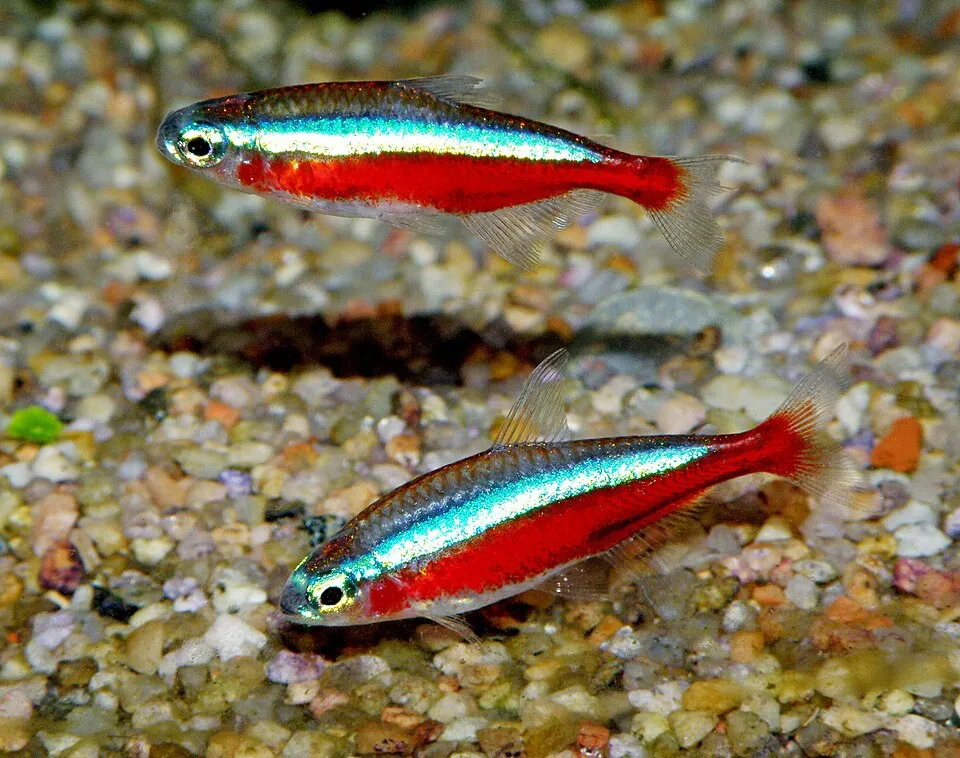
Cardinal tetra
Paracheirodon axelrodi
Freshwater1.8 in (4.5 cm) · 16 gal (60 L)73–84°F (23–29°C)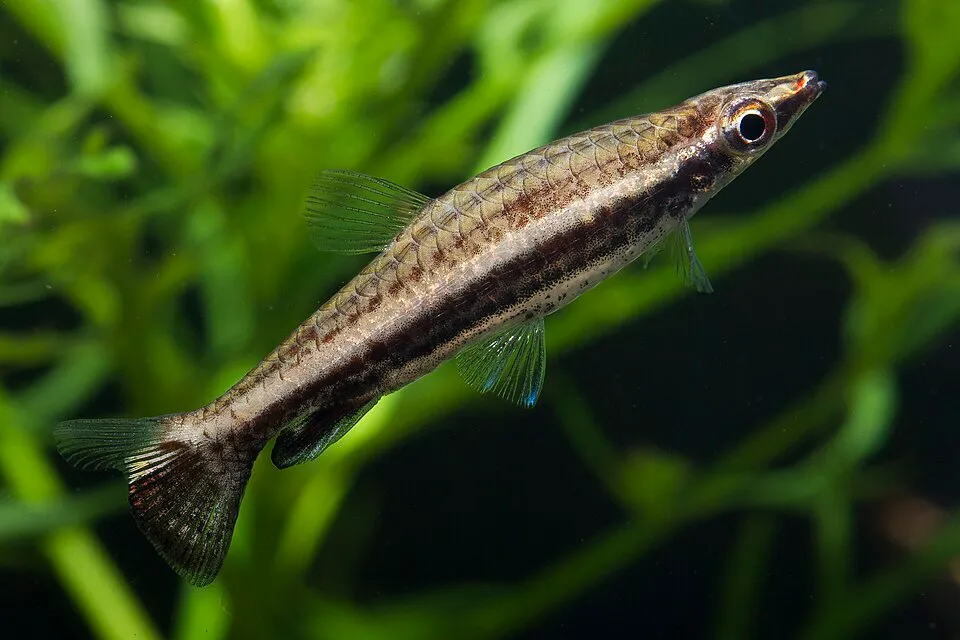
Hockeystick pencilfish
Nannostomus eques
Freshwater1.4 in (3.5 cm) · 15 gal (55 L)72–82°F (22–28°C)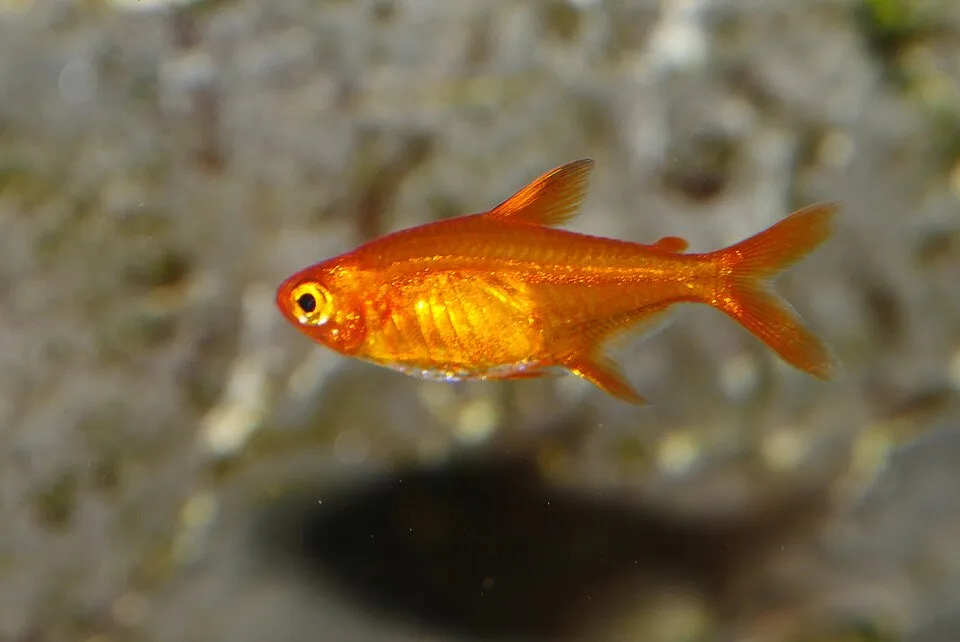
Ember tetra
Hyphessobrycon amandae
Freshwater0.8 in (2 cm) · 9 gal (35 L)72–82°F (22–28°C)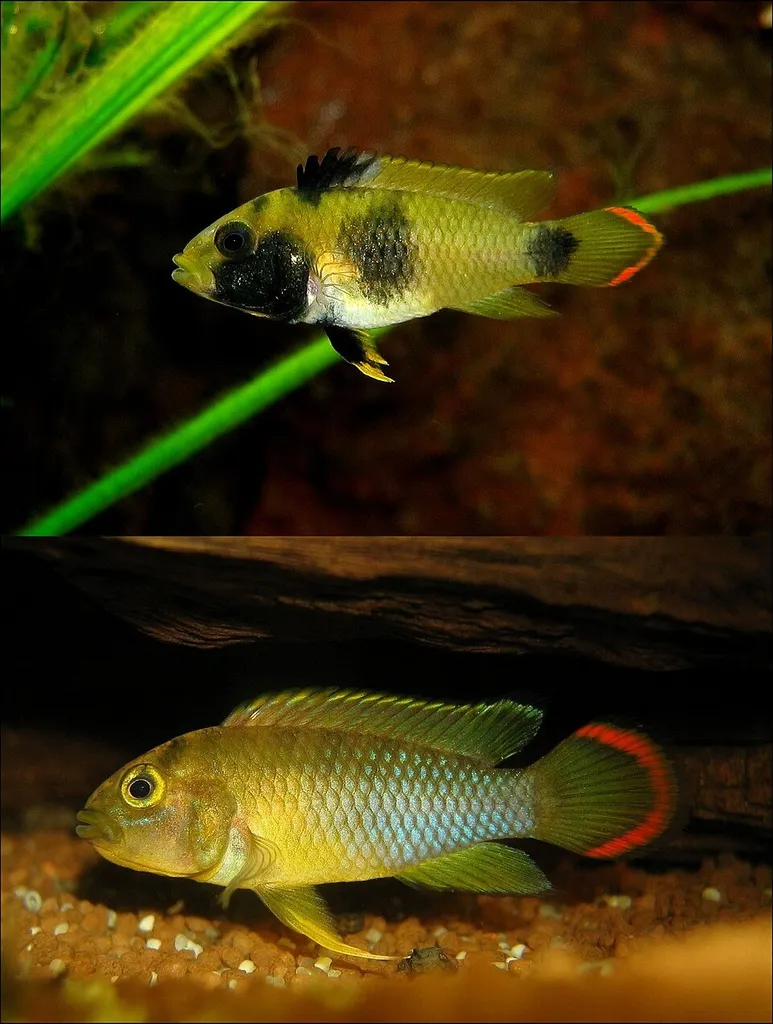
Panda dwarf cichlid
Apistogramma nijsseni
Freshwater3.3 in (8.5 cm) · 18 gal (70 L)75–82°F (24–28°C)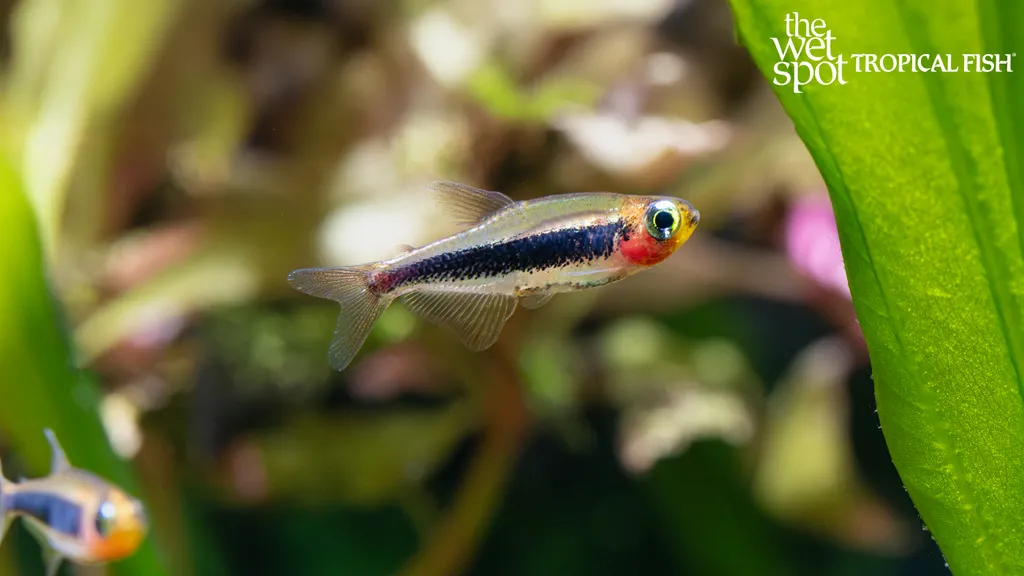
Tucano tetra
Tucanoichthys tucano
Freshwater0.8 in (2 cm) · 12 gal (45 L)75–82°F (24–28°C)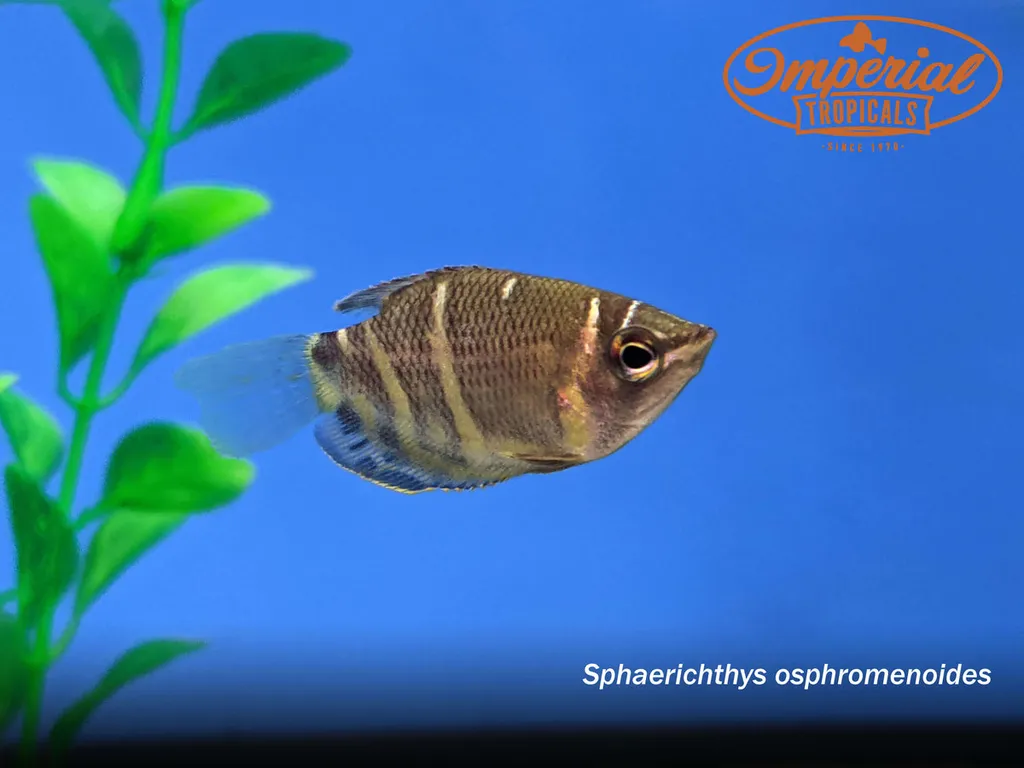
Chocolate gourami
Sphaerichthys osphromenoides
Freshwater2 in (5 cm) · 17 gal (65 L)79–88°F (26–31°C)
Three fish from the Rio Negro
Cardinal tetras come from the Rio Negro and the Orinoco, and hockeystick pencilfish live in Rio Negro blackwater too. The Tukano cory was described from the Rio Tiquié, a blackwater river of the upper Rio Negro, and it shoals over sand and leaf litter.
Their pH ranges overlap from 5.2 to 6.8, and that's inside the blackwater profile. Their temperatures overlap too, from 75 to 82°F (24 to 28°C), so a heater set to 78°F suits all three. The plan below stays in the calculator's Comfortable band, which leaves room for a filter slowed by the low pH.
Give the corys fine sand with leaves on top, and keep the flow gentle and the light low. Wild blackwater moves slowly under a forest canopy, and blackwater fish are less shy in a tank that copies it.
Cardinals, pencilfish and Tukano corys
These species overlap at 75–82°F (24–28°C), pH 5.2–6.8.
Add one group at a time, as the community tank guide lays out, and test ammonia for a few days after each one goes in.
For a 20 gallon (75 liter) tank, eight cardinals with six pygmy corys also read Comfortable. The pygmy cory lists pH 6.0 to 7.5, so that tank keeps to the profile's mild end, from 6.0 to 6.8. If you'd like a different mix, the stocking calculator checks it for crowding, group sizes and shared water ranges.
Plants for dim, stained water
Brown water doesn't let as much light through, and blackwater fish come out more in a dim tank, so choose plants that grow in low light and soft water.
Epiphytes, the plants that grow on wood and rock, suit a tank built around driftwood. Java fern grows in low light without added CO₂ and lists pH 5.0 to 7.5. Bucephalandra sordidula takes shade as well, and it lists pH 5.0 to 7.0.
Cryptocoryne wendtii is a beginner crypt for low light, and it lists pH 6.0 to 7.5. If your tank runs lower, Cryptocoryne pygmaea is rated easy and takes a pH as low as 5.5. The crypts thwaitesii and schulzei list pH no higher than 6.5, but both are rated difficult.
Cryptocoryne →51 plants
Floating plants dim the tank further, and pencilfish gather just beneath them. Salvinia cucullata lists a pH from 5.0 and floating water sprite lists a pH from 5.5. Both are rated easy and don't need CO₂.
Floating plants →26 plants
Syngonanthus Belem is native to blackwater rivers near Belém, at the mouth of the Amazon. Even so, it needs high light and injected CO₂, so it belongs in a high-tech soft-water tank instead.
FAQ
Common questions
Do you need RO water for a blackwater tank?
Only if your tap water is hard. Leaves and wood can't hold the pH down against more than about 3 dKH, so cut hard tap water with RO first. If your tap water is already soft, it works once it's dechlorinated.
Can neon tetras live in a blackwater tank?
The neon tetra lists pH 5.0 to 7.5, so the water suits it. The neon tops out at 77°F (25°C), though, and TankBud's blackwater profile starts at 76°F, so a neon only fits the cool end. For the warmer end, the cardinal tetra lists 73 to 84°F (23 to 29°C).
Do bettas prefer blackwater?
The show betta lists pH 6.0 to 7.5, so it only suits the mild end of a blackwater tank. Wild species such as the wine-red betta list 4.0 to 6.0, though, and they need water that soft and acid.
Does activated carbon remove tannins?
Yes, carbon strips the tea color out of the water. That's why blackwater keepers leave it out of the filter, though some run it for about a week a month to keep the water from turning too dark.
Why does the pH keep dropping in my blackwater tank?
Nitrification makes acid, and rotting leaves and food add more, but a tank near 0 dKH has nothing to absorb it. Small weekly changes with prepared water lift the pH back slowly, and if you add leaves a few at a time, the drop stays gentle.
Sources
The claims the catalog does not hold come from these pages.
- A blackwater breakdown, Practical Fishkeeping
- 17.2.1. Blackwater Biotope, Aquarium Science
- Dissolved organic carbon from the upper Rio Negro protects zebrafish (Danio rerio) against ionoregulatory disturbances caused by low pH exposure (Duarte, Smith, Val and Wood, 2016), Scientific Reports
- Leaf Litter & More: How to Naturally Lower Aquarium pH, Tropical Fish Hobbyist Magazine
- All the leaves are brown..., Seriously Fish
- Are Indian Almond Leaves Good for Aquarium Fish?, Aquarium Co-Op
- Benefits of Using Alder Cones in Your Shrimp Tank, Shrimp Science
- Freshwater Planted Aquarium Set-Up: Adding Driftwood to Your Aquarium, LiveAquaria
- Aquarium pH: How to Safely Adjust pH, Aqueon
- Peatlands and climate change, IUCN
- Total Alkalinity (Publication 3776), Mississippi State University Extension
- Water Softening (Ion Exchange) (WQ1031), NDSU Extension, North Dakota State University
- pH Test Kit, API Fishcare
- Blackwater Aquarium Beginners Guide 101: Managing Water Chemistry in Blackwater Aquariums, Castle Dawn Aquatics
- How to Cycle a Freshwater Aquarium with FritzZyme, Fritz Aquatics
- Quick Guide to Fishless Cycling, DrTim's Aquatics
- High-Rate Nitrification at Low pH in Suspended- and Attached-Biomass Reactors (Tarre and Green, 2004), Applied and Environmental Microbiology
- Ammonia in Aquatic Systems (FA031), UF/IFAS Extension, University of Florida
- Site Selection for Aquaculture: Chemical Features of Water (Table 9.V, percent NH3 after Emerson and others, 1975), Food and Agriculture Organization of the United Nations
- Paracheirodon axelrodi (Cardinal Tetra), Seriously Fish
- Nannostomus eques (Hockeystick Pencilfish), Seriously Fish
- Sphaerichthys osphromenoides (Chocolate Gourami), Seriously Fish
- Corydoras tukano, a new species of corydoradine catfish from the rio Tiquié, upper rio Negro basin, Brazil (Britto and Lima, 2003), Neotropical Ichthyology
Keep a record of your own tank
TankBud tracks water tests, reminders and how full your tank reads, free for up to 4 tanks.
More guides
Tank setups
Clownfish tank setup: tank size, salt water and anemones
An ocellaris or percula pair fits in a 20 gallon reef, but a bubble tip anemone needs 30 gallons and a tank that's been running for six months.
By Curtis W. · Updated Oct 20, 2026 · 8 min read
Tank setups
Pea puffer tank: tank size, plants and feeding
A small group of pea puffers needs 10 gallons, dense plants and a tank of its own, and most of them won't eat dry food.
By Curtis W. · Updated Oct 20, 2026 · 8 min read
Tank setups
African cichlid tank: stocking, rocks and water
Most African cichlid tanks hold Lake Malawi mbuna, which need hard water and stacked rock, and you'll want a 75 gallon tank for a group of twelve.
By Curtis W. · Updated Oct 20, 2026 · 8 min read


