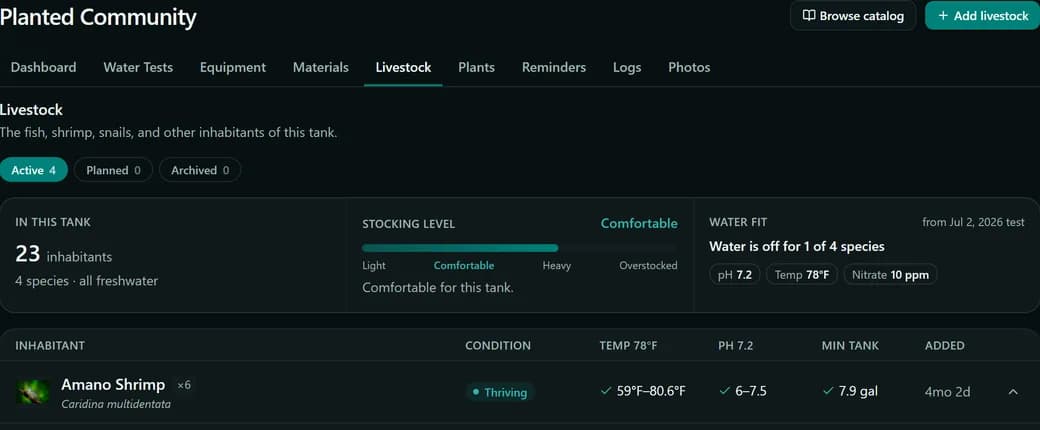
Aquarium stocking calculator
Set the tank, add the species you are considering, and see how full the tank really is before anything goes in the water. It runs on the same curated ranges as the care guides, free and without an account.
Set the tank and add livestock to see the band.
Set the tank and add livestock to see the band.
Temperature and pH ranges are checked as soon as two species are in the plan.
TankBud checks these ranges against your water tests once the tank is running.
How the estimate works
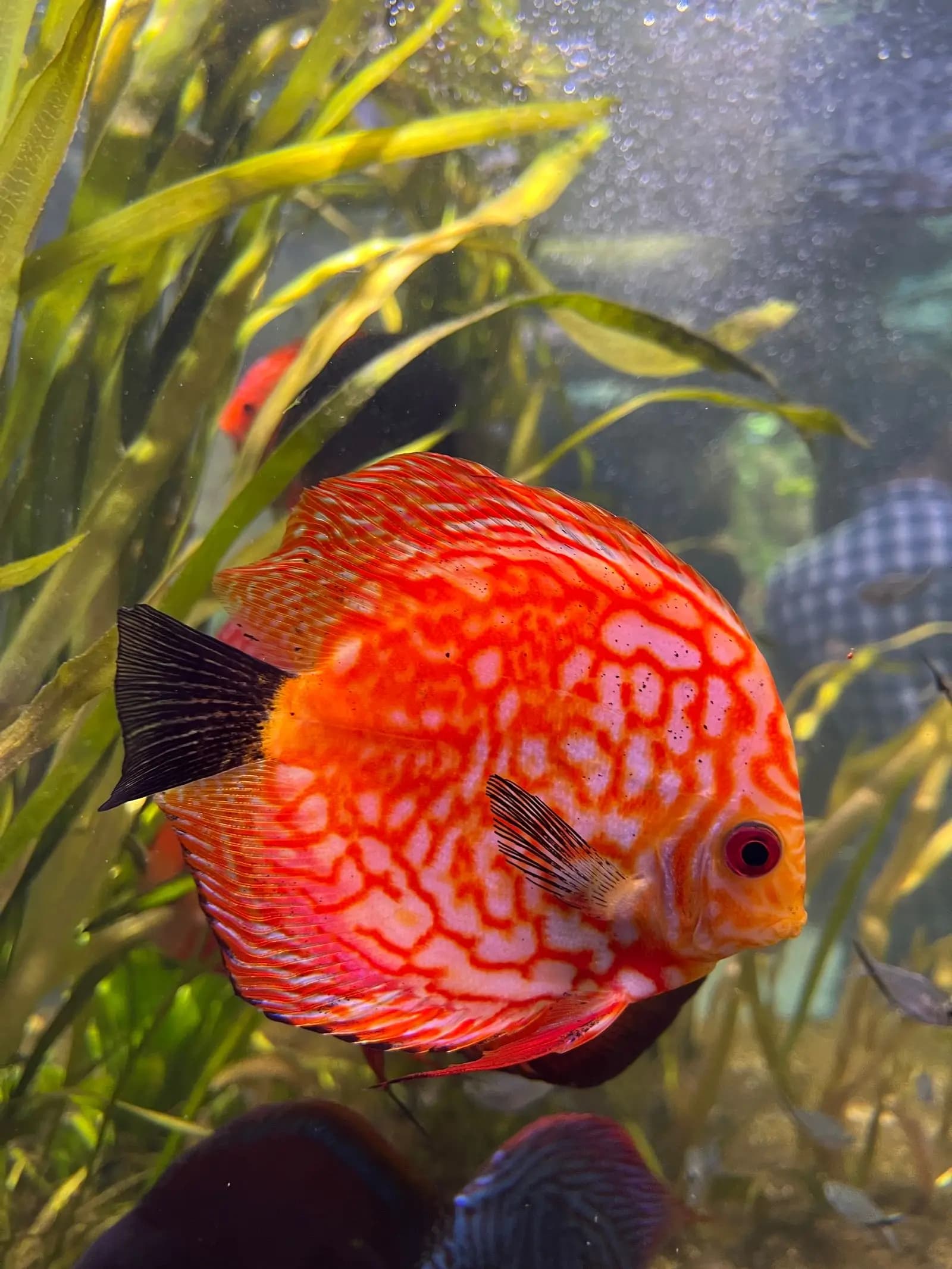
Every species in the catalog carries the same care data the app uses: adult size, minimum tank size, temperament and social behavior. The calculator scores your plan on two dimensions against the volume you set, and the worse dimension decides the band.
Adult size stands in for the waste a species produces, scaled by what it is: a big cichlid loads water far beyond its length, while shrimp and snails barely register.
Each species claims room from its curated minimum tank size, group size and temperament, weighed against the volume you set.
The scale is calibrated safety first, so a plan that reads Comfortable holds up in practice. That is also why you get a band instead of a percentage: a single number would suggest a precision the estimate does not have.
The band is an estimate, not a verdict. It cannot see aggression between individuals, breeding, filtration quality or how heavily you feed, and it is no substitute for researching each species before you buy. The care guides are the place to start.
Common questions
How many fish fit in a 20 gallon tank?
It depends on adult size, waste and behavior rather than a per-gallon rule. A school of ten neon tetras with a cleanup crew of cherry shrimp sits comfortably in a 20 gallon, while a single oscar needs 95 gal (360 L) on its own. Build the plan above and the band answers for your exact mix.
Is the one inch per gallon rule accurate?
Not really. Waste scales with body mass rather than length, so one 10 inch fish loads a tank far more than ten 1 inch fish. The rule also ignores territory and behavior. The calculator weighs adult size, species type and grouping instead.
How many neon tetras should be kept together?
Neon tetras are schooling fish. Keep at least 6 together, and 10 or more is better; a short school stays stressed no matter how clean the water is. The calculator flags any schooling species short of a group of 6.
What size tank does an oscar need?
The catalog lists 95 gal (360 L) as the minimum for one adult oscar. They grow to about 14 in (35 cm) and carry a heavy waste load, so bigger is always better.
Do plants count toward stocking?
No. Plants add nothing to the waste or territory load, so they sit outside the band. They help water quality, but they don't earn room for extra fish.
Do I need an account to use the calculator?
No. The calculator is free and works without an account. A free account lets you save the plan to the planner, where TankBud tracks the budget and checks water fit against your real tests.
From plan to running tank.
Save this plan to a free account and it becomes a tank you can track: water tests, reminders, and the same range checks against real readings.