Pea puffer tank: tank size, plants and feeding
By Curtis W. · Updated Oct 20, 2026 · 8 min read

The pea puffer is the smallest known pufferfish, and it's 1.4 inches (3.5 cm) long when fully grown. Stores also sell it as the dwarf pufferfish, which is the name you'll find on its catalog profile. Its scientific name is Carinotetraodon travancoricus, and it comes from slow, weedy rivers, lakes and floodplains in Kerala and southern Karnataka, in southwestern India.
A small group of pea puffers needs at least 10 gallons (38 liters) and a tank with no other fish. The group also needs dense plants, which break up the view across the tank so each puffer can get out of the others' sight. Most of them won't eat flakes or pellets, so you'll be feeding frozen and live food, with small snails on the side.
The 5 gallon rule and the 10 gallon floor
Several care guides give the first pea puffer 5 gallons (19 liters) and each extra one 3 gallons (11 liters) more. TankBud lists 10 gallons (38 liters) instead, which is the median of six published minimums that run from 6.6 to 16 gallons (25 to 60 liters).
You'll want room for several because the pea puffer is one of the few puffers that lives in groups, and a lone one can turn edgy or withdrawn. More water also dilutes the waste from meaty food, and a bigger tank holds enough plants to hide one puffer from the next. In a bare 10 gallon tank, even a trio fights, so plant it heavily from the start.
Pick a long tank over a tall one, because a group's territories spread out along the glass. The usual home for six is a 20 gallon long tank, which is the low version of that size.
| Tank | Comfortable | Full |
|---|---|---|
| 5 gallons | Below its 10 gal (38 L) minimum | |
| 10 gallons | None | Four |
| 20 gallons | 9 | 12 |
| 29 gallons | 15 | 20 |
Five gallons falls short of the minimum for even one pea puffer. A 10 gallon tank reads Full from the first fish because it's the smallest tank the species lists. Full means the tank is stocked to its limit without crossing it. That tank stays Full up to four puffers, though care guides stop at a trio of one male and two females.
Published rules for groups give each puffer about 2.6 gallons (10 liters), which comes to seven in a 20 gallon tank and about eleven in a 29 gallon tank. Both counts read Comfortable in the stocking calculator. The calculator's counts run higher because it weighs waste and room, and it can't tell which fish are males.
Males, females and the pecking order
You can tell an adult male by the dark stripe down the middle of his belly and the fine, wrinkle-like lines behind each eye. His blotches also tend to join into bands along the flanks. Females stay rounder, with smaller spots scattered over the body, and they swell further when they're carrying eggs. Since young fish all look like females, a group bought small can end up with more males than you planned.
Keep at least two females for every male, and three if you can. Each male claims a patch of plants and chases other puffers out of it. Because rival males can fight to the death, a 10 gallon tank holds one male at most.
In a group of six or more, the chasing spreads out, so no single fish takes all of it. A puffer also gives up a chase once its rival is out of sight.
Much of the chasing is courtship, with a male following a ripe female around the tank until she's ready to spawn. That's where thick cover helps, since it gives her somewhere to rest. She scatters a few eggs a day into moss, though the adults may eat them. If you move the eggs to a separate container, they'll hatch in four to five days.
Plants that break up the sight lines
In the wild, pea puffers shelter among leaf litter, roots and overhanging plants at the water's edge. Plant the tank just as thickly, from the sand to the surface, so no puffer can see from one end to the other. Twisted wood and a few rocks add more breaks between territories. Live plants also take up some of the waste, which helps in a small tank.
For the lower layer, tie Java moss and Christmas moss to wood or stone, since both grow in low light. Males claim clumps of the moss, and females lay their eggs in it.
Mosses →25 plants
Above the moss, taller plants such as Cryptocoryne wendtii and Java fern fill the middle of the tank. Floating plants cover the top layer and shade the water below.
Floating plants →26 plants
Use fine, smooth sand, because a startled puffer dives into the substrate. Since pea puffers are weak swimmers, pick a large filter with a gentle outflow that spreads across the tank.
Fresh water, no salt
Pea puffers are freshwater fish, so their tank doesn't need any salt. A 2000 report found wild fish from brackish water near the coast to forest rivers far inland. Care guides that mention those coastal records still keep the fish in plain fresh water.

Keep the water at 72 to 82°F (22 to 28°C) with a pH of 6.5 to 7.5, which is the range on the species profile. If the room runs cool, or it warms and cools between day and night, a heater will hold the temperature steady. Hardness doesn't matter much as long as it stays away from the extremes.
Pea puffer skin has no scales, which leaves the fish sensitive to nitrate and to old water. That's why you'll want to change water often enough to hold nitrate under 20 ppm, the safe line in the profile below. A bigger tank makes that easier, because the same meals raise nitrate more slowly in more water.
Before the puffers go in, set up and cycle the tank, then let it run a few weeks longer so the plants and filter can settle.
- pH
- 6.5 to 8.0
- Ammonia
- up to 0.02 ppm
- Nitrite
- up to 0.02 ppm
- Nitrate
- up to 20 ppm
- Temperature
- 72 to 80°F (22.2 to 26.7°C)
- GH
- 4 to 12 dGH
- KH
- 2 to 10 dKH
- Phosphate
- up to 1 ppm
Established freshwater community tanks. TankBud reads every water test against these targets when a tank uses this profile.
Frozen food, live food and snails
Flakes and pellets mostly go uneaten, because few pea puffers ever learn to take them. Instead, they hunt by sight, moving each eye on its own and picking off prey one piece at a time.
Frozen brine shrimp, daphnia, cyclops and bloodworms cover most meals. Thaw each portion in a little tank water and pour off the juice from the pack. If you have a fussy eater, live blackworms and daphnia will get it eating. Daphnia and grindal worms are easy to culture at home, so you can keep live food on hand between trips to the store.
Nearly every puffer takes bloodworms, which makes them the food to start a new fish on. Once it's eating, hold bloodworms to a small share of the diet, because a puffer fed one or two foods runs short of vitamins.
Feed once or twice a day, about as much as the group clears in three minutes. You'll know a pea puffer is well fed when its belly is gently rounded. Siphon out leftovers after each meal, because meaty food rots fast.
Like every puffer, the pea puffer has a beak of fused teeth that grows for life. The beak grows slowly in this species, though, so keepers rarely need to trim one. Some care guides call snails essential for wearing the beak down, while others say a pea puffer does fine without them. Snails help either way, and the puffers hunt them eagerly.
Offer snails as a regular extra on top of the frozen food. Pick small ones, because a puffer bites at a large snail without finishing it, and the leftover body fouls the water.
A snail tub beside the tank
Bladder and ramshorn snails breed on their own in a spare tub or small tank. Because bladder snails can fertilize themselves, even one can start a colony. Ramshorns lay flat jelly clutches that hatch within about three weeks, depending on the temperature.
Malaysian trumpet snails give birth to live young, and a single female can clone herself into a colony. Feed them to the puffers while the snails are still under half an inch (1.3 cm).
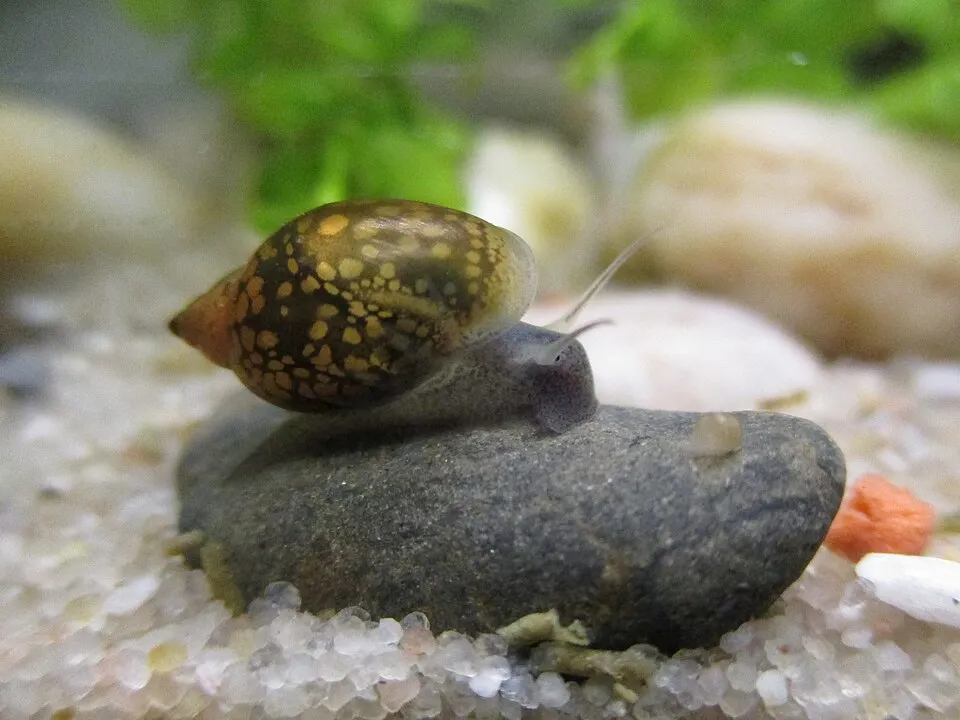
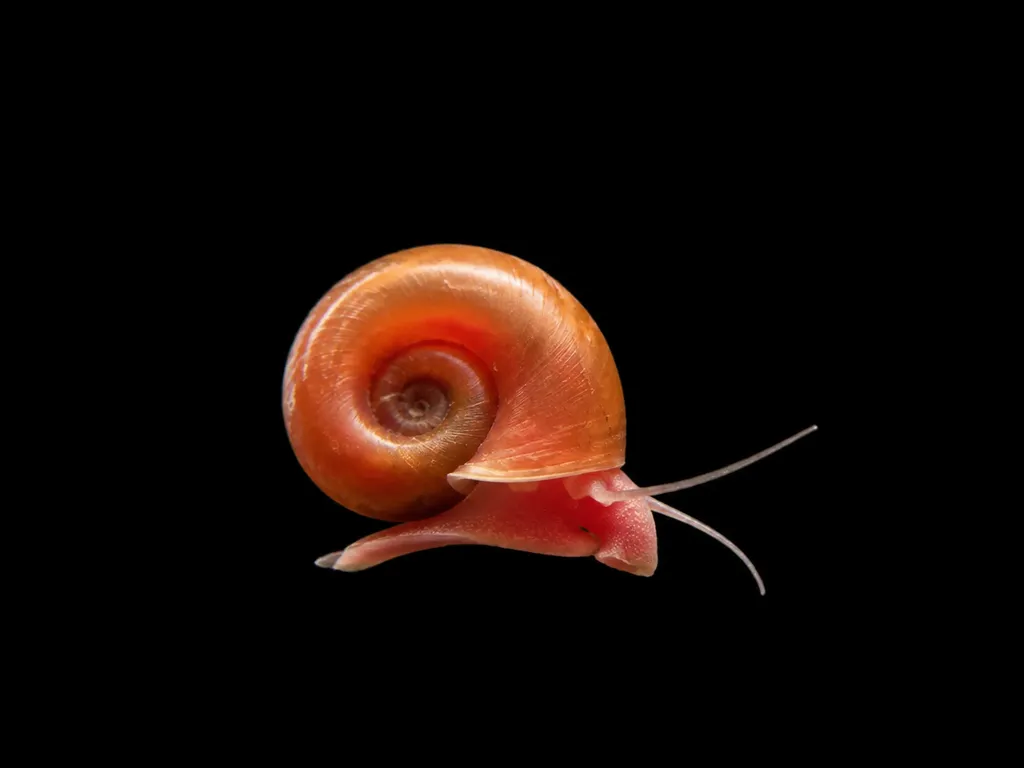
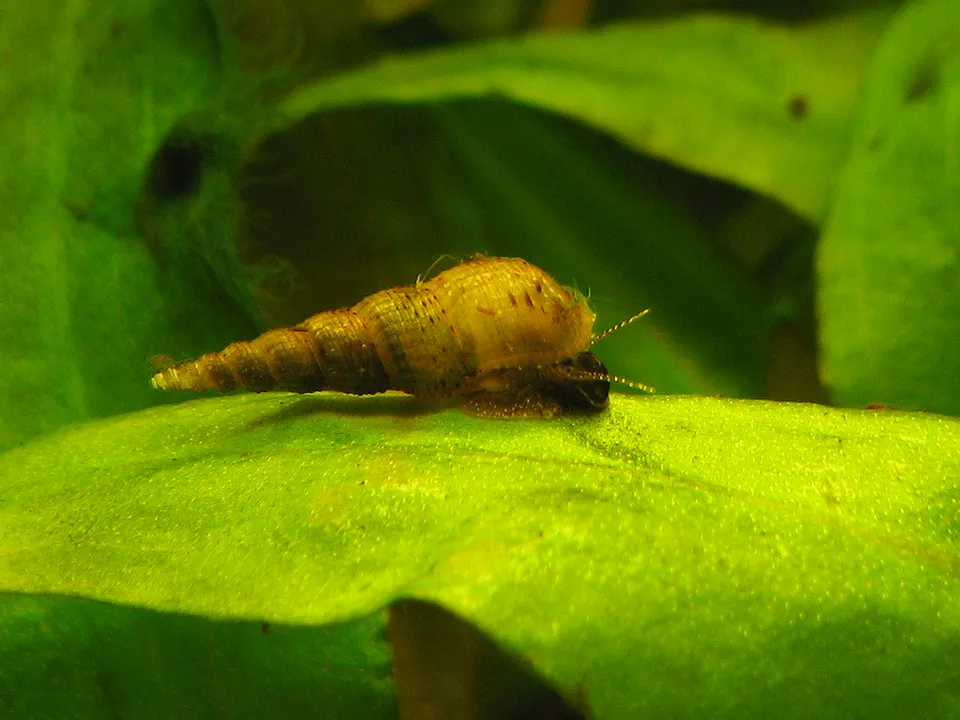
A snail tub needs only 5 to 10 gallons (19 to 38 liters), a sponge filter and a few plants. Unless the room drops below 68°F (20°C), you can skip the heater. Start it with five to ten snails and feed them a varied diet with some calcium in it for their shells.
The more the snails eat, the faster they breed. Move a handful into the puffer tank at a time, so the puffers can clear them before the snails grow too big.
A tank of their own
A pea puffer nips fins at any group size, so slow or long-finned fish such as bettas and guppies lose the most to it. Fast fish don't fare much better, because they beat the puffers to every meal. That leaves a species tank, with pea puffers and no other kinds of fish.
Some keepers report success with otocinclus or quick tetras, but most report nipped fins, and the pea puffer's catalog profile doesn't name any tank mates for it.
Snails go in as food, so the tank won't have a cleanup crew. You'll need to scrape the algae off the glass and siphon the leftovers yourself.
Among the pea puffer's close relatives, the red-tail dwarf puffer is the only one marked peaceful, while the red-eye puffers are all marked aggressive.
Pufferfish →31 species
Captive-bred fish and quarantine
Both wild-caught and captive-bred pea puffers reach stores, and the label doesn't always say which. A 2024 study of one Kerala river found collectors taking many fish before they were old enough to breed. Since the species is listed as Vulnerable, ask where the fish came from and buy captive-bred ones when you can.
Some stores sell tank-raised pea puffers from farms in Indonesia. Shop in person if you can, because you'll see the fish before they're bagged. Pick puffers with rounded bellies and bright eyes, and pass on any that look hollow or clamp their fins. Captive-bred fish often arrive small, so they may need live baby brine shrimp or microworms at first.
Wild-caught puffers often carry worms, so quarantine new fish in a separate tank for four to six weeks and deworm the wild ones while they're there. Levamisole treats roundworms, and praziquantel treats tapeworms. When you move puffers between tanks, make sure to use a cup of water rather than a net, because a puffer that swallows air can die from it.
FAQ
Common questions
Can two pea puffers live in a 5 gallon tank?
Two pea puffers in a 5 gallon tank would fall below the 10 gallon (38 liter) minimum TankBud lists for the species. A single puffer can often manage in 5 gallons, but two don't have much room to get out of each other's sight.
Are pea puffers hard to keep?
TankBud rates the pea puffer medium, which is a step up from the easiest fish. Feeding is most of the work, because most pea puffers won't eat dry food and need frozen or live meals. They also need clean water with little nitrate in it.
How often should pea puffers be fed?
Feed pea puffers once or twice a day, giving about as much as the group eats in three minutes. Siphon out anything that's left over, because meaty food fouls the water quickly.
Why won't my new pea puffer eat?
New pea puffers often refuse food when they first arrive, and wild-caught ones most of all. Offer live blackworms or daphnia, because movement sets off their hunting, and switch to frozen food once they're feeding. If they're wild fish, treat them for worms during quarantine.
Can pea puffers live with cherry shrimp?
No, because pea puffers hunt dwarf shrimp and cherry shrimp are small enough to eat. Keep a shrimp colony in its own tank, and keep Amano shrimp away from puffers as well.
How long do pea puffers live?
Care guides give pea puffers three to four years, but well-kept fish often reach six years or more. Clean water, a varied diet and a temperature toward the cool end of their range all help them get there.
Sources
The claims the catalog does not hold come from these pages.
- Carinotetraodon travancoricus (Dwarf Puffer), Seriously Fish
- Care Guide for Pea Puffers: The Smallest Pufferfish in the World, Aquarium Co-Op
- Pea Puffers: Frequently Asked Questions, Pufferfish Enthusiasts Worldwide
- Pea Puffer Care Sheet, Pufferfish Enthusiasts Worldwide
- All you need to know about dwarf pufferfish and how to keep them, Practical Fishkeeping
- How do I keep a puffer?, Practical Fishkeeping
- Pufferfish: Inflated egotists, Practical Fishkeeping
- Join the puffer fish fan club, Practical Fishkeeping
- A Care Guide for Pea Puffers, FishLab
- Pea Puffer (Dwarf Pufferfish) Care & Species Profile, Fishkeeping World
- Fish Files: Dwarf Yellow Puffer, Carinotetraodon travancoricus, All Pond Solutions
- Indian Dwarf Puffer, LiveAquaria
- Pygmy Puffer, Carinotetraodon travancoricus, Fishkeeper (Maidenhead Aquatics)
- Indian Dwarf Pea Puffer (Carinotetraodon travancoricus), Aquatic Arts
- Dwarf Pea Puffer (Carinotetraodon travancoricus), Imperial Tropicals
- Pea Puffer, Dan's Fish
- Pea Puffer (Carinotetraodon travancoricus): Origins, Care & More, The Shrimp Farm
- Breeding Ramshorn Snails, The Shrimp Farm
- Malaysian Trumpet AKA Red-Rimmed Melania Snail (Melanoides tuberculata), Aquatic Arts
- Carinotetraodon travancoricus, Malabar pufferfish, FishBase
- On a report of Tetraodon (Monotretus) travancoricus from South Kanara, Karnataka, India (Rema Devi, Indra and Raghunathan, 2000), Journal of the Bombay Natural History Society
- Demographics and reproductive characteristics of threatened Malabar pufferfish (Carinotetraodon travancoricus) from Western Ghats hotspot, India (Renjithkumar and Roshni, 2024), Marine and Freshwater Research
- Embryonic development of the world's smallest puffer fish, Carinotetraodon travancoricus (Chandana and others, 2024), Zygote
Keep a record of your own tank
TankBud tracks water tests, reminders and how full your tank reads, free for up to 4 tanks.
More guides
Tank setups
Clownfish tank setup: tank size, salt water and anemones
An ocellaris or percula pair fits in a 20 gallon reef, but a bubble tip anemone needs 30 gallons and a tank that's been running for six months.
By Curtis W. · Updated Oct 20, 2026 · 8 min read
Tank setups
African cichlid tank: stocking, rocks and water
Most African cichlid tanks hold Lake Malawi mbuna, which need hard water and stacked rock, and you'll want a 75 gallon tank for a group of twelve.
By Curtis W. · Updated Oct 20, 2026 · 8 min read
Tank setups
Shrimp tank setup: water, tank size and equipment
Cherry shrimp take dechlorinated tap water, but crystal reds need soft RO water, so the rest of a shrimp tank follows from which one you pick.
By Curtis W. · Updated Oct 20, 2026 · 9 min read


