African cichlid tank: stocking, rocks and water
By Curtis W. · Updated Oct 20, 2026 · 8 min read

Mbuna are the small, colorful cichlids that live among the rocks of Lake Malawi. They're hardy and easy to breed, and they're widely sold. The electric yellow and the yellow-tail acei make good first picks. The red zebra is just as common in stores, but it's marked aggressive.
A mbuna tank needs hard, alkaline water and rock stacked into caves, and it holds more fish than a community tank would. That crowding is deliberate, even though the stocking calculator reads twelve electric yellows and acei as Heavy in a 55 gallon tank. Peacocks, haps and the cichlids of Lake Tanganyika share the hard water, but they want different tanks.
Rock dwellers and sand dwellers
Mbuna live along Lake Malawi's rocky shores, where they graze the film of algae and tiny animals that coats every stone. Keepers call that film aufwuchs, which is German for surface growth. A male claims a rock and defends it, while females, young fish and weaker males shelter in the gaps between the stones.
Peacocks live where the rock gives way to open sand. They hover just above the bottom until sensory pores on the head pick up movement, and then they sift mouthfuls of sand for food. Most mbuna are far too rough for them. The sunshine peacock grows to 4.3 inches (11 cm) and lists 63 gallons (240 liters), while the electric yellow is slightly larger and lists 35 gallons (134 liters).

Haps grow larger, and some of them hunt fish. The venustus hunts by lying still on the bottom to ambush smaller fish, mbuna included. It reaches 11.8 inches (30 cm) and lists 74 gallons (280 liters).
Cichlids →536 species
Lake Tanganyika's cichlids
Lake Tanganyika's water carries even more dissolved minerals than Malawi's, with a pH of about 8.7 to 9.1. Shell dwellers such as the multie, which reaches 1.8 inches (4.5 cm) and lists 20 gallons (75 liters), live and breed in empty snail shells on the sand. That's why a group needs more shells than fish, laid over sand at least 2 inches (5 cm) deep.
Tropheus graze algae the way mbuna do, so they need the same low-protein food. Keep them as one large group of a single species, because a small group fights. The frontosa grows to 12.6 inches (32 cm) and lists 227 gallons (860 liters), and it'll eat any fish small enough to swallow.
Julies and the other lamprologines stay close to the rock, and if you keep one pair of each species, clashes between them are less likely. The Rift lake profile below covers both lakes, though it marks a pH above 8.8 as a caution.
Hard water that holds its pH
Lake Malawi's open water sits near pH 8.5, with a KH of about 7 dKH. The electric yellow, the acei and the red zebra all list 75 to 82°F (24 to 28°C) and a pH from 7.5 to 8.5. Set the heater near 77°F (25°C), since that's close to the middle of their temperature range.
KH is the carbonate in the water, and it soaks up the acid a filter makes as it breaks down waste. A crowded tank makes a lot of that acid, so if the KH is low, the pH can slide between water changes. TankBud's Rift lake profile reads 6 to 18 dKH as safe, and it flags anything lower.
If your tap water already tests hard and alkaline, a dechlorinator is all it needs. If it's soft, you'll need to add minerals, and crushed coral raises KH and GH as it slowly dissolves. The lower the pH, the faster the coral dissolves. Start with about 1 pound per 10 gallons (12 grams per liter), and expect to replace it every 6 to 12 months.
Reverse osmosis strips out the minerals mbuna need, so RO water shouldn't go in without a cichlid salt mix added. Skip driftwood, too, because it softens the water and pulls the pH down.
- pH
- 7.6 to 8.8
- Ammonia
- up to 0.02 ppm
- Nitrite
- up to 0.02 ppm
- Nitrate
- up to 20 ppm
- Temperature
- 73 to 82°F (22.8 to 27.8°C)
- GH
- 8 to 22 dGH
- KH
- 6 to 18 dKH
- Phosphate
- up to 1 ppm
Hard, alkaline Lake Malawi and Tanganyika tanks. TankBud reads every water test against these targets when a tank uses this profile.
Rock from the glass up
Rock fills most of the tank, piled into caves with small patches of open water between the piles. Stack it high enough to block the view from one end to the other, because two males that can't see each other settle into separate territories. Give every cave more than one way out, since a cave with a single opening can trap a chased fish.

Most keepers use limestone, which comes in big pieces and slowly hardens the water. Holey rock is a porous limestone full of holes and hollows, and it can raise hardness and pH too. Rock that fizzes in the vinegar test holds calcium carbonate, which is what a mbuna tank wants.
Dark, rounded stones from a landscaping supplier work as well. Just don't use sharp or abrasive stone, because mbuna graze the rock all day.
Lay a sheet of plastic egg crate under the rock, because it spreads the rock's weight across the glass. For tall stacks, you can glue the rock together with aquarium silicone, in sections small enough to lift out when you need to catch a fish.
Sand that buffers
Fine sand suits mbuna and peacocks better than gravel, which can scratch their mouths and gills as they dig and sift. Aragonite sand and coral sand both dissolve slowly, so they help hold the KH up.
A dark substrate brings out mbuna color, and electric yellows turn pale over new coral sand. If you'd like a dark bottom, use a dark sand and put the aragonite or crushed coral in a mesh bag inside the filter.
Picking mbuna that get along
The electric yellow and the yellow-tail acei are both marked mostly peaceful, and they both grow to 4.7 inches (12 cm). When you run them through the pair check on the fish compatibility chart, it recommends them together. The red zebra is marked aggressive, but published care guides pair it with both, and the check agrees.
The rusty cichlid and the saulosi mbuna also pass the check beside electric yellows and acei, though they don't pass beside the red zebra. Leave out the auratus and the kenyi, because they turn aggressive and tend to take over a young tank. The dwarf mbuna, sold as demasoni, is the one mbuna the calculator wants in a group of 12 or more.
Mix species that look different, since a 2008 study found that male Mbenji zebras aimed more of their aggression at rivals colored like themselves. Mbuna can also hybridize in tanks, so keep one color form of each species and give every female a male of her own kind. With two or more females for each male, no single female gets singled out.
The Lake Malawi syno is the only Synodontis catfish in the lake, and it suits a tank of boisterous hard-water cichlids. At 7.5 inches (19 cm), though, even one tips the 75 gallon plan below into Heavy.
The cuckoo squeaker, which care guides list beside the red zebra, comes from Lake Tanganyika, and it's kept in groups of four or more. It lays its eggs among a mouthbrooding cichlid's, and its young then eat the cichlid's eggs.
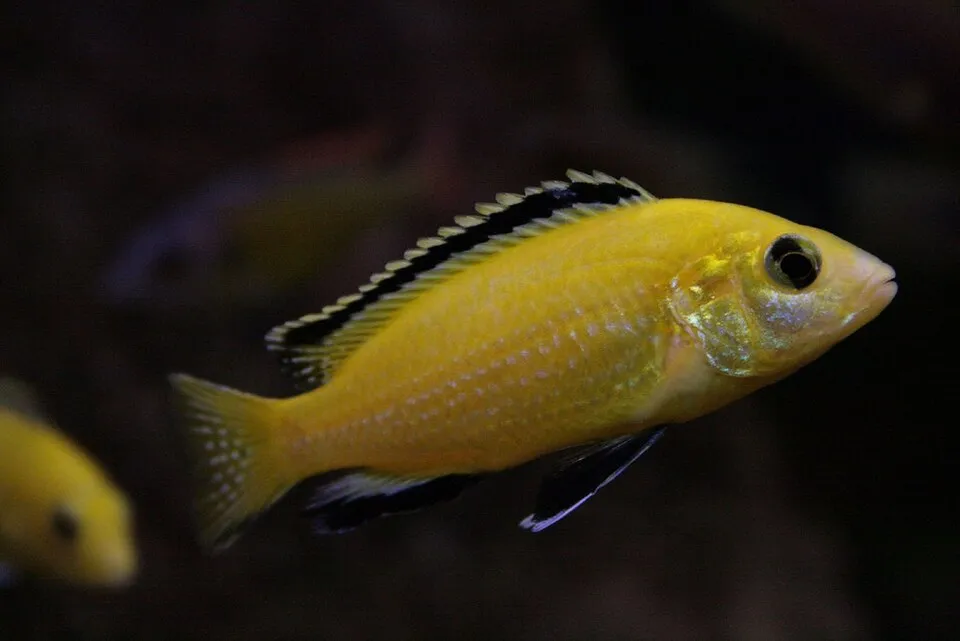
Electric yellow cichlid
Labidochromis caeruleus
Freshwater4.7 in (12 cm) · 35 gal (134 L)75–82°F (24–28°C)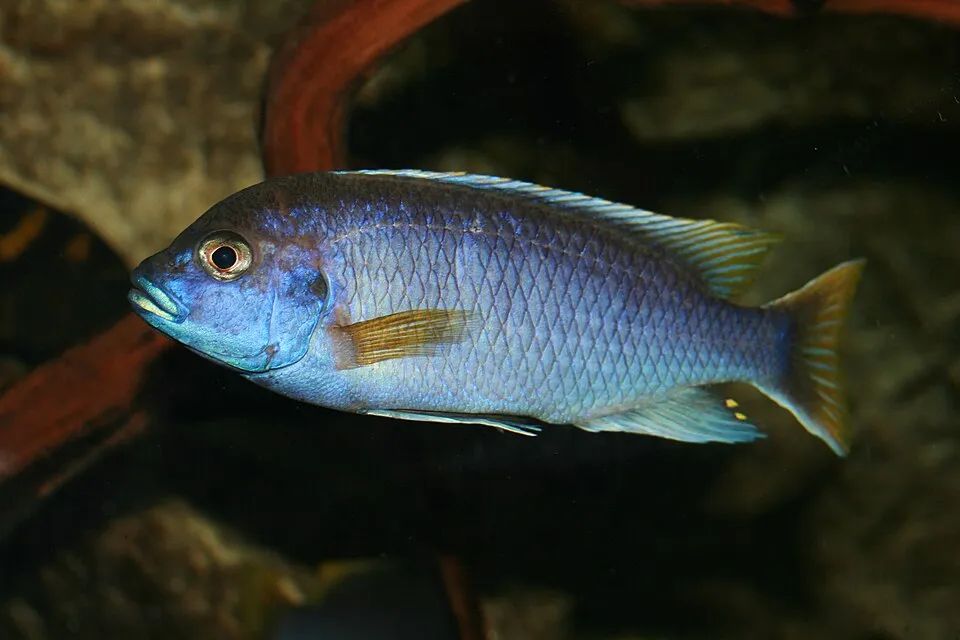
Yellow-tail acei
Pseudotropheus acei
Freshwater4.7 in (12 cm) · 42 gal (160 L)75–82°F (24–28°C)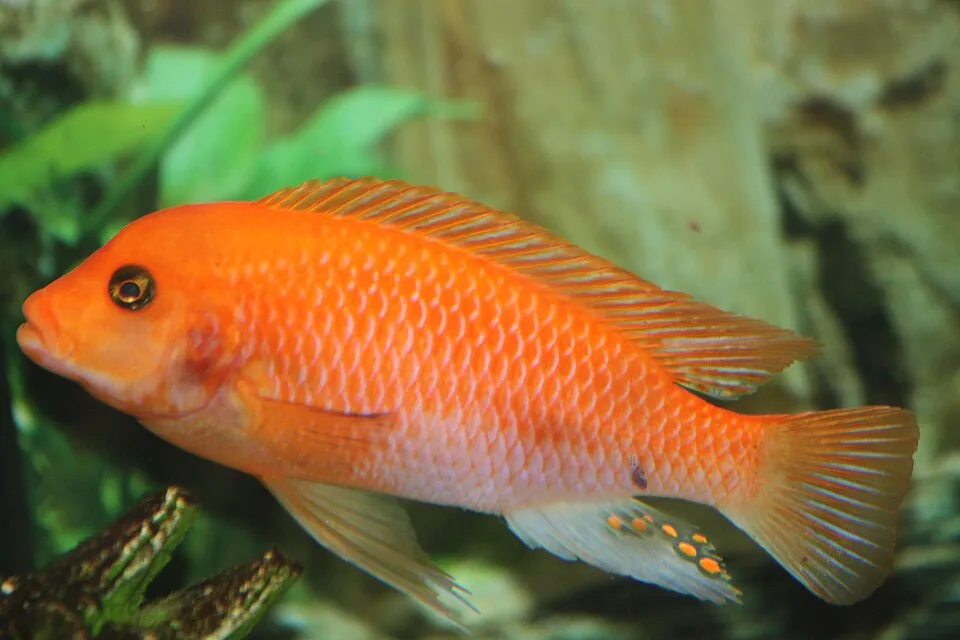
Red zebra cichlid
Maylandia estherae
Freshwater3.9 in (10 cm) · 45 gal (170 L)75–82°F (24–28°C)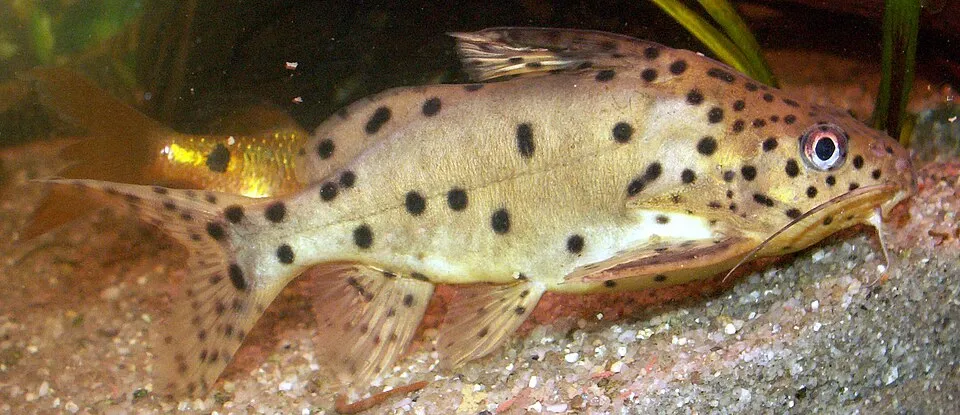
Lake Malawi syno
Synodontis njassae
Freshwater7.5 in (19 cm) · 40 gal (150 L)73–82°F (23–28°C)
Soft-water community fish don't belong in a mbuna tank. On the chart, the electric yellow conflicts with cardinal tetras, ember tetras, harlequin rasboras and blue rams on pH alone. Neon tetras read as a size risk, because a 4.7 inch fish may treat them as food.
Twelve mbuna in a 55 or a 75
Keepers crowd mbuna tanks on purpose. In a crowd, a male's chasing spreads across many fish, so no single fish takes all of it. Practical Fishkeeping's mbuna guide asks for a 4 foot tank or larger, and it calls 20 fish an absolute minimum.
That kind of crowd shows up as a warning in the stocking calculator. Six electric yellows and six yellow-tail acei read Heavy in a 55 gallon tank and Full in a 75 gallon tank. With twenty of the same fish, the calculator reads Overstocked in a 75 gallon tank and Full in a 125 gallon tank.
| Tank | Comfortable | Full |
|---|---|---|
| 55 gallons | 8 | 10 |
| 75 gallons | 11 | 14 |
| 125 gallons | 18 | 23 |
The calculator's band comes from two loads, waste and room, and the worse of them wins. Waste grows with adult body mass, so twelve fish of 4.7 inches (12 cm) make a lot of it. Room comes from each species' listed minimum tank, and a mixed mbuna group shares one allowance, the way it shares one set of rock.
In the 55 gallon tank, room alone reads Full, but waste reads Heavy. Moving up to a 75 gallon tank gives the same waste 20 more gallons (76 liters) to spread through, which brings the waste down to Full. A standard 75 gallon tank has the same 48 inch (122 cm) length as a 55 gallon tank, and it adds 5 inches (13 cm) from front to back.
Filters and water changes aren't part of that math, but crowded mbuna tanks lean on both. That's why the guides that recommend crowding also call for strong filtration and large, frequent water changes.
Electric yellows with yellow-tail acei
These species overlap at 75–82°F (24–28°C), pH 7.5–8.5.
Swap red zebras in for some of the acei, and the calculator adds its one-male warning, since it can't tell a male from a female.
Filtration for a crowd
Run a filter rated for four to five times the tank's volume an hour. On a 75 gallon tank, that comes to 300 to 375 gallons (about 1,140 to 1,420 liters) an hour. Pick a filter rated for a larger tank than yours. Add an air stone as well, because crowded fish use a lot of oxygen and warm water holds less of it.
Change at least a quarter of the water every week, and up to half in a crowded tank. Test nitrate before each change and keep it at 20 ppm or lower, since that's where the Rift lake profile's safe band ends. Treat the new water with a dechlorinator. Rinse filter media in old tank water, because chlorine kills the bacteria living in the media.
Feeding mbuna
Wild mbuna graze mostly algae, so a tank diet should be mostly vegetable too. Use a spirulina flake or pellet as the staple, with blanched spinach or nori now and then. Never feed beefheart or other meat, because it upsets a mbuna's digestion.
Electric yellows eat more insects than most mbuna, and they're less prone to Malawi bloat on richer food. Feed twice a day, giving only what the fish clear in a few minutes. Since mbuna grow fat on rich food and frequent meals, skip feeding one day a week.
Adding the colony
Cycle the tank without fish first, so the filter can carry the whole group from the first day. Then add the mbuna together, as young fish of a similar size, because a newcomer meets residents that already own the rock and a new male comes off worst. If the group has to go in over several weeks, add the milder species first and the aggressive ones last.
Once they're in, test ammonia and nitrite every day for the first week. If either one shows up on the kit, change a third of the water and feed lightly until both read zero.
FAQ
Common questions
How many mbuna can live in a 55 gallon tank?
The stocking calculator reads ten electric yellows as Full in a 55 gallon tank, and twelve mbuna of that size read Heavy. Keepers often stock more than that, and they keep up with the extra waste by running strong filtration and doing large weekly water changes.
Can mbuna live with peacock cichlids?
Seriously Fish keeps them apart, since most mbuna are far rougher and peacocks need open sand to hunt over, but other care guides mix the milder mbuna with peacocks. TankBud's pair check recommends the electric yellow and the yellow-tail acei beside the sunshine peacock. Even so, a male electric yellow can turn more aggressive than you'd expect in a peacock tank.
Can you keep live plants with African cichlids?
Mbuna uproot most plants as they dig, so the plants that grow attached to rock last best. Anubias barteri lists a pH up to 8.0. Giant vallisneria lists up to 8.5, and a dense stand of its tall leaves breaks up the sight lines between rival males.
How long do mbuna hold their eggs?
A female mbuna carries the eggs, and then the fry, in her mouth for three to four weeks. When she releases them, the young are free-swimming, and they need small gaps in the rock to hide from the adults.
Why is my African cichlid bloated?
A mbuna with a swollen, firm belly and slightly bulging eyes may have Malawi bloat, which is almost always fatal. Rich, high-protein food is the cause most often blamed, so feed a vegetable-based diet and skip feeding one day a week.
Sources
The claims the catalog does not hold come from these pages.
- The mbuna keeper's survival guide, Practical Fishkeeping
- Which mbuna are best to start with?, Practical Fishkeeping
- Malawi's finest: The Yellow lab, Labidochromis caeruleus, Practical Fishkeeping
- What rocks should I use for Malawi cichlids?, Practical Fishkeeping
- Quick guide to Tanganyikan cichlids, Practical Fishkeeping
- How to set up a Tanganyikan cichlid aquarium, Practical Fishkeeping
- Maylandia estherae (Red Zebra), Seriously Fish
- Labidochromis caeruleus (Caeruleus), Seriously Fish
- Aulonocara stuartgranti (Grant's Peacock), Seriously Fish
- Nimbochromis venustus (Venustus), Seriously Fish
- Synodontis njassae (Lake Malawi Synodontis), Seriously Fish
- Synodontis multipunctatus (Cuckoo Synodontis), Seriously Fish
- Tropheus moorii, Seriously Fish
- Neolamprologus multifasciatus, Seriously Fish
- Aggressive biases towards similarly coloured males in Lake Malawi cichlid fishes (Pauers, Kapfer, Fendos and Berg, 2008), Biology Letters
- What Is the Chemical Composition of Lake Malawi Water?, The Cichlid Fishes of Lake Malawi, M. K. Oliver
- How to look after African Malawi Cichlids, Ornamental Aquatic Trade Association (OATA)
- The Fish Keeper's Guide to pH, GH, and KH, Aquarium Co-Op
- How to Set Up an Easy Planted Tank for African Cichlids, Aquarium Co-Op
- Aquascaping, Malawi Cichlids
- Maison Reef Zebra Cichlid, Maylandia fainzilberi, Maidenhead Aquatics
- Holey Rock, Buce Plant
- Aquarium Size Calculator and Standard Tank Dimensions Chart, Top Shelf Aquatics
Keep a record of your own tank
TankBud tracks water tests, reminders and how full your tank reads, free for up to 4 tanks.
More guides
Tank setups
Clownfish tank setup: tank size, salt water and anemones
An ocellaris or percula pair fits in a 20 gallon reef, but a bubble tip anemone needs 30 gallons and a tank that's been running for six months.
By Curtis W. · Updated Oct 20, 2026 · 8 min read
Tank setups
Pea puffer tank: tank size, plants and feeding
A small group of pea puffers needs 10 gallons, dense plants and a tank of its own, and most of them won't eat dry food.
By Curtis W. · Updated Oct 20, 2026 · 8 min read
Tank setups
Shrimp tank setup: water, tank size and equipment
Cherry shrimp take dechlorinated tap water, but crystal reds need soft RO water, so the rest of a shrimp tank follows from which one you pick.
By Curtis W. · Updated Oct 20, 2026 · 9 min read


