Clownfish tank setup: tank size, salt water and anemones
By Curtis W. · Updated Oct 20, 2026 · 8 min read

An ocellaris or percula clownfish pair needs a saltwater tank of at least 20 gallons (75 liters), and both species grow to about 3.1 inches (8 cm). You don't need an anemone, because most clownfish in stores come from hatcheries, and those captive-bred fish live well without one.
If you'd like the pairing anyway, the usual host is a bubble tip anemone. It needs 30 gallons (115 liters), strong reef lighting and a tank that's run for at least six months. With or without the anemone, the tank itself is a small reef, built on RO/DI water, salt mixed to a measured strength and a finished cycle.
Tank size for a pair
Published minimums for a clownfish pair start at 15 gallons. One UK guide goes higher and wants 21 to 26 gallons (80 to 100 liters) in any first marine tank, so there's room for enough live rock. The ocellaris and percula profiles both list 20 gallons (75 liters).
In a pair, the female grows larger than the male, and together they claim a patch of rock or coral and guard it. Since the temperature and salinity change faster in a small marine tank, it needs closer watching than a larger one.
Clark's and tomato clownfish grow to 5.5 inches (14 cm) and list 30 gallons (115 liters). The maroon clownfish reaches 6.7 inches (17 cm), lists 40 gallons (150 liters) and is marked aggressive, so none of the three fits a 20 gallon tank.
In a 20 gallon tank, the simplest plan is the pair with one skunk cleaner shrimp.
An ocellaris pair with a cleaner shrimp
These species overlap at 75–81°F (24–27°C), pH 8.1–8.4.
If you want a little more, one plan on the 20 gallon saltwater page adds a firefish and five snails to this one. Each saltwater tank-size page lists the reef fish that fit, with plans the stocking calculator has checked.
Ocellaris or percula
Most designer clownfish are color lines of these two species. The snowflake, black ice and storm lines come from the ocellaris, while the picasso and platinum lines come from the percula. Each line takes the same care as its parent, so the setup doesn't change.
The two species look nearly alike, but the ocellaris usually has 11 spines in its dorsal fin and the percula typically has 10. The percula's white bars also carry broad black edges, which the ocellaris usually lacks. Their profiles match on adult size, minimum tank, temperature and pH, so pick the one you like the look of.
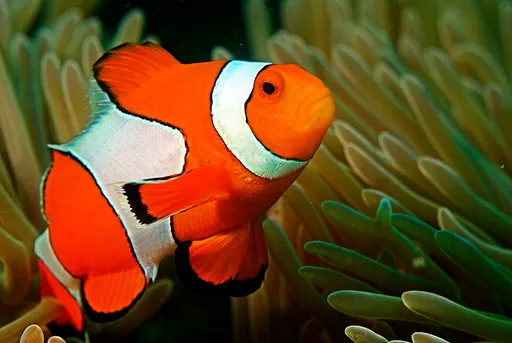
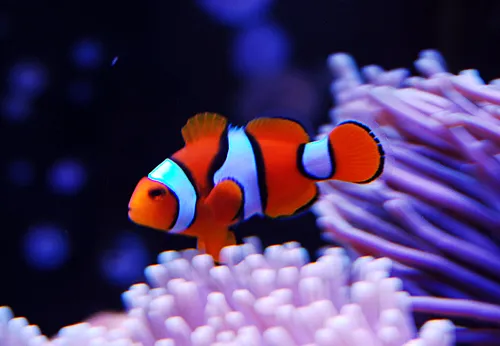
Keep the two species apart, though, because an ocellaris and a percula wear the same three white bars. In a 2022 experiment, an ocellaris colony attacked a model fish with white bars for longer than one with white stripes.
A wild group is a breeding pair and a few smaller fish that don't breed. The female is the largest, the male comes second, and each fish below them stays smaller than the one above it. In an aquarium, groups of three or more need a large tank and close watching for aggression, so a first tank should hold one pair.
Mixing the salt water
Every batch of salt water should start from RO/DI water, which is tap water filtered down to zero TDS. That's because tap water can carry chlorine, ammonia, nitrate, phosphate, silica and metals such as copper and iron. Several of those feed nuisance algae, and a reef's water can't be cleaner than the water it was mixed from.
Mix the salt in a clean bucket, or in a new tank before any animals go in. For small batches, Instant Ocean's directions give half a cup of salt per gallon. Stir or run a small pump until the salt dissolves, then aerate the water before you measure it.
Read the specific gravity with a refractometer, which has no floating parts and corrects for temperature on its own. Calibrate it about once a month with saltwater calibration fluid rather than RO/DI water. Natural seawater is about 35 ppt, or a specific gravity near 1.026. If the reading comes in low, add salt, and if it's high, add RO/DI water.
- pH
- 7.9 to 8.5
- Ammonia
- up to 0.02 ppm
- Nitrite
- up to 0.02 ppm
- Nitrate
- up to 10 ppm
- Temperature
- 76 to 82°F (24.4 to 27.8°C)
- KH
- 7 to 12 dKH
- Phosphate
- up to 0.05 ppm
- Salinity
- 1.023 to 1.027
- Calcium
- 380 to 470 ppm
- Magnesium
- 1,250 to 1,400 ppm
Saltwater tanks keeping corals and other sensitive inverts. TankBud reads every water test against these targets when a tank uses this profile.
Evaporation takes only fresh water and leaves the salt behind, so the specific gravity climbs until you top off. A 40 gallon tank can lose about half a gallon a day that way. To keep the reading steady, top off with fresh RO/DI water, or let an auto top-off do it from a reservoir.
A heater holds the water inside the clownfish range of 75–82°F (24–28°C). If a bubble tip and a cleaner shrimp live in the tank too, keep the water within 75–81°F (24–27°C), the range all three share.
Cycling at full salinity
A saltwater tank cycles by the same fishless method as a freshwater one, which the cycling guide sets out step by step. You feed the filter bottled ammonia until it clears a full dose to nitrate within a day. Without bottled bacteria, that takes 30 to 45 days, and salt water usually takes longer.
Make sure to mix the salt to the specific gravity you plan to keep before the first dose, because raising it later can set the filter back. When a 2019 study raised the salinity on working filters, they lost much of their ammonia capacity and regained it only with time.
If you add bottled bacteria, use a culture sold for salt water, since a 1996 study found different ammonia-oxidizing bacteria in marine filters than in freshwater ones.
Live rock brings bacteria and decaying matter in with it, so a tank built on it usually cycles in four to six weeks. Dry rock doesn't bring either, which means it needs bottled bacteria and an ammonia source, and the cycle takes longer. For a first marine tank, you'll want a protein skimmer and as much live rock as you can afford.
Buying and adding the pair
Buy captive-bred clownfish, since they're hardier and more used to tank life than wild ones. Brooklynella, the parasite behind clownfish disease, commonly hits wild-caught clownfish, and once the late signs show, it can kill within hours. Hold any new fish in a quarantine tank first, because it's far easier to treat the disease there than in the display.
Start with two small juveniles of one species and add them on the same day. That works because clownfish are sequential hermaphrodites that mature as males, and the larger fish of the pair turns female. In a 2019 study, juvenile percula paired with a same-size rival grew faster than juveniles kept alone on the same food.
Feed small portions two or three times a day, and only what the pair finishes in a few minutes. They'll take most meaty foods and frozen preparations. When a pair settles in, it may spawn, and both parents then guard the eggs from their tank mates.
A cleaner shrimp and other tank mates
A skunk cleaner shrimp fits in the same 20 gallons (75 liters) and grows to 2.4 inches (6 cm). It'll set up a cleaning station on the rock and pick parasites and dead tissue off the fish, sometimes from inside their mouths.

Bring the shrimp in by drip, because it doesn't handle sudden changes in water quality. The shrimp tank guide walks through the drip method for freshwater shrimp.
Copper medicines kill most invertebrates, so they can't go into a tank with the shrimp or an anemone. Leave hawkfish and lionfish out of this tank, too, since they may eat a cleaner shrimp.
Add any other fish one at a time, about a week apart. If you're stocking more than the pair, a plan from the 30 gallon saltwater page puts a royal gramma and a firefish with them.
Clownfish with a royal gramma
These species overlap at 75–79°F (24–26°C), pH 8.1–8.4.
This mix needs the bigger tank because the royal gramma lists 29 gallons (110 liters). You'll find more fish suited to a first reef on the beginner saltwater list.
Beginner saltwater fish →100 species
Host anemones in the wild and in tanks
Ten anemone species host clownfish on reefs across the Indo-Pacific, but the ocellaris and percula each use only a few of them. The ocellaris lives in the magnificent anemone and two carpet anemones, the gigantea and Mertens', while the percula uses the magnificent, the gigantea and the sebae anemone. The symbiotic relationships page lists the hosts of every clownfish in the catalog.
All four are marked difficult and list 40 to 53 gallons (150 to 200 liters), and both carpets are marked aggressive as well. Mertens' carpet reaches 35.4 inches (90 cm) across. That's three times the width of a bubble tip.
So the bubble tip anemone is the usual tank host instead. Neither fish uses it in the wild, but both take to it in captivity, as most clownfish do.
The hosting instinct is inborn, so captive-bred clownfish keep it without ever learning it from their parents. Some move into a bubble tip, while others settle on a large-polyp stony coral, a xenia or a patch of rock.
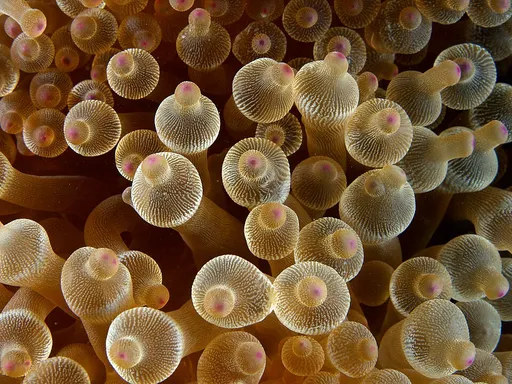
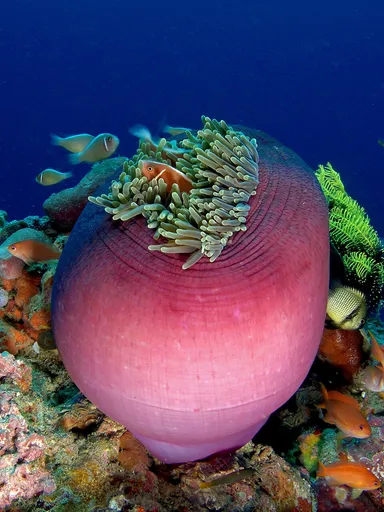
Since the bubble tip reproduces by splitting in two, you can buy an anemone that was split in a tank. That's the kind to get, because collecting for the aquarium trade has thinned host anemones on some reefs.
Light, rock and flow for a bubble tip
Give the tank six months to a year of stable water first. The bubble tip feeds partly through the zooxanthellae in its tissue, so it needs strong reef lighting, and about 150 to 200 PAR at the anemone suits it. Under weak light, it stretches its body out to catch more.
A bubble tip anchors its foot deep in a crevice of hard rock and never in sand. So when you build the rockwork, leave holes it can wedge into, in a spot with moderate flow.
A new anemone often walks around the tank before it settles. Once it's settled, though, a fresh move means something is off, so test the water and check the light.
Feed the bubble tip small pieces of meaty food, such as mysis, chopped shrimp or krill, one to three times a week. Offer each piece with tongs and keep it smaller than the anemone's mouth, since an oversized piece can come back up.
The anemone stings any coral it touches, so leave it room on every side. In a small tank, a quiet fish or a shrimp can also drift into its tentacles overnight.
FAQ
Common questions
Is 10 gallons enough for two clownfish?
No. The ocellaris and percula profiles list 20 gallons (75 liters) for a pair, which is about twice what a 10 gallon tank holds. A tank that small also changes temperature and salinity faster, so you'd have to watch it more closely.
Can I add a third clownfish to a pair?
Keep a first tank to one pair. A wild group can hold a few smaller fish beside the breeding pair, but in an aquarium a group needs a large tank and close watching for aggression.
Will a captive-bred clownfish host an anemone?
Many do, since the urge to host is inborn, and most clownfish species accept a bubble tip anemone in a tank. If a pair ignores one, it may settle on a coral or a patch of rock instead.
How long should a tank run before an anemone goes in?
Give it six months to a year of stable readings first. Even then, a bubble tip needs strong reef lighting, 30 gallons (115 liters) or more and a guard on every pump intake.
What specific gravity should a clownfish tank be?
The reef profile scores 1.023 to 1.027 as safe, a range that includes natural seawater at about 1.026 (35 ppt). If the tank is fish-only, it can run a little lower, and the FOWLR profile accepts 1.019 to 1.027.
Sources
The claims the catalog does not hold come from these pages.
- Captive-Bred Ocellaris Clownfish, LiveAquaria
- How to care for percula clownfish, Bulk Reef Supply
- What is the smallest viable marine tank and what equipment do I need?, Fishkeeper
- Western Clown Anemonefish, Amphiprion ocellaris Cuvier 1830, Fishes of Australia, Museums Victoria
- Eastern Clown Anemonefish, Amphiprion percula (Lacépède 1802), Fishes of Australia, Museums Victoria
- Competitive growth in a social fish (Reed, Branconi, Majoris, Johnson and Buston, 2019), Biology Letters
- Colour patterns influence symbiosis and competition in the anemonefish-host anemone symbiosis system (Hayashi, Tachihara, Reimer and Laudet, 2022), Proceedings of the Royal Society B
- 5 minute saltwater aquarium guide, episode 9: freshwater and RO/DI, Bulk Reef Supply
- Instant Ocean Synthetic Sea Salt, mixing directions, LiveAquaria
- How to use a refractometer to measure salinity, Bulk Reef Supply
- 5 minute saltwater aquarium guide, episode 20: evaporation, Bulk Reef Supply
- Fishless Cycling, DrTim's Aquatics
- Influence of rate of salinity increase on nitrifying biofilms (Navada and others, 2019), Journal of Cleaner Production
- Comparative analysis of nitrifying bacteria associated with freshwater and marine aquaria (Hovanec and DeLong, 1996), Applied and Environmental Microbiology
- The best ways to cycle your reef aquarium, Bulk Reef Supply
- Brooklynellosis (clownfish disease): a subtle, fast-moving killer, Reef Builders
- Skunk Cleaner Shrimp, LiveAquaria
- Use of Copper in Marine Aquaculture and Aquarium Systems, UF/IFAS Extension
- The clownfish-hosting sea anemones: updated nomenclature, biogeography, and practical field guide (Titus, Bennett-Smith, Chiodo and Rodríguez, 2024), Zootaxa
- Best aquarium invertebrates: bubbletip anemone, CORAL Magazine
- Frequently asked questions, ORA (Oceans, Reefs and Aquariums)
- Asexual propagation of sea anemones that host anemonefishes (Scott, Hardefeldt and Hall, 2014), PLoS ONE
- Bubble anemone, Fishkeeper
- Green Bubble Tip Anemone, LiveAquaria
- Clownfish and bubble tip anemone tank build, Bulk Reef Supply
- Introduction to bubble tip anemone care, Reef Builders
Keep a record of your own tank
TankBud tracks water tests, reminders and how full your tank reads, free for up to 4 tanks.
More guides
Tank setups
Pea puffer tank: tank size, plants and feeding
A small group of pea puffers needs 10 gallons, dense plants and a tank of its own, and most of them won't eat dry food.
By Curtis W. · Updated Oct 20, 2026 · 8 min read
Tank setups
African cichlid tank: stocking, rocks and water
Most African cichlid tanks hold Lake Malawi mbuna, which need hard water and stacked rock, and you'll want a 75 gallon tank for a group of twelve.
By Curtis W. · Updated Oct 20, 2026 · 8 min read
Tank setups
Shrimp tank setup: water, tank size and equipment
Cherry shrimp take dechlorinated tap water, but crystal reds need soft RO water, so the rest of a shrimp tank follows from which one you pick.
By Curtis W. · Updated Oct 20, 2026 · 9 min read


