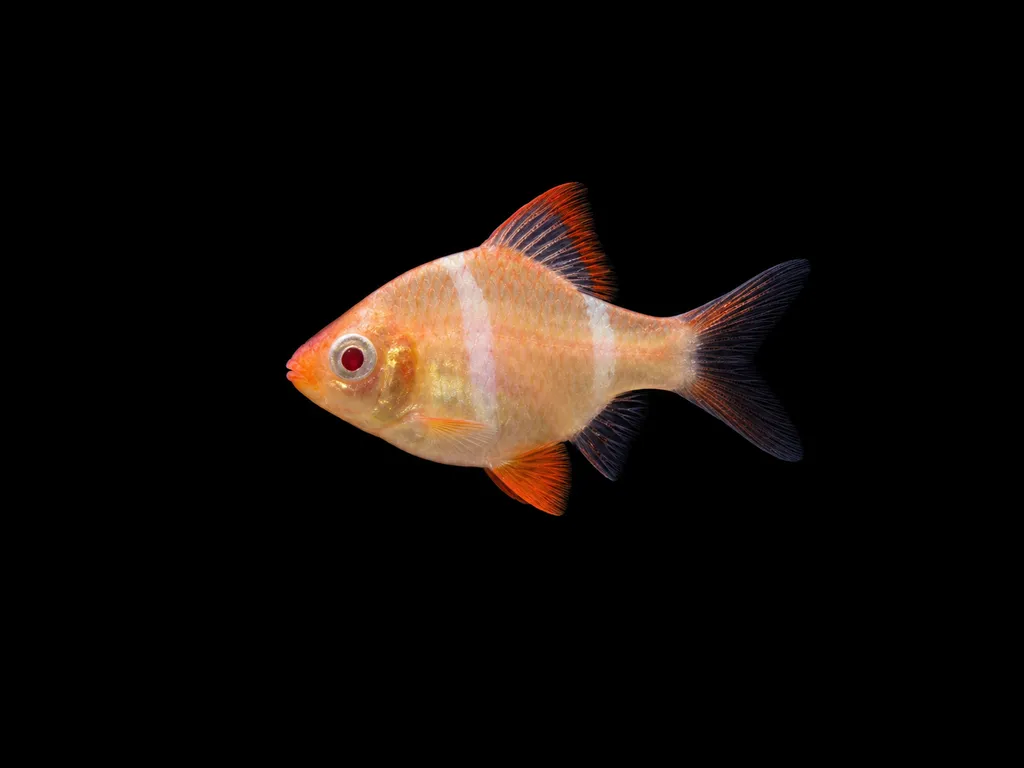
Albino tiger barbs are pale gold with cream bars and pink to red eyes. On some fish the bars are faint enough to look almost absent. Albino fish are often reported to see less well than pigmented ones, so shaded cover and a settled feeding spot help in a bright open tank. The strain is one of the most widely farmed tiger barb forms and turns up in most shops that stock the species.
In the wild
The albino tiger barb is a farm bred strain with no documented originator, country or date. Albino mutations turn up regularly in commercially spawned fish, and breeders keep the ones that appear. Albinos are selected against hard in the wild, so the form exists only in tanks.
Good to know
Albinism here is recessive, so a fish needs two copies to show it and a normal looking barb can carry the gene invisibly. Albino to albino pairings breed true, which is why farms run the strain separately instead of pulling albinos out of mixed spawns. With melanin gone the bars survive only as faint cream bands, and the eyes look red because blood vessels show through the iris.
Did you know
Cross an albino to a normal tiger barb and every fry looks normal, because the albino gene needs two copies to show. Those fry carry it silently, and spawning them together brings albinos back at roughly one fish in four.
Common questions
Is an Albino tiger barb a different species from the Tiger barb?
No. An Albino tiger barb is a variety of the Tiger barb, Puntigrus tetrazona, and it wants the same tank, water and food as the species.
What size tank does an Albino tiger barb need?
An Albino tiger barb needs at least 20 gal (75 L). It spends most of its time in the middle.
How big does an Albino tiger barb get?
An adult Albino tiger barb reaches about 2.8 in (7 cm).
Does an Albino tiger barb need a group?
Yes. An Albino tiger barb is a schooling species and should be kept in a group, not singly.
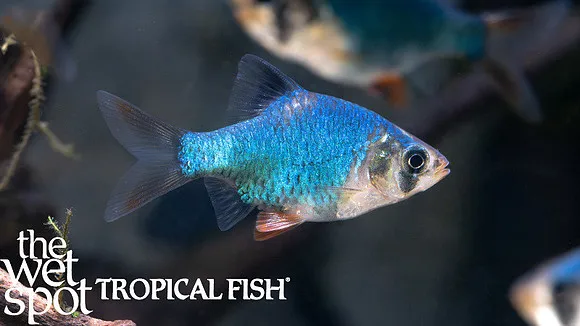
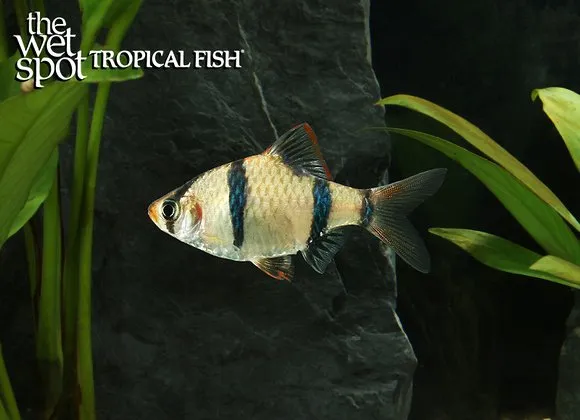 2.8 in (7 cm)29 gal (110 L)73–81°F (23–27°C)
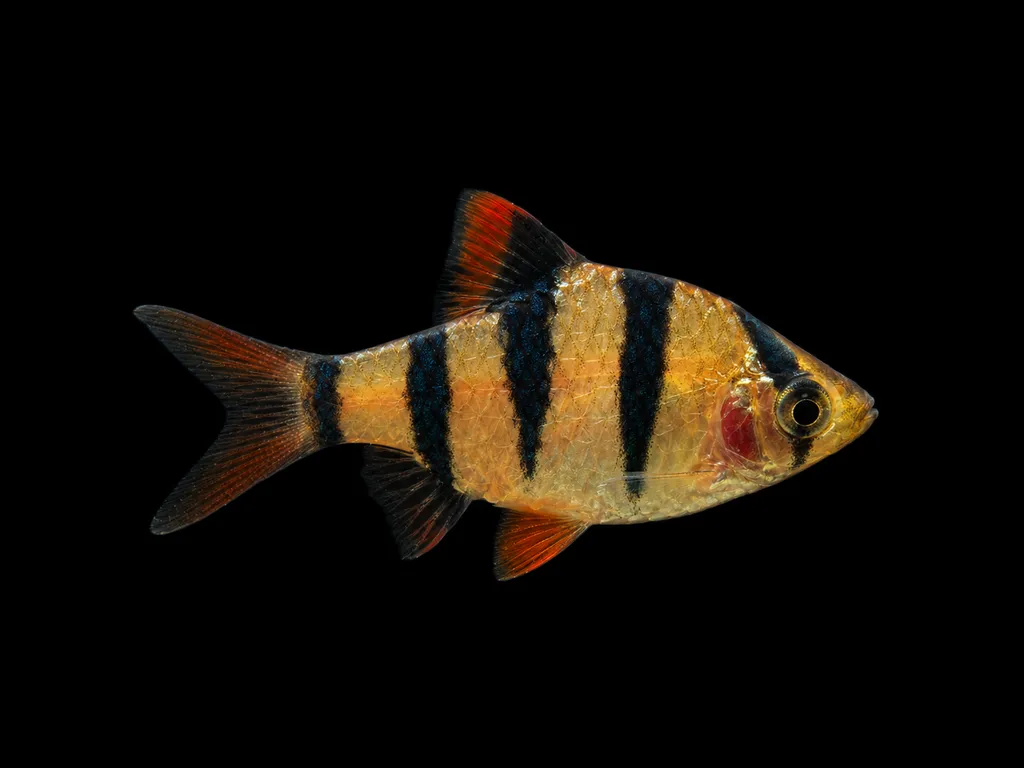 2.2 in (5.5 cm)29 gal (110 L)73–81°F (23–27°C)
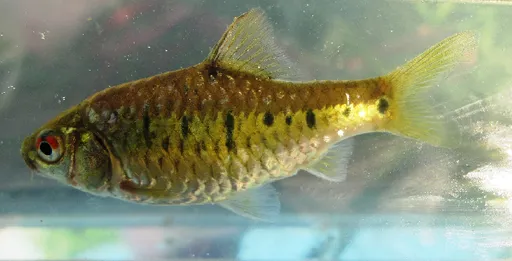 2.8 in (7 cm)20 gal (75 L)64–75°F (18–24°C)
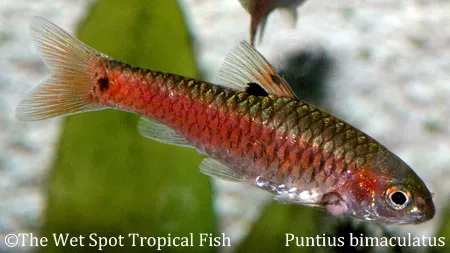 2.8 in (7 cm)20 gal (75 L)72–81°F (22–27°C)
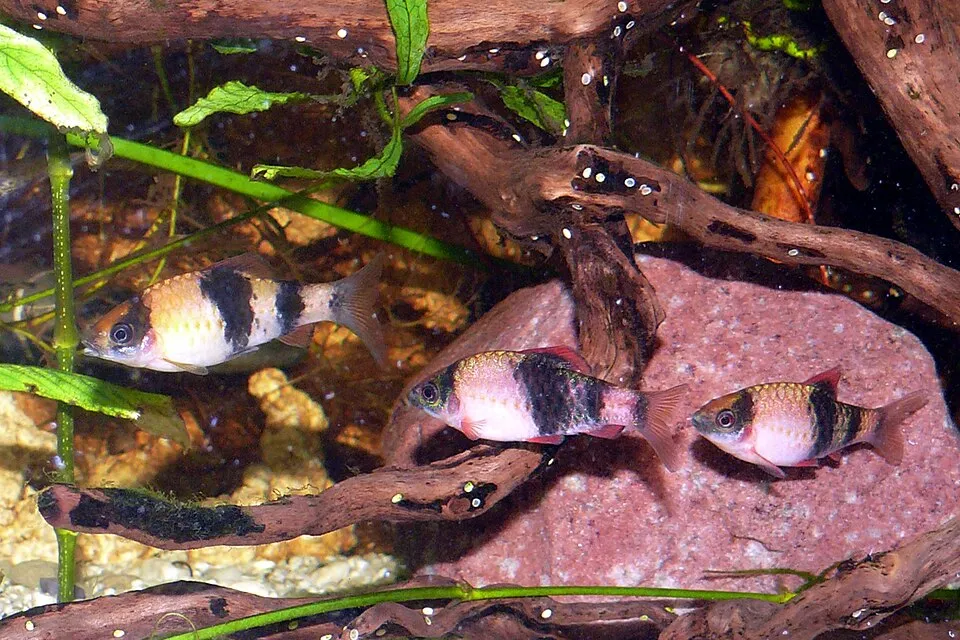 2.8 in (7 cm)40 gal (150 L)72–79°F (22–26°C)
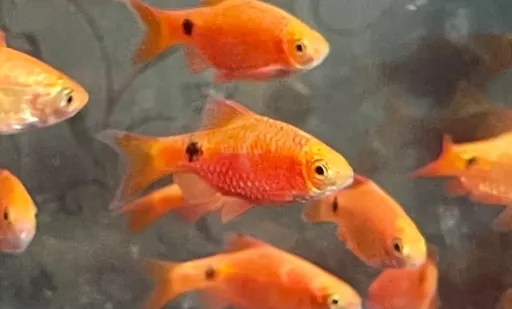 2.8 in (7 cm)24 gal (90 L)61–75°F (16–24°C)