Six-banded barb
Desmopuntius hexazona
Also known as Puntius hexazona, Six-banded tiger barb
FreshwaterFish
Care at a glance
- Temperature
- 73–82°F
- 23–28°C
- pH
- 4.5–6.8
- Adult size
- 2.4 in
- 6 cm
- Minimum tank
- 24 gal
- 90 L
- Temperament
- Peaceful
- Social behavior
- Schooling
- Swim level
- Middle
- Difficulty
- Medium
- Breeding
- Egg scatterer · Medium
- Rarity
- Rare
- Family
- Cyprinidae
- Origin
- Peat swamps of the Malay Peninsula, Sumatra and Borneo
Overview
The six-banded barb is a peaceful blackwater barb for the middle and lower water of a shaded, soft-water tank. It is a step up from the easiest barbs to keep.
Did you know
Six-banded barbs are often sold under the wrong name. They share the peat swamps with a cluster of nearly identical banded barbs. Shop fish labeled pentazona or hexazona are frequently one of the lookalikes.
Caring for the six-banded barb
Keep six-banded barbs in a group of eight or more. A group gives them confidence, and the tidy banded pattern moves as a school. A tank of 24 gal (90 L) suits a good group. Plant it well and dim the light, with leaf litter and wood over a dark substrate and a gentle flow.
Keep the water warm and very soft, at 73 to 82°F (23 to 28°C) and a low pH of 4.5 to 6.8. Feed small foods such as fine flake, micro pellets and frozen or live daphnia, cyclops and bloodworm.
Unlike the superficially similar tiger barb, the six-banded barb does not nip fins. It makes a fine companion for gouramis, small rasboras and other gentle soft-water fish.
It scatters its eggs among fine plants and gives no parental care. Breeding is moderately achievable in soft, acidic water.
Good to know
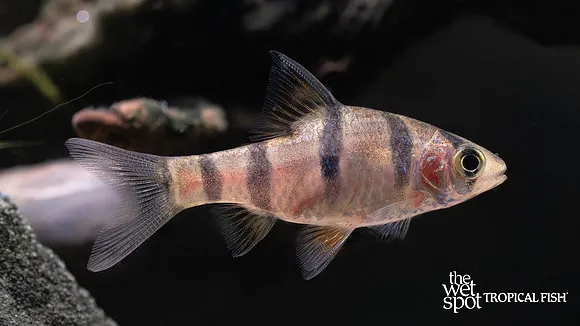
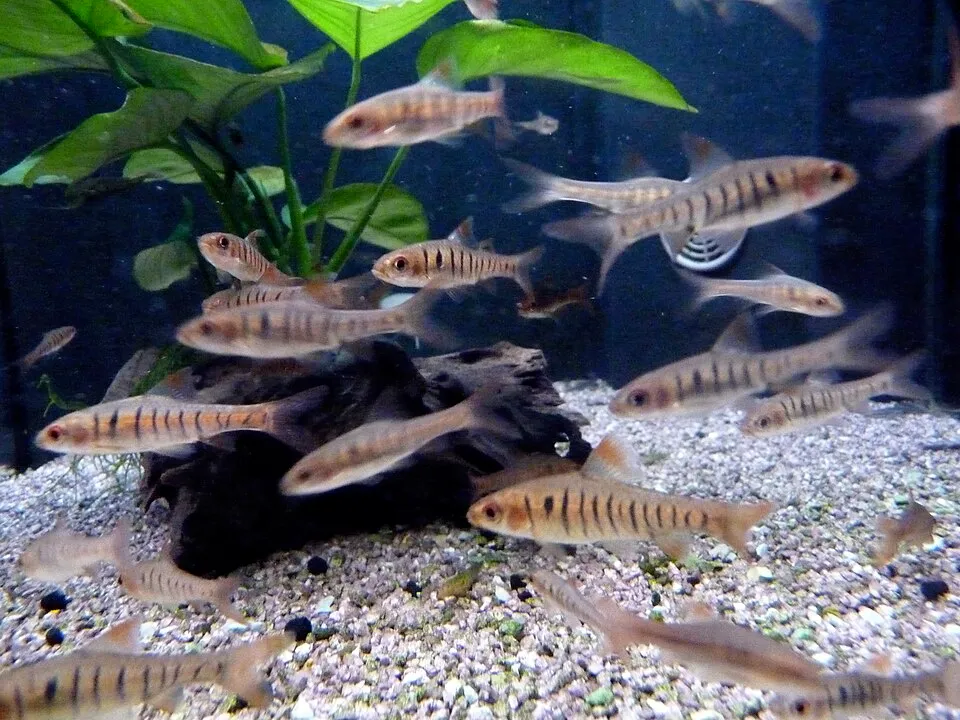
The six-banded barb, Desmopuntius hexazona, is a small member of the carp family, Cyprinidae. Its gold body is crossed by six dark bars. That is one more than its five-banded relative and two more than the true tiger barb.
In the wild
The six-banded barb lives in true blackwater across Sundaland, in the Malay Peninsula, Sumatra and Borneo. Its home is peat swamps and slow, shaded forest streams, where the water is soft, acidic and stained brown with tannins.
Weekly picks
Tank mates
The six-banded barb is a peaceful, schooling species that keeps to the middle. These picks share a community profile with it, are safe together in both directions, and overlap on water type, temperature and pH.
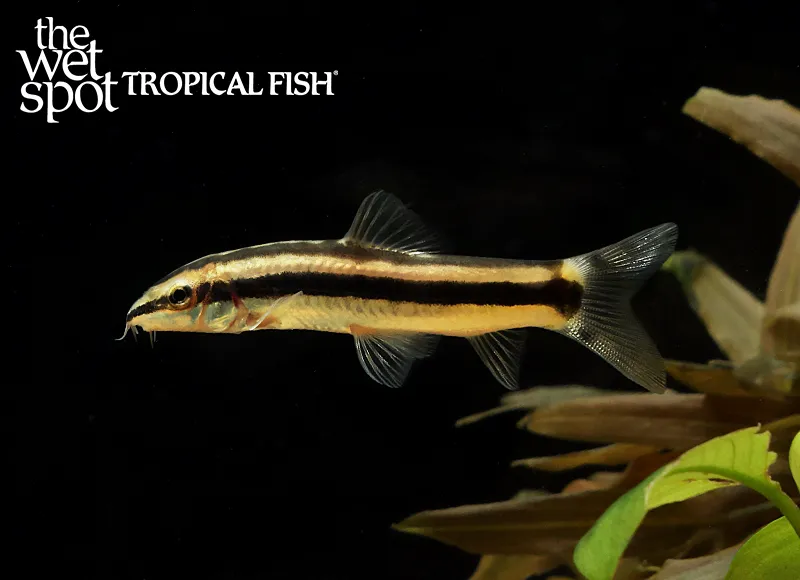
Black-lined loach
Ambastaia nigrolineata
Freshwater3.1 in (8 cm) · 24 gal (90 L)72–81°F (22–27°C)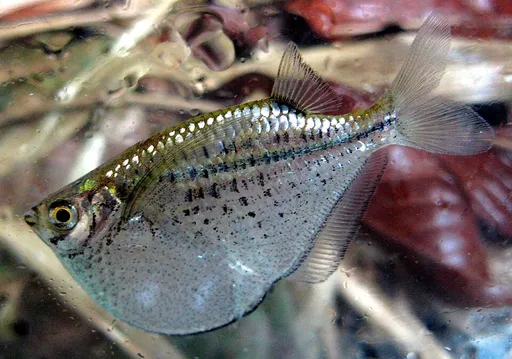
Spotted hatchetfish
Gasteropelecus maculatus
Freshwater3.5 in (9 cm) · 26 gal (100 L)73–82°F (23–28°C)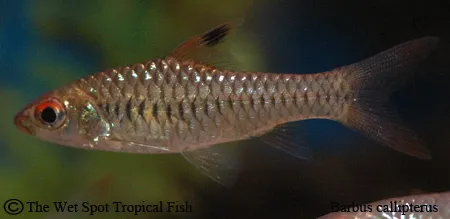
Clipper barb
Enteromius callipterus
Freshwater3.5 in (9 cm) · 24 gal (90 L)72–81°F (22–27°C)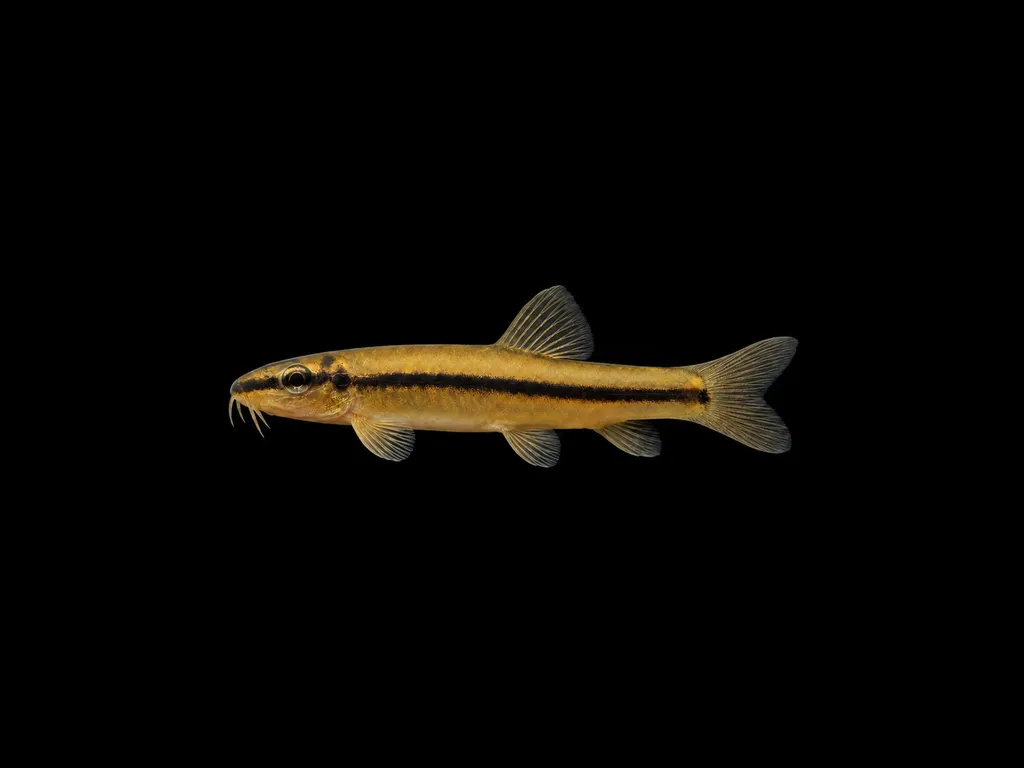
Twin-spot loach
Nemacheilus binotatus
Freshwater2.8 in (7 cm) · 24 gal (90 L)72–81°F (22–27°C)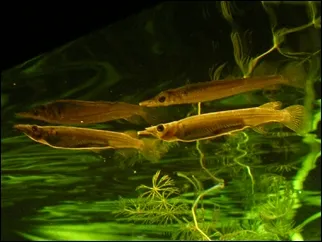
Wrestling halfbeak
Dermogenys pusilla
FreshwaterBrackish2.8 in (7 cm) · 25 gal (95 L)75–82°F (24–28°C)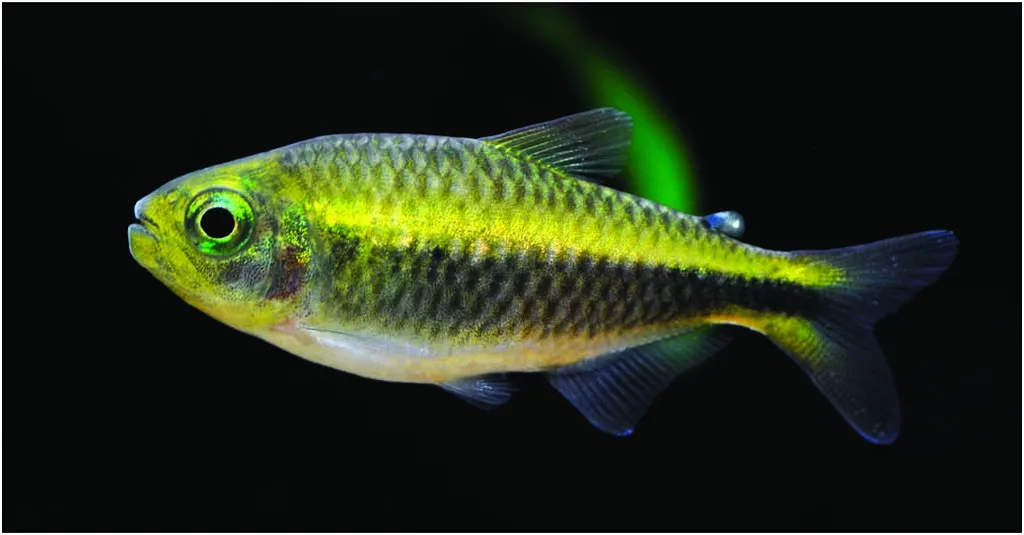
Green-eye tetra
Moenkhausia chlorophthalma
Freshwater3.1 in (8 cm) · 24 gal (90 L)75–82°F (24–28°C)
Common questions
What size tank does a six-banded barb need?
A six-banded barb needs at least 24 gal (90 L). It spends most of its time in the middle.
What temperature and pH does a six-banded barb need?
A six-banded barb is comfortable at 73–82°F (23–28°C) with a pH of 4.5–6.8.
What does a six-banded barb eat?
A six-banded barb eats small foods such as fine flake, micro pellets and frozen or live daphnia, cyclops and bloodworm.
How big does a six-banded barb get?
An adult six-banded barb reaches about 2.4 in (6 cm).
Does a six-banded barb need a group?
Yes. A six-banded barb is a schooling species and should be kept in a group, not singly.
How does a six-banded barb breed?
Six-banded barbs scatter their eggs among fine plants and give no parental care. Breeding them is moderately achievable in soft, acidic water.
Related species
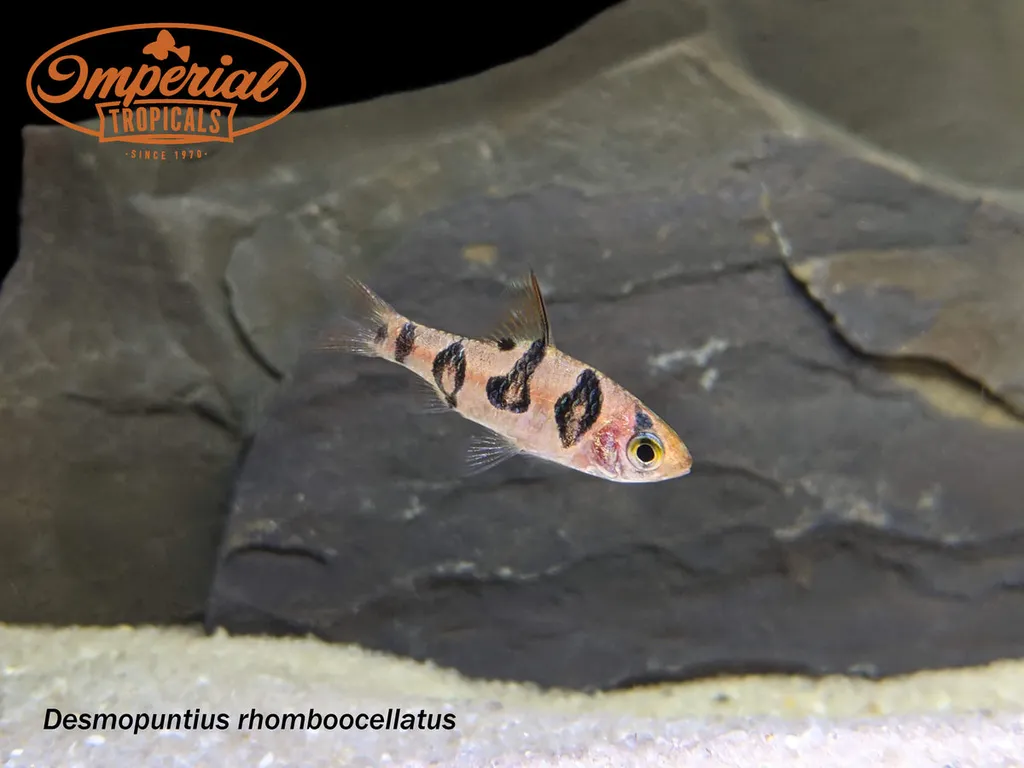 2.2 in (5.5 cm)20 gal (75 L)72–82°F (22–28°C)
Snakeskin barb
Desmopuntius rhomboocellatus
2.2 in (5.5 cm) · 20 gal (75 L)
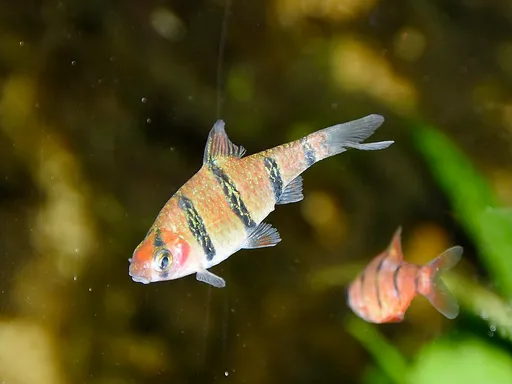 2 in (5 cm)20 gal (75 L)73–81°F (23–27°C)
Five-banded barb
Desmopuntius pentazona
2 in (5 cm) · 20 gal (75 L)
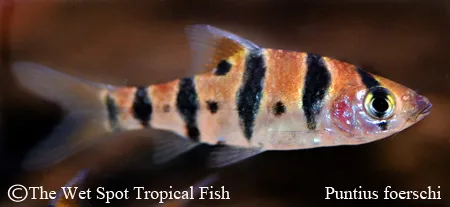 3.1 in (8 cm)29 gal (110 L)73–82°F (23–28°C)
Foersch's barb
Desmopuntius foerschi
3.1 in (8 cm) · 29 gal (110 L)
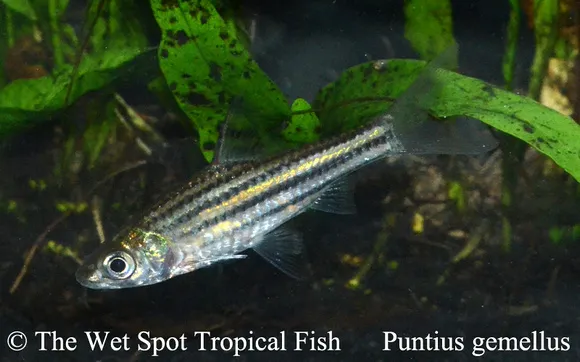 3.5 in (9 cm)29 gal (110 L)73–82°F (23–28°C)
Twin-striped barb
Desmopuntius gemellus
3.5 in (9 cm) · 29 gal (110 L)
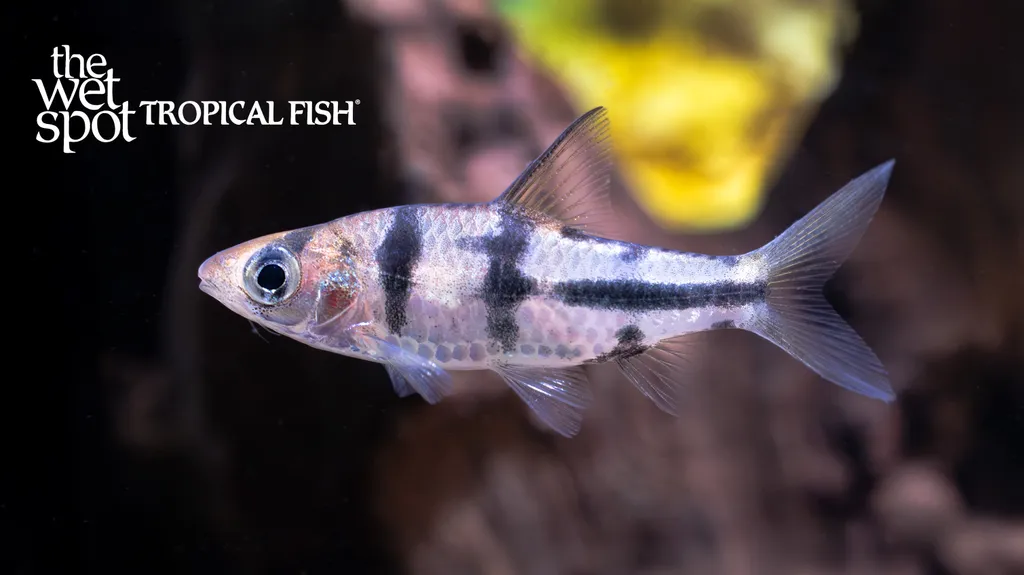 4.7 in (12 cm)40 gal (150 L)73–79°F (23–26°C)
Striped barb
Desmopuntius johorensis
4.7 in (12 cm) · 40 gal (150 L)
 2.4 in (6 cm)20 gal (75 L)68–79°F (20–26°C)
African banded barb
Barbus fasciolatus
2.4 in (6 cm) · 20 gal (75 L)