Ribbon eel
Rhinomuraena quaesita
Also known as Blue ribbon eel, Black ribbon eel, Ribbon moray, Bernis eel
SaltwaterFish
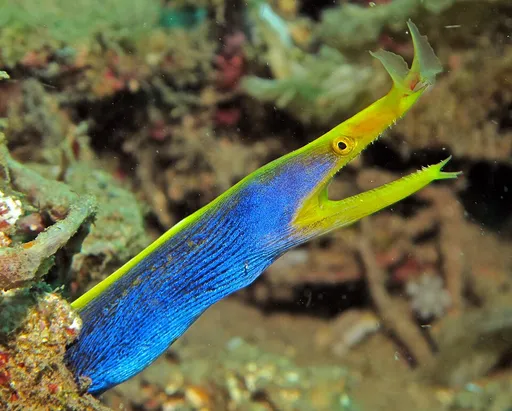
Care at a glance
- Temperature
- 75–81°F
- 24–27°C
- pH
- 8.0–8.4
- Adult size
- 39.4 in
- 100 cm
- Minimum tank
- 66 gal
- 250 L
- Temperament
- Mostly peaceful
- Social behavior
- Solitary
- Tankmates
- With caution
- Swim level
- Bottom
- Difficulty
- Difficult
- Breeding
- No record
- Rarity
- Common
- Reef safe
- Reef safe with caution
- Family
- Muraenidae
- Origin
- Native to the Indo-Pacific, where it lives buried in sand or rubble on reef flats and lagoon slopes with only its head showing.
Overview
This is an expert-only fish with a poor survival record, since most starve in captivity. It needs a mature tank of at least 250 litres with a deep sand bed, secure rockwork and an absolutely tight lid, as it escapes readily, kept at 24 to 27 C and pH 8.0 to 8.4. Getting one to eat is the whole battle: start with live saltwater feeder shrimp or ghost shrimp and only later try to wean it onto frozen. It ignores corals but will eat small fish and shrimp, and it should never share a tank with aggressive feeders that outcompete it.
In the wild
The ribbon eel is a slender, ribbon-thin moray with flaring nostril flaps and a bright, changing colour. Juveniles are jet black with a yellow dorsal fin, subadults turn electric blue and yellow, and mature females become all yellow. It spends the day poking its head from a burrow, mouth open, swaying in the current.
Good to know
Rhinomuraena quaesita is a protandrous hermaphrodite: it starts life as a black male, becomes a blue male, then changes into a yellow female. It is the only moray with such dramatic colour and sex change tied to its life stage. Despite an eel-like length near 1 metre, its body is barely thicker than a pencil.
Did you know
A single ribbon eel changes sex and colour as it ages, so a black, a blue and a yellow eel that look like three different species can all be the same kind of fish at different points in its life.
Common questions
What size tank does a Ribbon eel need?
A Ribbon eel needs at least 66 gal (250 L). It spends most of its time in the bottom.
What temperature and pH does a Ribbon eel need?
A Ribbon eel is comfortable at 75–81°F (24–27°C) with a pH of 8.0–8.4.
How big does a Ribbon eel get?
An adult Ribbon eel reaches about 39.4 in (100 cm).
Related species
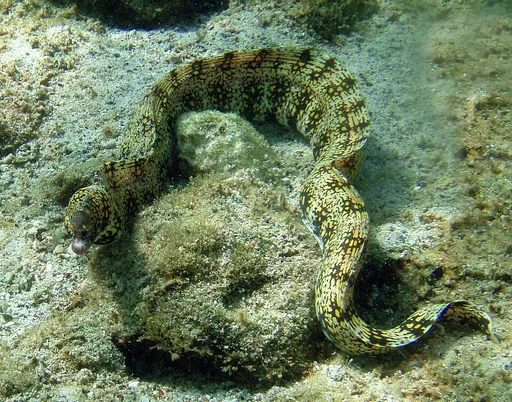 39.4 in (100 cm)50 gal (189 L)72–79°F (22–26°C)
Snowflake eel
Echidna nebulosa
39.4 in (100 cm) · 50 gal (189 L)
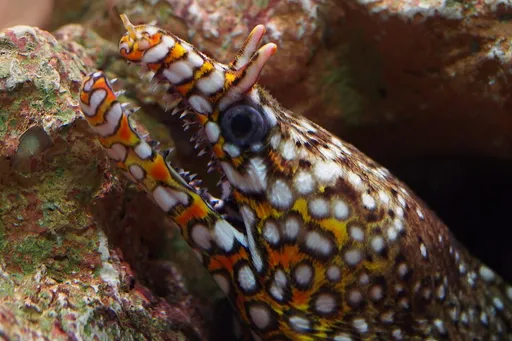 35.4 in (90 cm)180 gal (680 L)72–79°F (22–26°C)
Dragon moray
Enchelycore pardalis
35.4 in (90 cm) · 180 gal (680 L)
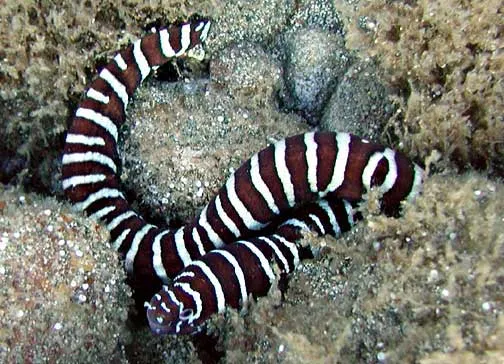 59.1 in (150 cm)180 gal (680 L)72–79°F (22–26°C)
Zebra moray
Gymnomuraena zebra
59.1 in (150 cm) · 180 gal (680 L)
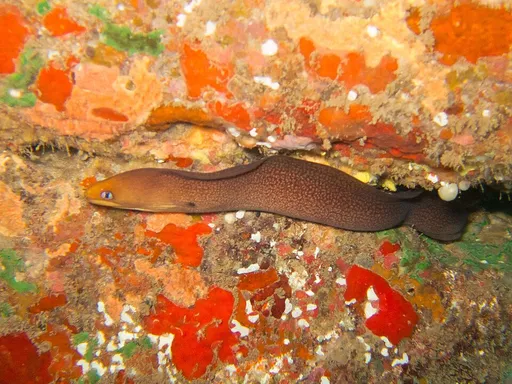 11.8 in (30 cm)65 gal (246 L)72–79°F (22–26°C)
Golden dwarf moray
Gymnothorax melatremus
11.8 in (30 cm) · 65 gal (246 L)
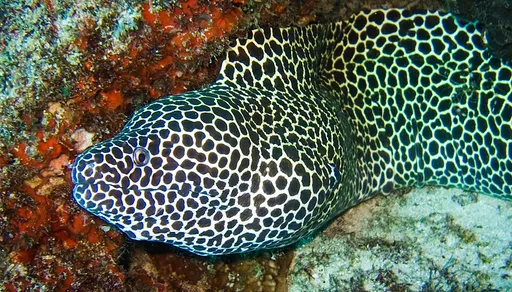 70.9 in (180 cm)291 gal (1,100 L)75–81°F (24–27°C)
Honeycomb moray
Gymnothorax favagineus
70.9 in (180 cm) · 291 gal (1,100 L)
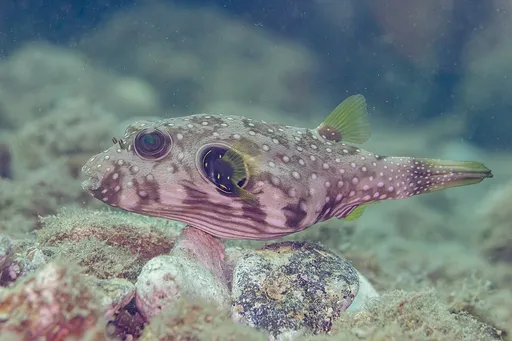 19.7 in (50 cm)180 gal (680 L)75–81°F (24–27°C)
Stars-and-stripes puffer
Arothron hispidus
19.7 in (50 cm) · 180 gal (680 L)