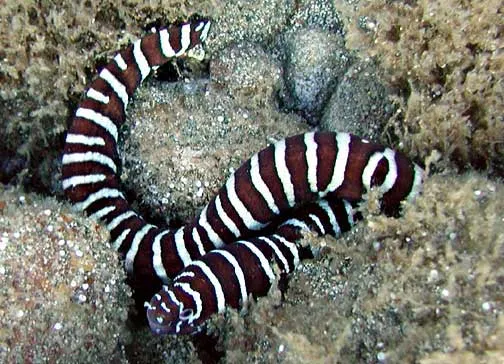
Zebra moray
Gymnomuraena zebra
Also known as Zebra Moray Eel, Zebra Eel
SaltwaterFish
Care at a glance
- Temperature
- 72–79°F
- 22–26°C
- pH
- 8.1–8.4
- Adult size
- 59.1 in
- 150 cm
- Minimum tank
- 180 gal
- 680 L
- Temperament
- Peaceful
- Social behavior
- Solitary
- Tankmates
- With caution
- Swim level
- Bottom
- Difficulty
- Medium
- Breeding
- No record
- Rarity
- Common
- Reef safe
- Reef safe with caution
- Family
- Muraenidae
- Origin
- Indo-Pacific reefs, from East Africa and the Red Sea across to Hawaii, with a further range extension into the eastern Pacific from Mexico to Peru, including the Galapagos Islands
Overview
Zebra morays are about as docile as morays get, rarely bothering fish tankmates and posing little threat to anyone who isn't handling them directly. They're reef safe with caution: corals and anemones are generally left alone, but the crushing teeth that give this eel its name make short work of sea urchins, snails, crabs, and shrimp, so it doesn't belong with a cleanup crew. Feed pieces of fish, shrimp, clam, and squid every few days rather than daily. A large adult can also be clumsy in a reef tank, bumping into and toppling corals simply by moving through the aquascape, and as with every moray, the lid needs to be completely sealed from day one.
In the wild
Zebra morays are found across an unusually wide range for a moray, from East Africa and the Red Sea through the Indo-Pacific to Hawaii, and then again along the eastern Pacific from Mexico down to Peru, including the Galapagos. They hide in reef crevices during the day and forage over rock and rubble at night. This is one of the largest eels in the hobby, so plan for at least 680 litres (180 US gal) with deep rockwork and a completely sealed lid, since a hiding spot has to be big enough to swallow the eel's entire body and an escape-proof top is non-negotiable.
Good to know
Gymnomuraena zebra is the only species in its genus, set apart from other morays by short, rounded, molar-like teeth built for crushing hard-shelled prey instead of the sharp, grabbing teeth most morays use on fish. FishBase records a maximum length of 150 cm, and while most aquarium specimens settle in well short of that, this is still a genuinely large eel that can live 10–15 years or more in captivity. Like its relatives it has no pelvic or pectoral fins and relies on smell more than eyesight to track down food at night.
Did you know
Most morays hunt fish with sharp, backward-curving teeth, but the zebra moray's teeth are flattened and rounded like little molars, built for crunching through the shells of crabs, urchins, and snails instead.
Common questions
What size tank does a Zebra moray need?
A Zebra moray needs at least 180 gal (680 L). It spends most of its time in the bottom.
What temperature and pH does a Zebra moray need?
A Zebra moray is comfortable at 72–79°F (22–26°C) with a pH of 8.1–8.4.
How big does a Zebra moray get?
An adult Zebra moray reaches about 59.1 in (150 cm).
Related species
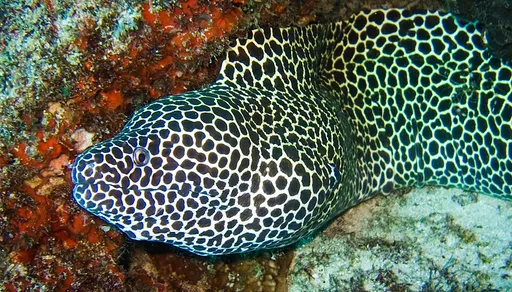 70.9 in (180 cm)291 gal (1,100 L)75–81°F (24–27°C)
Honeycomb moray
Gymnothorax favagineus
70.9 in (180 cm) · 291 gal (1,100 L)
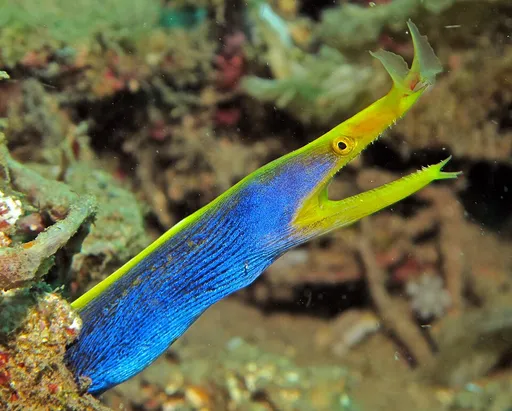 39.4 in (100 cm)66 gal (250 L)75–81°F (24–27°C)
Ribbon eel
Rhinomuraena quaesita
39.4 in (100 cm) · 66 gal (250 L)
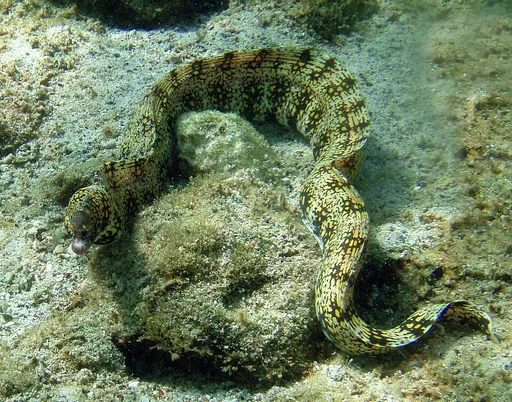 39.4 in (100 cm)50 gal (189 L)72–79°F (22–26°C)
Snowflake eel
Echidna nebulosa
39.4 in (100 cm) · 50 gal (189 L)
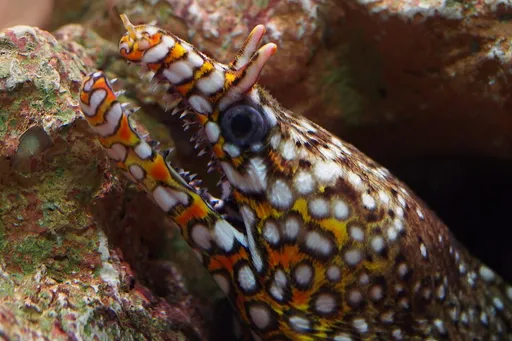 35.4 in (90 cm)180 gal (680 L)72–79°F (22–26°C)
Dragon moray
Enchelycore pardalis
35.4 in (90 cm) · 180 gal (680 L)
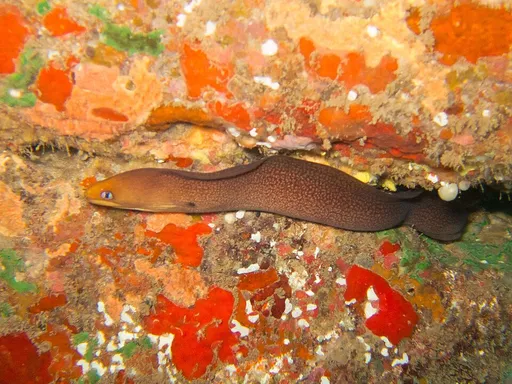 11.8 in (30 cm)65 gal (246 L)72–79°F (22–26°C)
Golden dwarf moray
Gymnothorax melatremus
11.8 in (30 cm) · 65 gal (246 L)
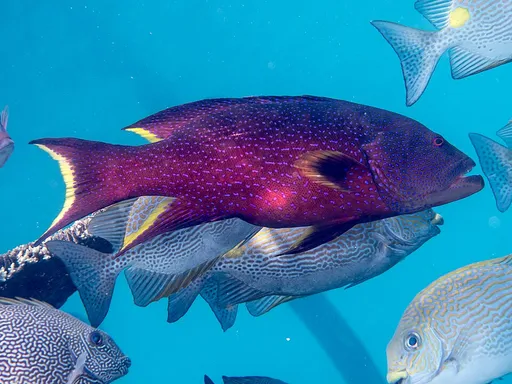 31.5 in (80 cm)291 gal (1,100 L)75–81°F (24–27°C)
Lyretail grouper
Variola louti
31.5 in (80 cm) · 291 gal (1,100 L)