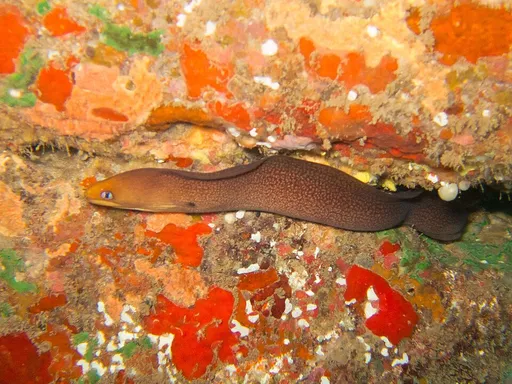
Golden dwarf moray
Gymnothorax melatremus
Also known as Dwarf Moray, Blackspot Moray, Dirty Yellow Moray
SaltwaterFish
Care at a glance
- Temperature
- 72–79°F
- 22–26°C
- pH
- 8.1–8.4
- Adult size
- 11.8 in
- 30 cm
- Minimum tank
- 65 gal
- 246 L
- Temperament
- Mostly peaceful
- Social behavior
- Solitary
- Tankmates
- With caution
- Swim level
- Bottom
- Difficulty
- Easy
- Breeding
- No record
- Rarity
- Very rare
- Reef safe
- Reef safe with caution
- Family
- Muraenidae
- Origin
- Indo-Pacific reefs, from East Africa to the Marquesas and Mangareva islands, north to Hawaii, south to the Austral Islands
Overview
This eel is semi-aggressive in the sense that it's a committed predator, but it largely ignores tankmates too big to fit in its mouth and spends most of daylight hours out of sight. It's reef safe with caution: it won't touch coral tissue, but any small fish or shrimp that wanders too close becomes a meal, and keepers need to avoid placing it near heavily stinging corals, since a moray can take burns to its skin from repeated contact. Feed small pieces of fish, shrimp, or krill every few days. Despite its small size, treat the lid the same way as for any other moray: fully sealed, with no gap it could squeeze through.
In the wild
Golden dwarf morays range across the Indo-Pacific from East Africa to the Marquesas and Mangareva islands, north to Hawaii and south to the Austral Islands. They hide in small holes and crevices in the reef by day and hunt at night, rarely straying into open water. Because it stays so much smaller than most morays, it can work in a tank of at least 246 litres (65 US gal) with a dense maze of live rock to hide in, though the lid still needs to be completely sealed, since this species is just as determined an escape artist as its larger relatives.
Good to know
Gymnothorax melatremus tops out around 30 cm, making it one of the smallest morays regularly kept in the hobby, a true dwarf species rather than a juvenile of something larger. Its rich yellow to golden-brown body, sometimes finely speckled, is where the common name comes from, and a close look often reveals faint pale blue rings around the eyes. Hawaii has restricted collection of this species, and much of what reaches the trade now comes from the Philippines instead, which keeps supply tight and prices high.
Did you know
A Hawaiian collection ban has cut off the main historical source for this eel, so a genuine golden dwarf moray today is one of the pricier small marine fish in the hobby, and buyers need to watch for juveniles of larger moray species sometimes sold under the same name.
Common questions
What size tank does a Golden dwarf moray need?
A Golden dwarf moray needs at least 65 gal (246 L). It spends most of its time in the bottom.
What temperature and pH does a Golden dwarf moray need?
A Golden dwarf moray is comfortable at 72–79°F (22–26°C) with a pH of 8.1–8.4.
How big does a Golden dwarf moray get?
An adult Golden dwarf moray reaches about 11.8 in (30 cm).
Related species
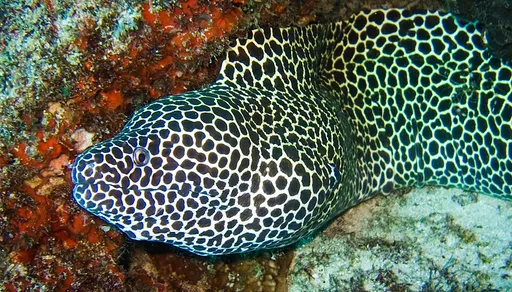 70.9 in (180 cm)291 gal (1,100 L)75–81°F (24–27°C)
Honeycomb moray
Gymnothorax favagineus
70.9 in (180 cm) · 291 gal (1,100 L)
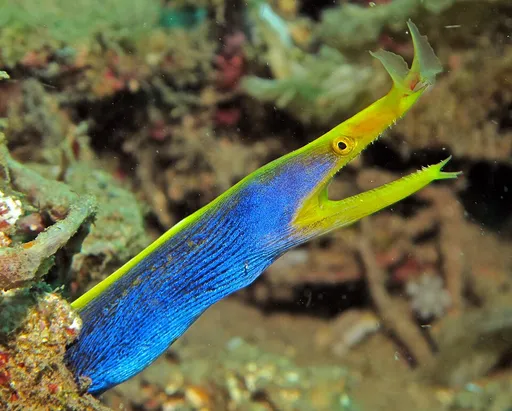 39.4 in (100 cm)66 gal (250 L)75–81°F (24–27°C)
Ribbon eel
Rhinomuraena quaesita
39.4 in (100 cm) · 66 gal (250 L)
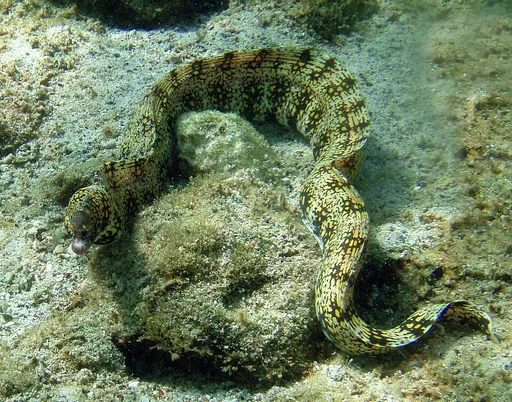 39.4 in (100 cm)50 gal (189 L)72–79°F (22–26°C)
Snowflake eel
Echidna nebulosa
39.4 in (100 cm) · 50 gal (189 L)
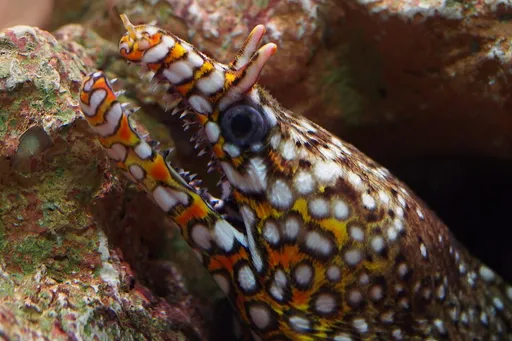 35.4 in (90 cm)180 gal (680 L)72–79°F (22–26°C)
Dragon moray
Enchelycore pardalis
35.4 in (90 cm) · 180 gal (680 L)
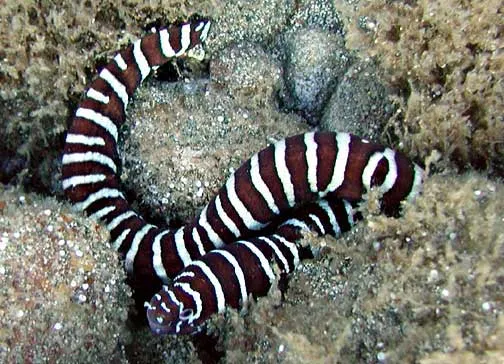 59.1 in (150 cm)180 gal (680 L)72–79°F (22–26°C)
Zebra moray
Gymnomuraena zebra
59.1 in (150 cm) · 180 gal (680 L)
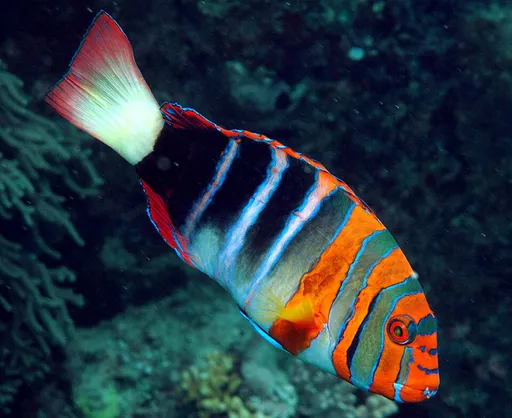 11.8 in (30 cm)125 gal (473 L)72–79°F (22–26°C)
Harlequin tuskfish
Choerodon fasciatus
11.8 in (30 cm) · 125 gal (473 L)