Snowflake eel
Echidna nebulosa
Also known as Snowflake Moray Eel, Clouded Moray, Starry Moray, Floral Moray
SaltwaterFish
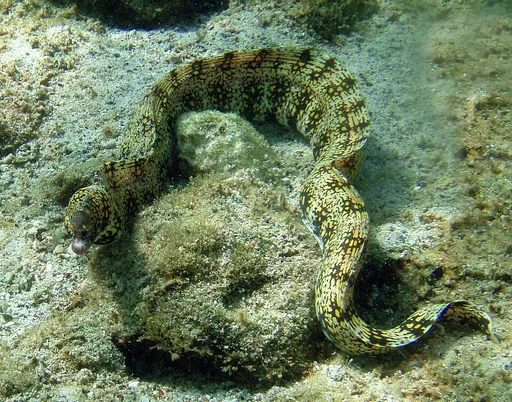
Care at a glance
- Temperature
- 72–79°F
- 22–26°C
- pH
- 8.1–8.4
- Adult size
- 39.4 in
- 100 cm
- Minimum tank
- 50 gal
- 189 L
- Temperament
- Mostly peaceful
- Social behavior
- Solitary
- Tankmates
- With caution
- Swim level
- Bottom
- Difficulty
- Easy
- Breeding
- No record
- Rarity
- Very common
- Reef safe
- Reef safe with caution
- Family
- Muraenidae
- Origin
- Indo-Pacific reefs, from the Red Sea and East Africa to Hawaii, with an isolated population along the eastern Pacific coast from Mexico to Colombia
Overview
This eel is hardy and generally calm with tankmates it can't swallow, rating semi-aggressive more for its predatory nature than for picking fights. It's reef safe with caution: it leaves coral and anemones alone but treats shrimp, crabs, and other crustaceans as food, so skip it if the plan includes a cleanup crew or ornamental shrimp. Offer chunks of fish, shrimp, and other meaty foods a couple times a week. Above all, keep the lid sealed with no gaps; a snowflake eel that finds any opening at the waterline will use it, often within the first few weeks in a new tank.
In the wild
Snowflake eels live across a huge stretch of the Indo-Pacific, from the Red Sea and East Africa to Hawaii, and turn up again in an isolated population along the eastern Pacific coast from Mexico to Colombia. They spend the day tucked into reef crevices and rubble, coming out at night to hunt. In the aquarium it needs at least 189 litres (50 US gal) with plenty of live rock offering caves to disappear into, and a tightly sealed, gap-free lid, since morays are relentless escape artists and most losses come from a poorly secured tank rather than anything else.
Good to know
Echidna nebulosa belongs to a group of morays sometimes called pebbletooth eels, named for their blunt, rounded teeth built for crushing crustacean shells rather than the long, needle-like teeth that fish-eating morays use to grab slippery prey. FishBase lists a maximum length of 100 cm, though most specimens in captivity stay well under that, more often topping out around 60 cm. Like other true eels it has no pelvic or pectoral fins, and it breathes by rhythmically opening and closing its mouth to pass water over the gills, a habit new owners sometimes mistake for aggression.
Did you know
A snowflake eel constantly opening and closing its mouth at the glass isn't threatening anyone, it's just moving water over its gills to breathe, one of the more commonly misread behaviors in the whole hobby.
Common questions
What size tank does a Snowflake eel need?
A Snowflake eel needs at least 50 gal (189 L). It spends most of its time in the bottom.
What temperature and pH does a Snowflake eel need?
A Snowflake eel is comfortable at 72–79°F (22–26°C) with a pH of 8.1–8.4.
How big does a Snowflake eel get?
An adult Snowflake eel reaches about 39.4 in (100 cm).
Related species
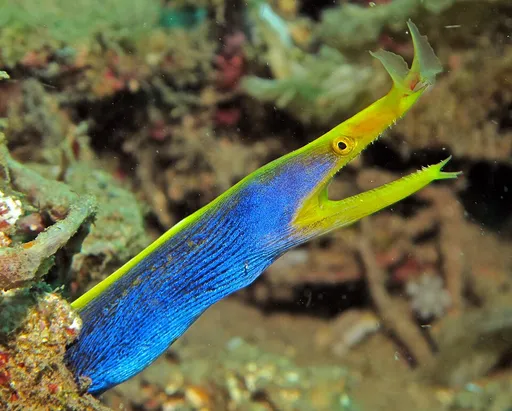 39.4 in (100 cm)66 gal (250 L)75–81°F (24–27°C)
Ribbon eel
Rhinomuraena quaesita
39.4 in (100 cm) · 66 gal (250 L)
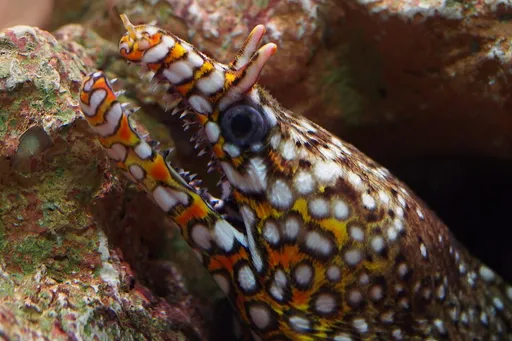 35.4 in (90 cm)180 gal (680 L)72–79°F (22–26°C)
Dragon moray
Enchelycore pardalis
35.4 in (90 cm) · 180 gal (680 L)
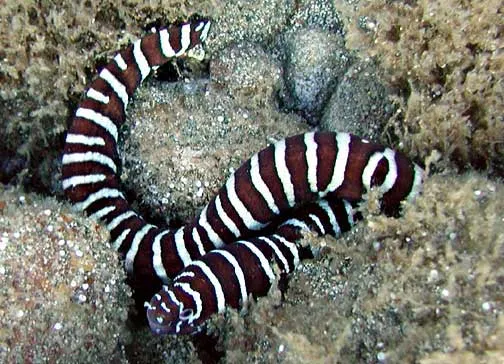 59.1 in (150 cm)180 gal (680 L)72–79°F (22–26°C)
Zebra moray
Gymnomuraena zebra
59.1 in (150 cm) · 180 gal (680 L)
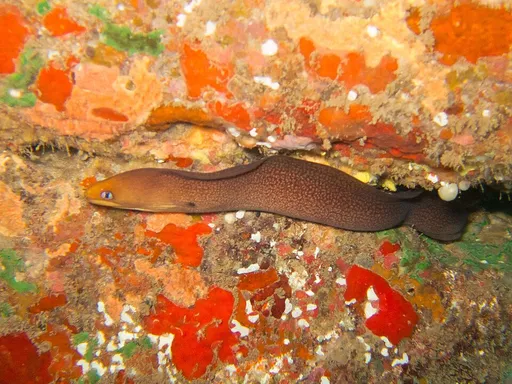 11.8 in (30 cm)65 gal (246 L)72–79°F (22–26°C)
Golden dwarf moray
Gymnothorax melatremus
11.8 in (30 cm) · 65 gal (246 L)
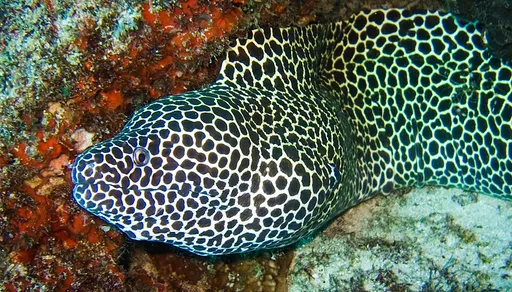 70.9 in (180 cm)291 gal (1,100 L)75–81°F (24–27°C)
Honeycomb moray
Gymnothorax favagineus
70.9 in (180 cm) · 291 gal (1,100 L)
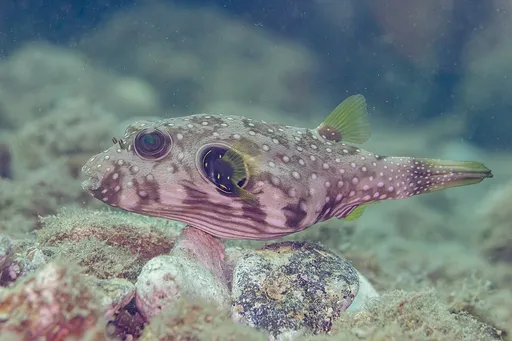 19.7 in (50 cm)180 gal (680 L)75–81°F (24–27°C)
Stars-and-stripes puffer
Arothron hispidus
19.7 in (50 cm) · 180 gal (680 L)