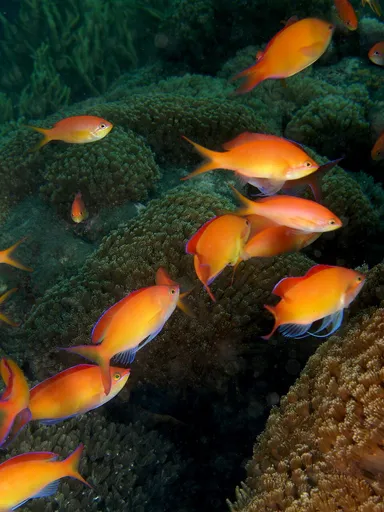
Dispar anthias
Pseudanthias dispar
Also known as Peach Anthias, Redfin Anthias, Peach Fairy Basslet, Madder Seaperch
SaltwaterFish
Care at a glance
- Temperature
- 72–79°F
- 22–26°C
- pH
- 8.1–8.4
- Adult size
- 3.7 in
- 9.5 cm
- Minimum tank
- 70 gal
- 265 L
- Temperament
- Peaceful
- Social behavior
- Social
- Swim level
- Middle
- Difficulty
- Medium
- Breeding
- Hard
- Rarity
- Common
- Reef safe
- Reef safe
- Family
- Serranidae
- Origin
- Western Pacific reefs, from Indonesia and the Philippines to Fiji and the Great Barrier Reef
Overview
A peaceful, active planktivore that spends its day picking food out of the water column, so it needs several small feedings a day rather than one or two large ones; underfeeding is the most common reason this species declines in captivity. It does well with other peaceful reef fish, clownfish, gobies, and dartfish, and is fully reef safe around corals, clams, and ornamental shrimp. Keep it as a single fish or, better, a harem of one male with several females, and avoid boisterous or fast-eating tankmates that can out-compete it at feeding time.
In the wild
Lives along the upper edges of steep outer reef slopes and drop-offs, usually at 1–15 m, where strong currents sweep in a steady supply of zooplankton. In the wild it gathers in large aggregations over branching coral, using the coral heads as cover at night and when startled. In the aquarium it needs a lot of open swimming space above a rockwork base riddled with caves and crevices, plus moderate to strong water flow and good surface agitation, since anthias come from well-oxygenated water and can struggle in stagnant tanks.
Good to know
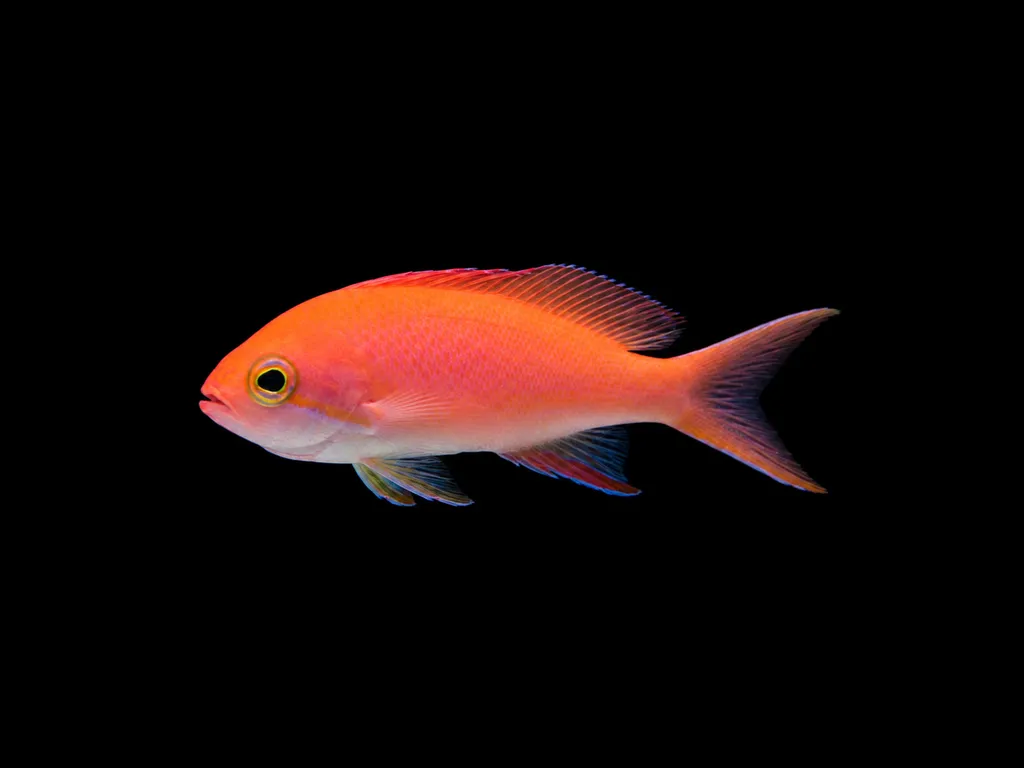
Like other anthias, this species is a protogynous hermaphrodite: every fish starts out female, and the largest, most dominant female in a harem will change sex to male within a few weeks if the resident male is lost. A harem is normally one male defending a loose territory over several to a dozen or more females. Males are larger and more colorful than females, with a long, flat, deep red dorsal fin and a violet-pink body, while females are yellow-orange fading to a pale magenta belly.
Did you know
Males flush a deeper red across the dorsal fin during courtship, flaring it while looping above the harem in a display distinct enough that a displaying male can look like a different fish from the one resting in the rocks minutes earlier.
Weekly picks
Tank mates
Dispar anthias is a peaceful, social species that keeps to the middle. These picks share a community profile with it, are safe together in both directions, and overlap on water type, temperature and pH.
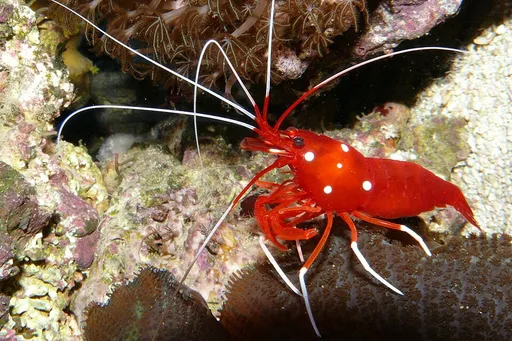
Fire shrimp
Lysmata debelius
Saltwater2.4 in (6 cm) · 20 gal (75 L)72–79°F (22–26°C)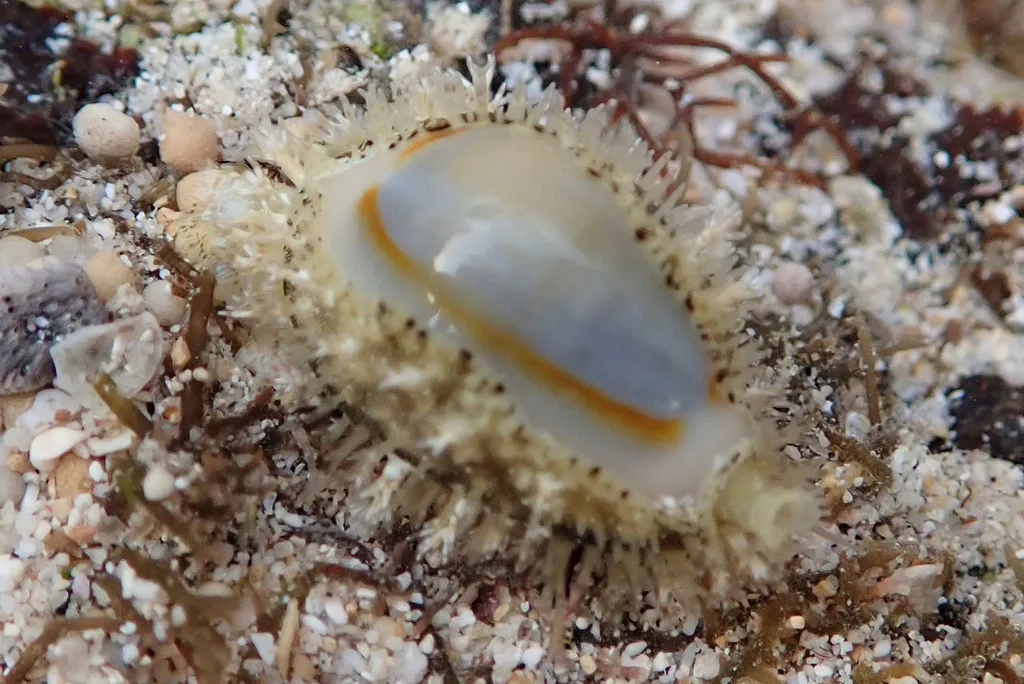
Ring cowrie
Monetaria annulus
Saltwater1.2 in (3 cm) · 20 gal (75 L)75–81°F (24–27°C)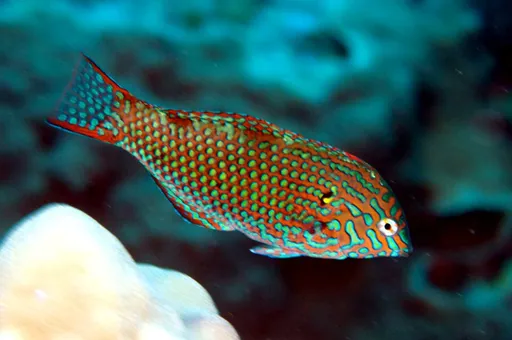
Leopard wrasse
Macropharyngodon meleagris
Saltwater5.9 in (15 cm) · 90 gal (340 L)72–79°F (22–26°C)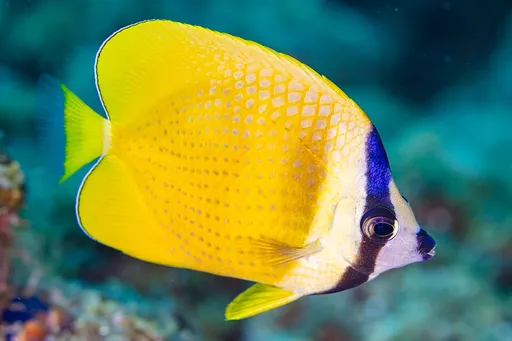
Klein's butterflyfish
Chaetodon kleinii
Saltwater5.9 in (15 cm) · 79 gal (300 L)75–81°F (24–27°C)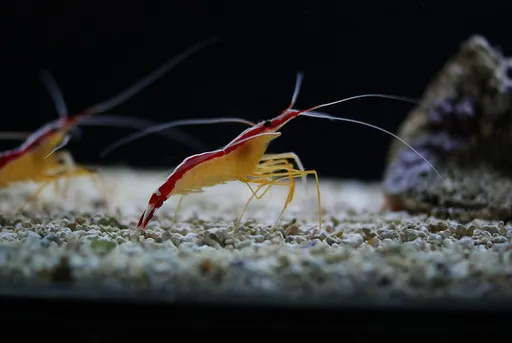
Skunk cleaner shrimp
Lysmata amboinensis
Saltwater2.4 in (6 cm) · 20 gal (75 L)73–81°F (23–27°C)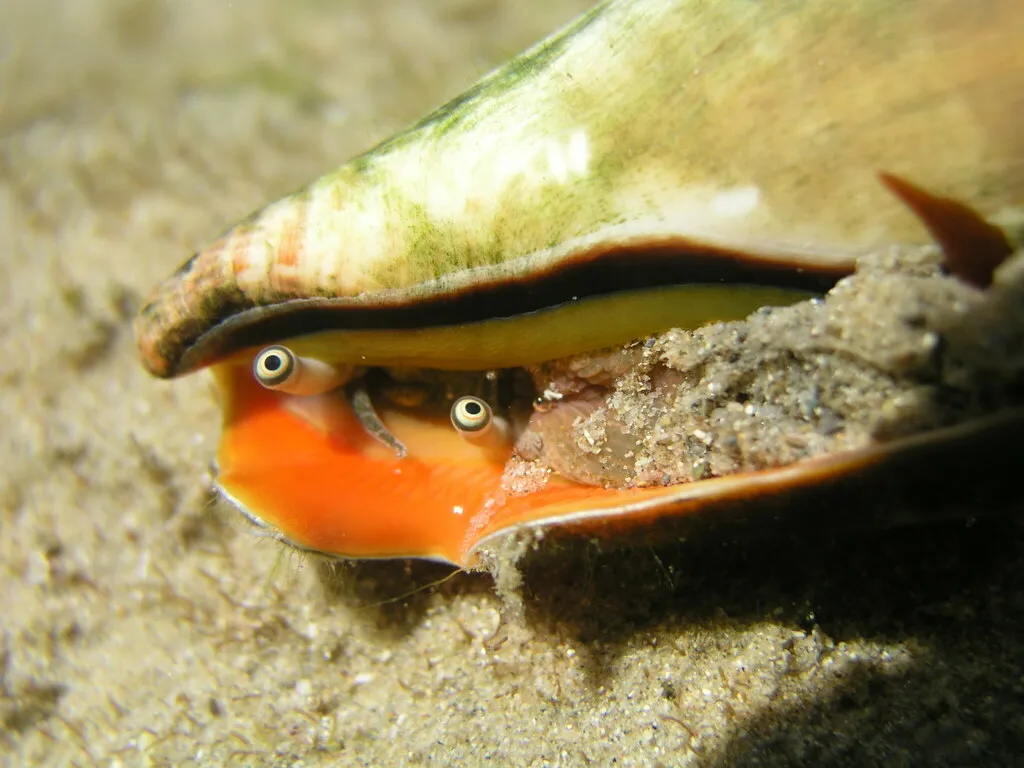
Tiger / strawberry conch
Conomurex luhuanus
Saltwater2.8 in (7 cm) · 20 gal (75 L)75–81°F (24–27°C)
Common questions
What size tank does a Dispar anthias need?
A Dispar anthias needs at least 70 gal (265 L). It spends most of its time in the middle.
What temperature and pH does a Dispar anthias need?
A Dispar anthias is comfortable at 72–79°F (22–26°C) with a pH of 8.1–8.4.
How big does a Dispar anthias get?
An adult Dispar anthias reaches about 3.7 in (9.5 cm).
Related species
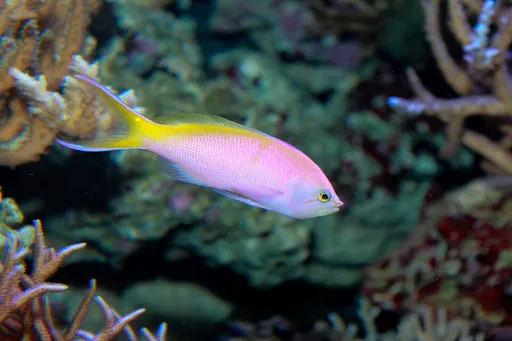 3.5 in (9 cm)70 gal (265 L)72–79°F (22–26°C)
Bartlett's anthias
Pseudanthias bartlettorum
3.5 in (9 cm) · 70 gal (265 L)
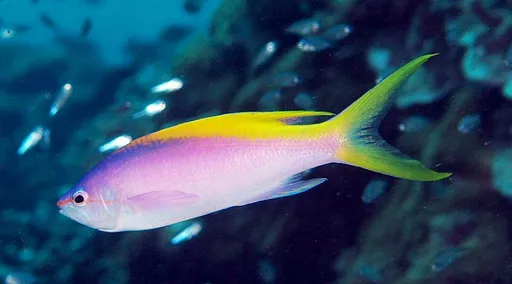
 3.1 in (8 cm)75 gal (285 L)75–81°F (24–27°C)
Randall's anthias
Pseudanthias randalli
3.1 in (8 cm) · 75 gal (285 L)
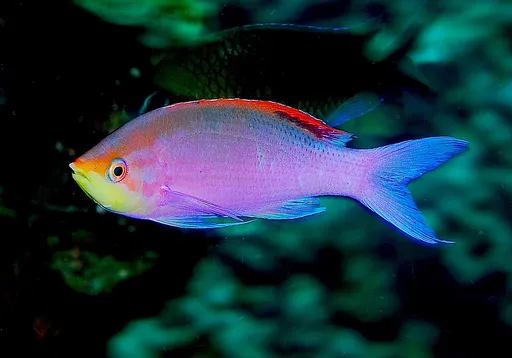
 4.7 in (12 cm)75 gal (285 L)75–81°F (24–27°C)
Evansi anthias
Pseudanthias evansi
4.7 in (12 cm) · 75 gal (285 L)
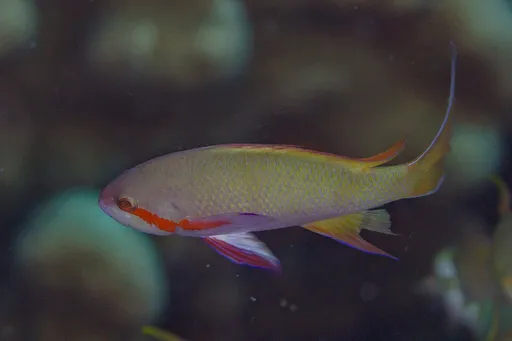
 4.7 in (12 cm)75 gal (285 L)75–81°F (24–27°C)
Purple queen anthias
Pseudanthias tuka
4.7 in (12 cm) · 75 gal (285 L)
 4.7 in (12 cm)90 gal (340 L)75–81°F (24–27°C)
Huchtii anthias
Pseudanthias huchtii
4.7 in (12 cm) · 90 gal (340 L)
 5.1 in (13 cm)125 gal (475 L)72–79°F (22–26°C)
Bicolor anthias
Pseudanthias bicolor
5.1 in (13 cm) · 125 gal (475 L)