Bicolor angelfish
Centropyge bicolor
Also known as Oriole Angelfish, Two-colored Angelfish, Blue and Gold Angelfish
SaltwaterFish

Care at a glance
- Temperature
- 72–81°F
- 22–27°C
- pH
- 8.1–8.4
- Adult size
- 5.9 in
- 15 cm
- Minimum tank
- 55 gal
- 210 L
- Temperament
- Mostly peaceful
- Social behavior
- Solitary
- Own kind
- One male per tank
- Tankmates
- With caution
- Swim level
- Middle
- Difficulty
- Medium
- Breeding
- Hard
- Rarity
- Common
- Reef safe
- Reef safe with caution
- Family
- Pomacanthidae
- Origin
- Indo-Pacific, from East Africa across to Samoa and the Phoenix Islands, north to southern Japan and south to the Great Barrier Reef
Overview
An active grazer that needs an established tank with steady algae growth plus regular feedings of algae-based and meaty foods. Bicolor angels are bolder and more prone to squabbling with tankmates than many dwarf angels, and they will not tolerate other Centropyge in anything but a very large system. Reef keepers rate it caution: many specimens leave corals alone, but some nip LPS polyps, zoanthids, soft corals, or clam mantles, especially if underfed.
In the wild
Found on outer reef slopes and reef flats across the Indo-Pacific, usually in areas with a mix of live coral and rubble where it can duck for cover. It grazes algae off rock and coral debris through the day and rarely strays far from a bolt-hole. In the tank it needs a mature setup with plenty of live rock, tight caves, and an established film of algae to pick at.
Good to know
Centropyge bicolor is a dwarf angel in the family Pomacanthidae, growing to about 15 cm. Like the rest of the genus it is a protogynous hermaphrodite that lives in small harems, one male over several females, and the top female changes sex if the male disappears. The sharp break between its yellow-orange front half and deep blue-black rear half, the source of both its scientific and common names, is one of the more distinctive color patterns among the dwarf angels.
Did you know
Its sharply split two-tone body is why the trade also calls it the Oriole Angelfish, a nod to the similarly bold black-and-orange plumage of the songbird.
Common questions
What size tank does a Bicolor angelfish need?
A Bicolor angelfish needs at least 55 gal (210 L). It spends most of its time in the middle.
What temperature and pH does a Bicolor angelfish need?
A Bicolor angelfish is comfortable at 72–81°F (22–27°C) with a pH of 8.1–8.4.
How big does a Bicolor angelfish get?
An adult Bicolor angelfish reaches about 5.9 in (15 cm).
Related species
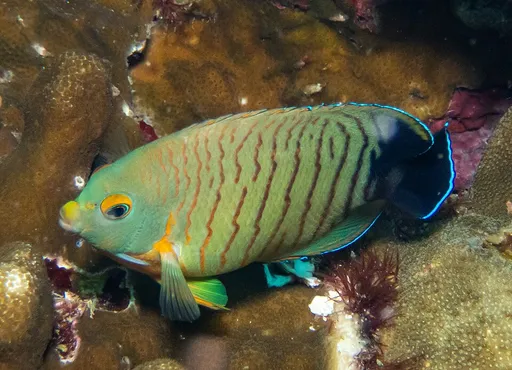 5.9 in (15 cm)55 gal (210 L)72–79°F (22–26°C)
Eibli angelfish
Centropyge eibli
5.9 in (15 cm) · 55 gal (210 L)
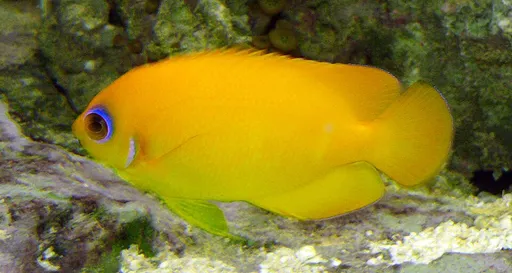 5.5 in (14 cm)55 gal (210 L)72–79°F (22–26°C)
Lemonpeel angelfish
Centropyge flavissima
5.5 in (14 cm) · 55 gal (210 L)
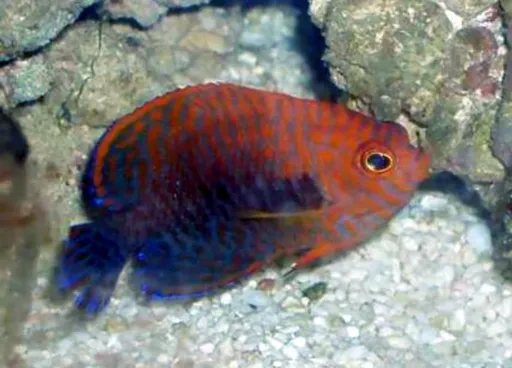 5.1 in (13 cm)65 gal (245 L)72–79°F (22–26°C)
Potter's angelfish
Centropyge potteri
5.1 in (13 cm) · 65 gal (245 L)
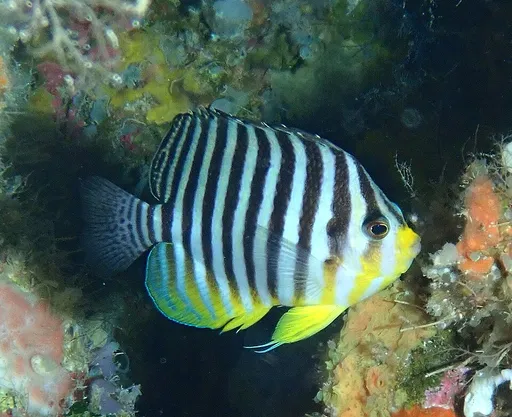 4.7 in (12 cm)59 gal (225 L)72–79°F (22–26°C)
Multibarred angelfish
Centropyge multifasciata
4.7 in (12 cm) · 59 gal (225 L)
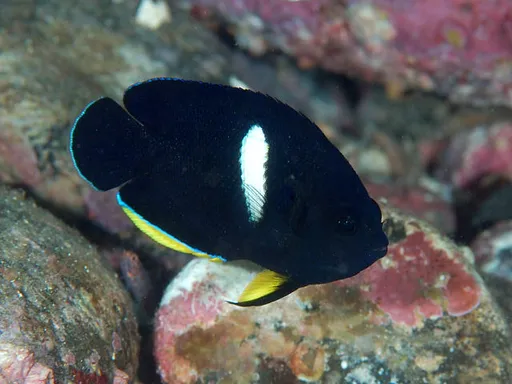 7.9 in (20 cm)70 gal (265 L)72–79°F (22–26°C)
Keyhole angelfish
Centropyge tibicen
7.9 in (20 cm) · 70 gal (265 L)
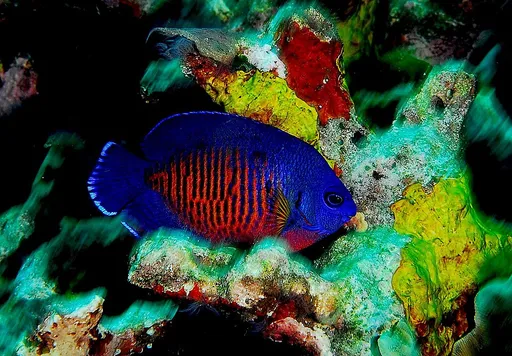 3.9 in (10 cm)50 gal (190 L)72–79°F (22–26°C)
Coral beauty angelfish
Centropyge bispinosa
3.9 in (10 cm) · 50 gal (190 L)