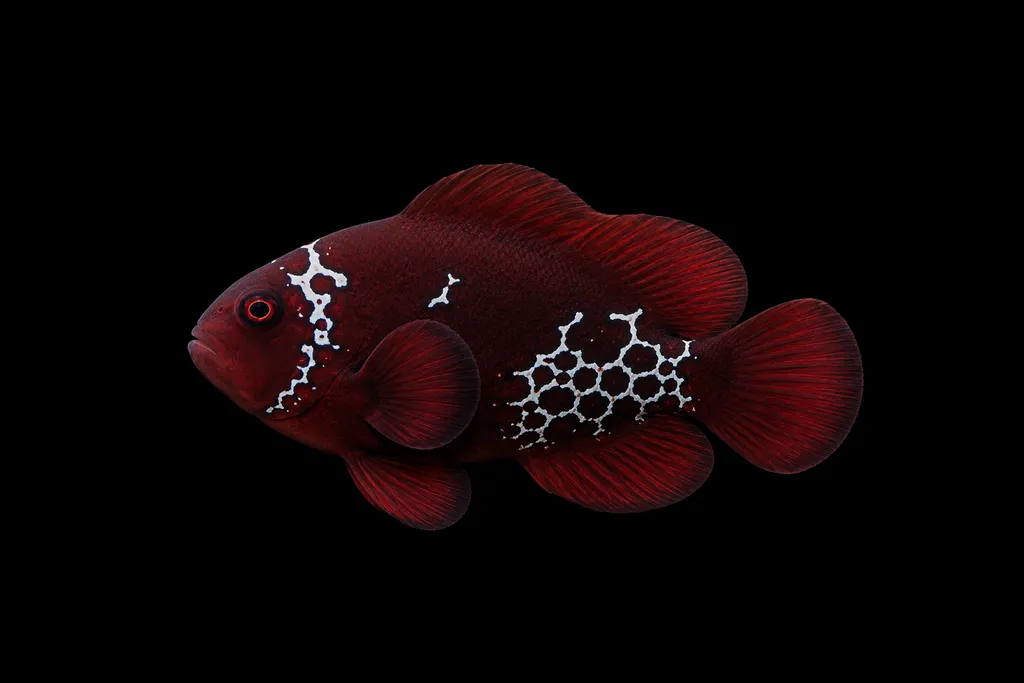
White bars break into a branching web across the flanks, and no two fish carry the same map. Buy from a photo of the actual animal. Pattern intensity varies within a spawn, so grades and prices differ even among siblings. Temperament is standard maroon, so the pattern buys you nothing on that front.
In the wild
The line traces to aberrant wild fish found off Papua New Guinea, not to a hatchery cross. Only two were ever collected, both near Port Moresby, and the second was taken by diver Steven Paul under the SEASMART program and delivered to breeder Matt Pedersen in Duluth, Minnesota in 2010. Pedersen paired her with a wild white stripe from the same PNG waters, and that pair spawned successfully in June 2012.
Good to know
Crossing the wild lightning fish to a normal white stripe produced lightning patterned offspring, so the trait passes from a single parent. Pedersen counted roughly half the settled F1 as lightning and read that as one dominant allele carried in a single copy, partial dominance being his best guess. He published the model as provisional, pending later generations. Expression varies between siblings rather than coming out uniform, which is why farms still grade the fry.
Did you know
Nearly every lightning maroon on the market descends from one project. When the original wild female died, Reef Builders published a eulogy for her in December 2020. Aquarium fish do not usually get obituaries.
Symbiotic relationships
Clownfish and their host anemones
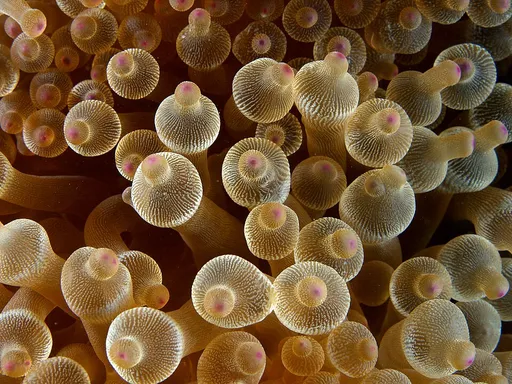
A clownfish lives inside an anemone that stings and eats other fish its size. Its mucus coat keeps the anemone's stinging cells from firing, and a new fish builds that protection up over hours of brief touches. The fish gets a refuge no predator will follow it into and a nest site at the anemone's base. The anemone gets a guard that drives off the butterflyfish that would graze its tentacles, a steady supply of nitrogen from the fish's waste, and water movement at night, when the fish fans its fins among the tentacles and the anemone takes up more oxygen. Only ten anemone species host clownfish in the wild, and each clownfish species uses its own short list of them.
Captive-bred clownfish have never seen an anemone and do not need one; they settle for a coral, a powerhead or a corner of the tank. If you want the pairing, the anemone is the harder animal by far and goes in first, into a mature tank with strong light and stable water, at the tank size its own profile lists. The bubble tip anemone is the hardy host, and the one most clownfish accept in captivity even when it is not a natural host, so a clownfish profile lists it as the usual tank host where that is the case. The sebae, magnificent and carpet anemones are marked difficult, and the carpets eat fish. Expect a paired clownfish to defend its anemone against everything else in the tank.
Is a Lightning maroon clownfish a different species from the Maroon clownfish?
No. A Lightning maroon clownfish is a variety of the Maroon clownfish, Premnas biaculeatus, and it wants the same tank, water and food as the species.
Where did the Lightning maroon clownfish come from?
From two aberrant wild fish found off Papua New Guinea near Port Moresby. The second was collected in 2010 under the SEASMART program and delivered to the breeder Matt Pedersen in Duluth, Minnesota, who paired her with a wild white stripe from the same waters. That pair spawned in June 2012, and nearly every lightning maroon sold today descends from the project.
Do all Lightning maroon clownfish look the same?
No two carry the same web. Pattern intensity varies within a spawn, so farms grade the fry and price siblings differently. Buy from a photo of the actual fish. The temperament is standard maroon, so the pattern changes nothing about how it treats tank mates.
What size tank does a Lightning maroon clownfish need?
A Lightning maroon clownfish needs at least 40 gal (150 L). It spends most of its time in the middle.
How big does a Lightning maroon clownfish get?
An adult Lightning maroon clownfish reaches about 6.7 in (17 cm).
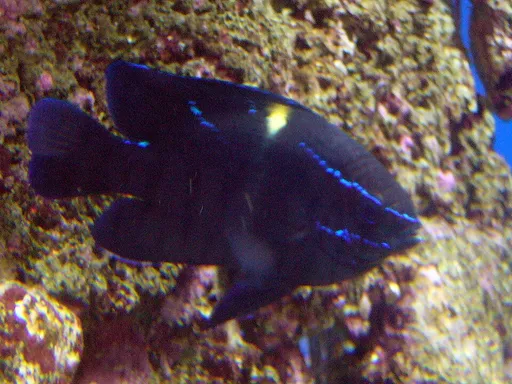 5.9 in (15 cm)55 gal (210 L)75–81°F (24–27°C)
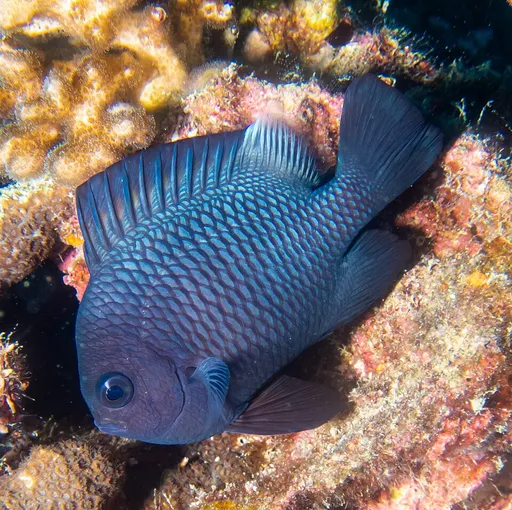 5.5 in (14 cm)55 gal (210 L)75–81°F (24–27°C)
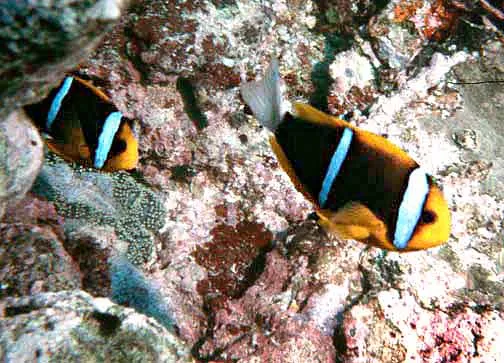 6.7 in (17 cm)55 gal (210 L)75–82°F (24–28°C)
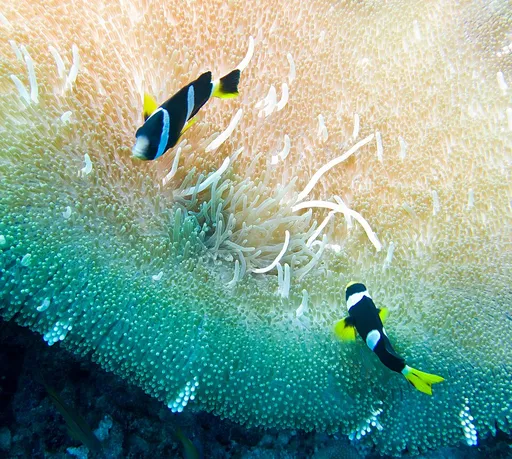 5.9 in (15 cm)30 gal (115 L)75–82°F (24–28°C)
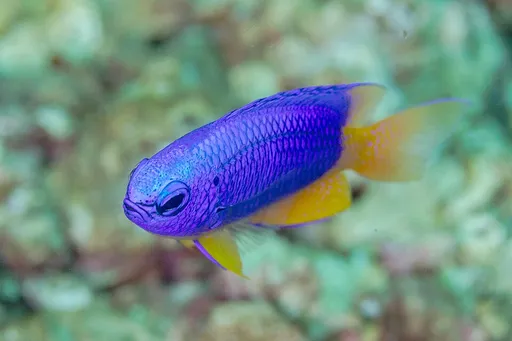 3.5 in (9 cm)29 gal (110 L)75–81°F (24–27°C)
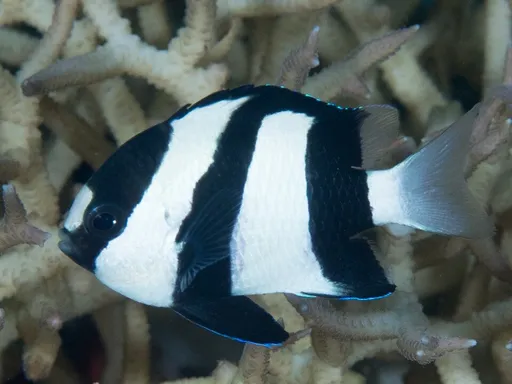 3.5 in (9 cm)29 gal (110 L)75–81°F (24–27°C)