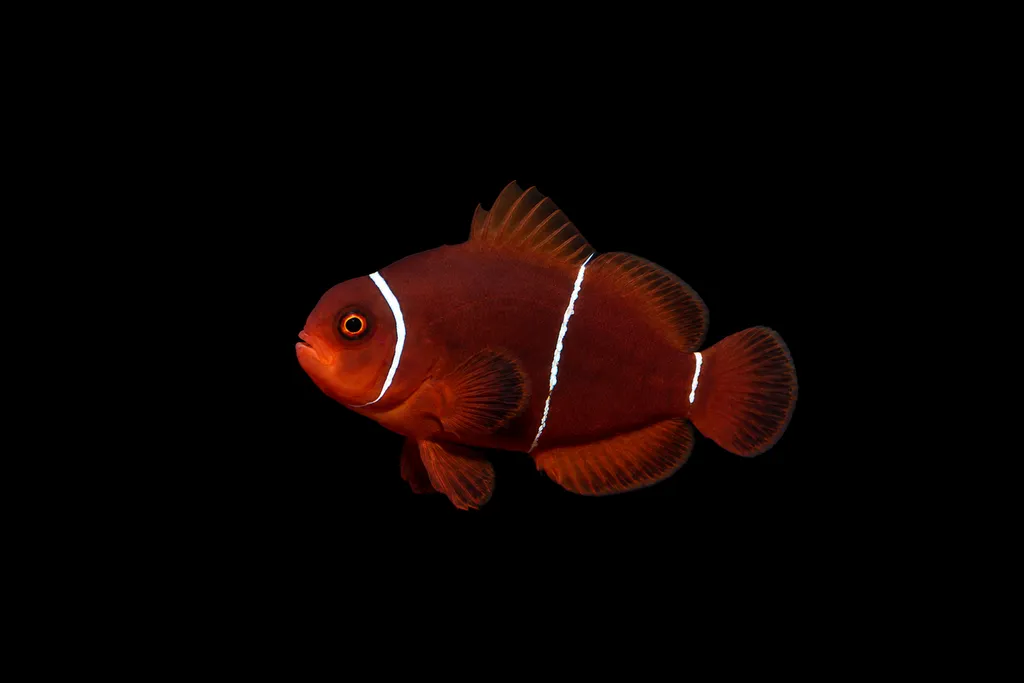
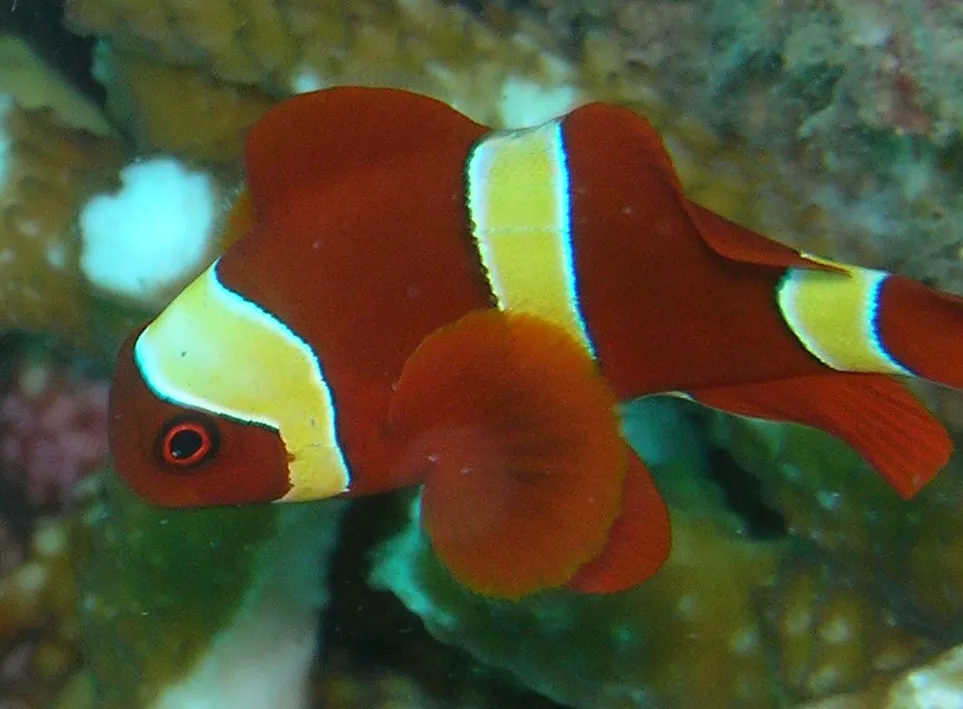
Juveniles arrive with white bars and turn gold between about nine and twelve months, the head bar changing first. Patience is part of the purchase. ORA reports it as the calmer of the two natural forms, which can matter when you plan tankmates. It is priced above a white stripe and stocked less often.
In the wild
Gold bars are the natural pattern of maroons around Sumatra, not a hatchery creation. ORA states its broodstock comes from that area, so captive fish carry a local wild pattern rather than a selected mutation. The same gold barring turns up in the Andaman Islands, while the rest of the range wears white bars, which makes this a regional form and not a designer line.
Good to know
The color shift is a maturation step, not a grade a farm assigns. White pigment in the bars gives way to gold as the fish matures, beginning at the head stripe and working back. Because gold is the local wild pattern rather than a rare pick out of a spawn, gold stripe pairs produce gold striped young.
Did you know
The Sumatran fish has an old name waiting for it. Fowler described a maroon from Sumatra in 1904 as Premnas epigrammata, a name now carried as a synonym rather than a valid species. Some writers argue it should be resurrected, under Amphiprion given the current genus, if the split holds up.
Symbiotic relationships
Clownfish and their host anemones
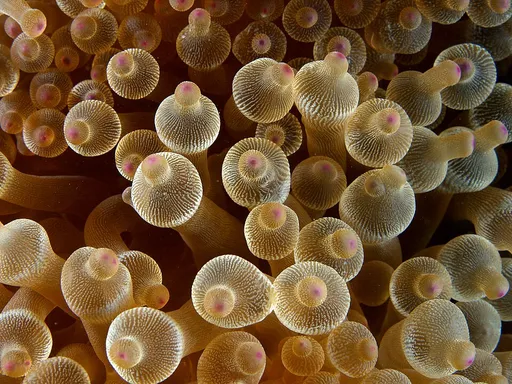
A clownfish lives inside an anemone that stings and eats other fish its size. Its mucus coat keeps the anemone's stinging cells from firing, and a new fish builds that protection up over hours of brief touches. The fish gets a refuge no predator will follow it into and a nest site at the anemone's base. The anemone gets a guard that drives off the butterflyfish that would graze its tentacles, a steady supply of nitrogen from the fish's waste, and water movement at night, when the fish fans its fins among the tentacles and the anemone takes up more oxygen. Only ten anemone species host clownfish in the wild, and each clownfish species uses its own short list of them.
Captive-bred clownfish have never seen an anemone and do not need one; they settle for a coral, a powerhead or a corner of the tank. If you want the pairing, the anemone is the harder animal by far and goes in first, into a mature tank with strong light and stable water, at the tank size its own profile lists. The bubble tip anemone is the hardy host, and the one most clownfish accept in captivity even when it is not a natural host, so a clownfish profile lists it as the usual tank host where that is the case. The sebae, magnificent and carpet anemones are marked difficult, and the carpets eat fish. Expect a paired clownfish to defend its anemone against everything else in the tank.
Is a Gold Stripe maroon clownfish a different species from the Maroon clownfish?
No. A Gold Stripe maroon clownfish is a variety of the Maroon clownfish, Premnas biaculeatus, and it wants the same tank, water and food as the species.
When do Gold Stripe maroon clownfish turn gold?
Between about nine and twelve months, starting with the head bar. Juveniles arrive with white bars, so patience is part of the purchase.
Are Gold Stripe maroons a designer line?
No. Gold bars are the natural pattern of maroons around Sumatra, and ORA states its broodstock comes from that area. The same gold barring turns up in the Andaman Islands, so this is a regional wild form rather than a hatchery creation, and gold stripe pairs produce gold striped young.
What size tank does a Gold Stripe maroon clownfish need?
A Gold Stripe maroon clownfish needs at least 40 gal (150 L). It spends most of its time in the middle.
How big does a Gold Stripe maroon clownfish get?
An adult Gold Stripe maroon clownfish reaches about 6.7 in (17 cm).
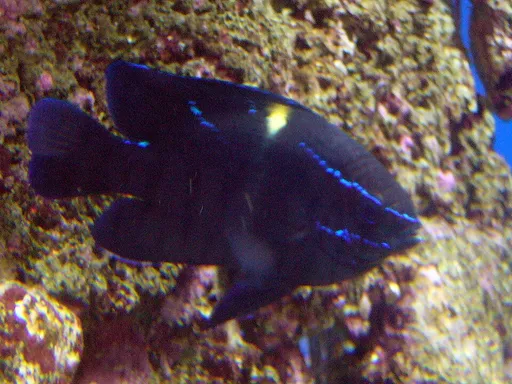 5.9 in (15 cm)55 gal (210 L)75–81°F (24–27°C)
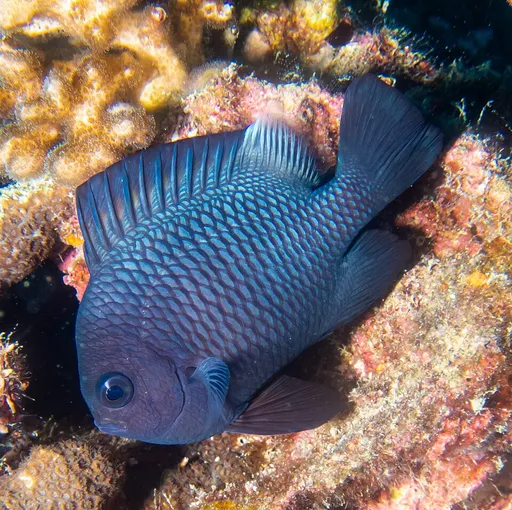 5.5 in (14 cm)55 gal (210 L)75–81°F (24–27°C)
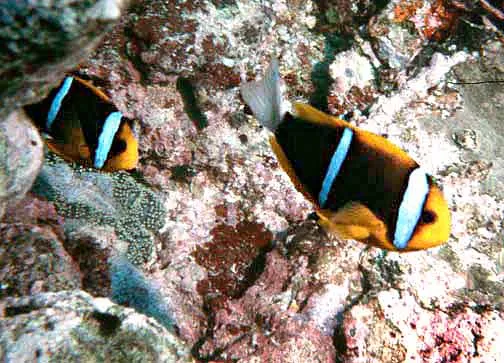 6.7 in (17 cm)55 gal (210 L)75–82°F (24–28°C)
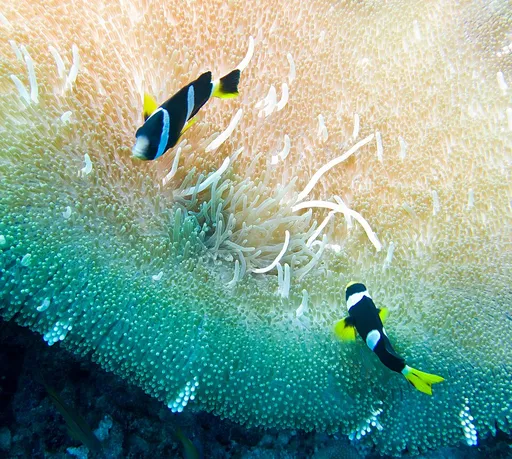 5.9 in (15 cm)30 gal (115 L)75–82°F (24–28°C)
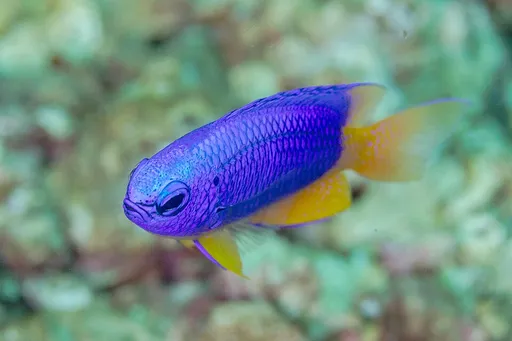 3.5 in (9 cm)29 gal (110 L)75–81°F (24–27°C)
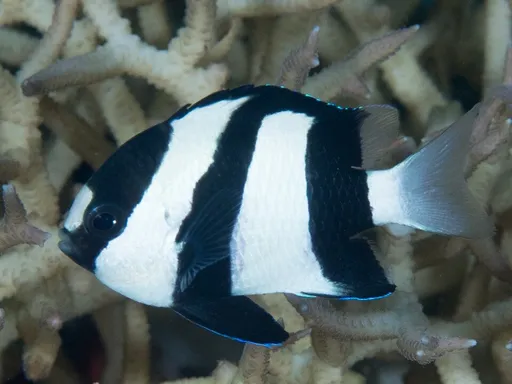 3.5 in (9 cm)29 gal (110 L)75–81°F (24–27°C)