Goldfish tank setup: tank size, filter and water
By Curtis W. · Updated Oct 20, 2026 · 7 min read

Goldfish grow much larger than most fish sold beside them in a pet store. An adult fantail reaches 7.1 inches (18 cm), a common goldfish 9.8 inches (25 cm) and a comet 11.8 inches (30 cm). With good care a goldfish lives 10 to 15 years.
A goldfish tank is sized for that adult fish, its waste and its need for oxygen. A young goldfish can look settled in a bowl for months while ammonia builds up in the water around it. That fish may live only a couple of years.
Why a goldfish bowl fails
A typical goldfish bowl holds about 2.6 gallons (10 liters). One fantail lists 20 gallons (75 liters), and one common goldfish lists 50 gallons (190 liters). RSPCA Australia calls traditional bowls too small for goldfish and says to avoid them. Bowl water goes bad long before the fish runs out of room to swim.
Fish give off most of their ammonia through the gills, and the more a fish eats, the more ammonia it makes. Goldfish are heavy eaters and make a lot of it. Ammonia damages the gills at low levels and kills fish at higher ones.
A filtered tank has bacteria that break ammonia down, and its larger volume dilutes what is left. A bowl has little water and usually no filter.
Oxygen enters water at the surface, and moving water takes it in faster. That is why a long, low tank suits goldfish better than a tall one of the same volume. A bowl has a small surface and nothing to stir it, and a goldfish gulping at the top may be short of oxygen.
A goldfish kept in a bowl often stays small, and that is the root of the idea that goldfish grow to fit their tank. Poor water in a small tank is what stunts it. A stunted fish can end up with a bent spine. In clean water and a big enough tank, a goldfish keeps growing for years.
Small starter tanks fail the same way, only more slowly. A 10 gallon tank holds half the water one fantail lists, so buy the tank for the adult fish from the start. Length counts as well as volume, so pick a tank at least four times as long as the adult fish. That comes to 28 inches (72 cm) for a fantail and 39 inches (100 cm) for a common goldfish.
Fancies and single-tails
The common goldfish, the comet and the shubunkin are single-tails, with a long body and one tail fin. They are fast, hardy swimmers and the largest goldfish. The fantail, the oranda and the black moor are fancies, with a short, round body that slows them down. Fancies grow to 5.9 to 9.8 inches (15 to 25 cm), depending on the variety.
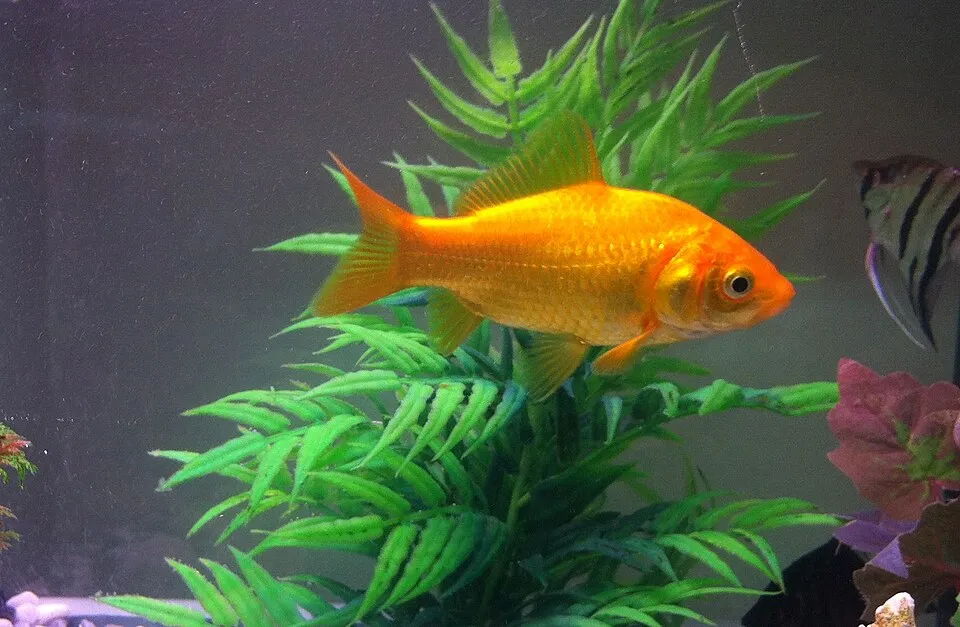
Common goldfish
Carassius auratus
Freshwater9.8 in (25 cm) · 50 gal (190 L)39–75°F (4–24°C)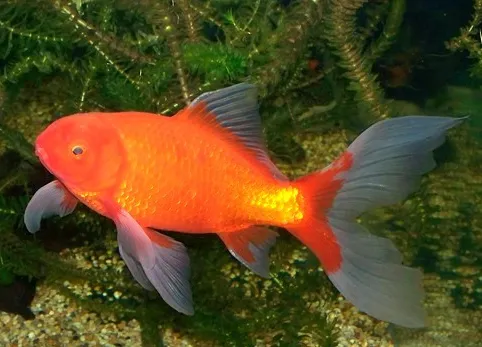
Comet
Carassius auratus
Freshwater11.8 in (30 cm) · 50 gal (190 L)39–75°F (4–24°C)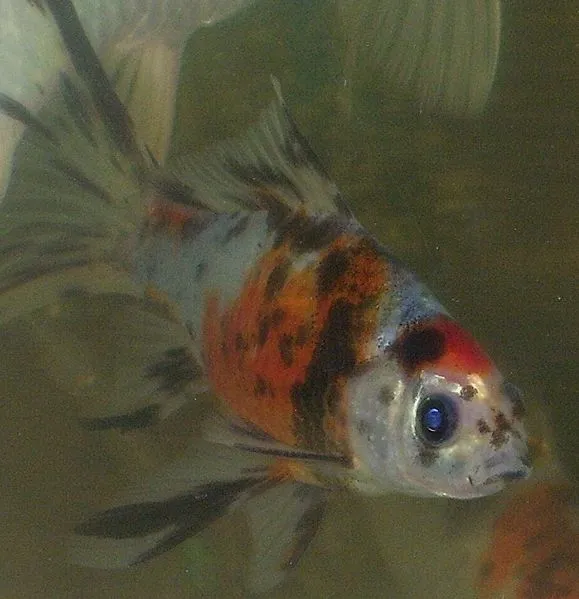
Shubunkin
Carassius auratus
Freshwater11.8 in (30 cm) · 50 gal (190 L)39–75°F (4–24°C)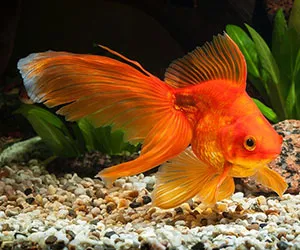
Fantail
Carassius auratus
Freshwater7.1 in (18 cm) · 20 gal (75 L)59–73°F (15–23°C)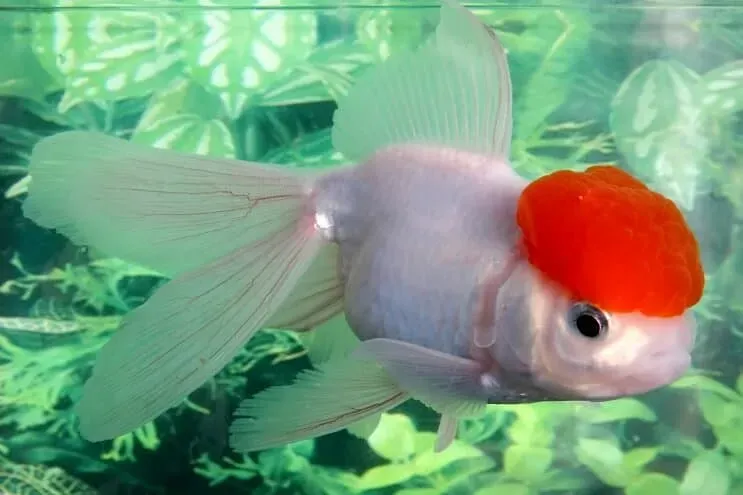
Oranda
Carassius auratus
Freshwater9.8 in (25 cm) · 30 gal (114 L)61–73°F (16–23°C)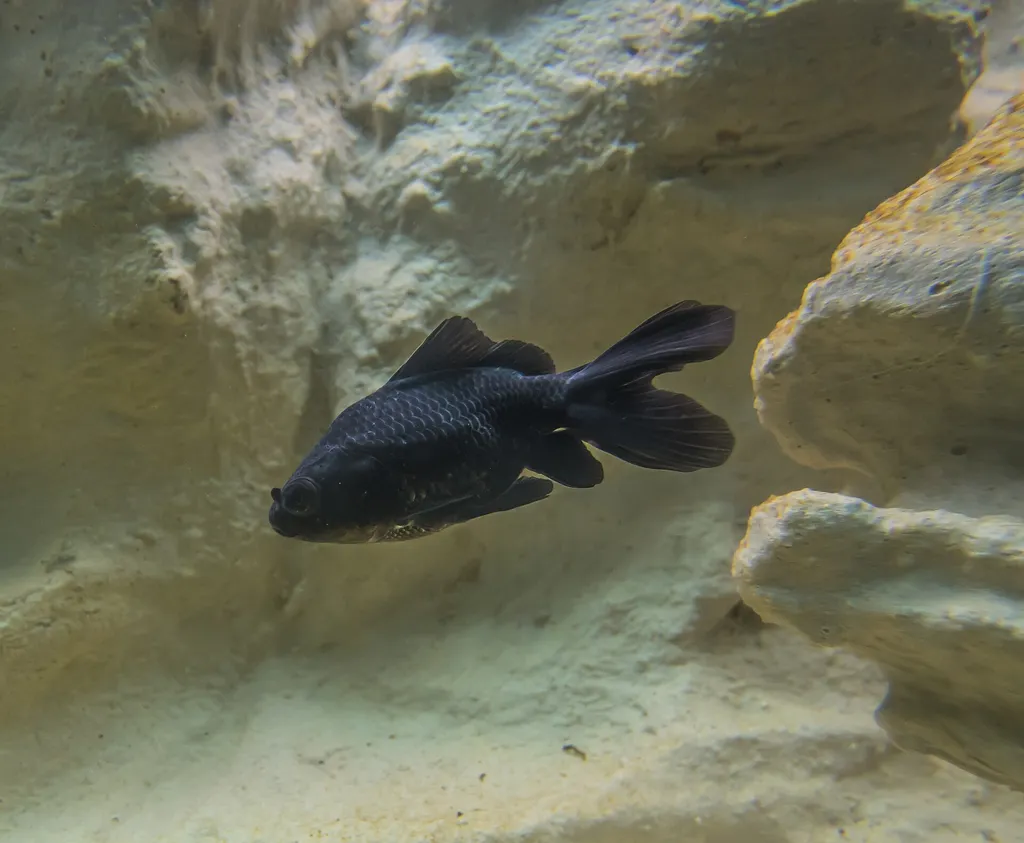
Black moor
Carassius auratus
Freshwater7.9 in (20 cm) · 25 gal (95 L)61–75°F (16–24°C)
Fancies are more delicate than single-tails and need more care. They also stay smaller and list less room, which makes them the better fit for an indoor tank. The ryukin, ranchu, lionhead and pearlscale are fancies too, as are the bubble eye and the celestial eye.

Goldfish →2 species
How many fancy goldfish fit in a tank
The fantail is the hardiest fancy and the usual first one, and it lists 20 gallons (75 liters) for a single fish. Each adult adds the waste of a 7.1 inch (18 cm) fish, which is why the count climbs slowly as tanks get bigger.
| Tank | Comfortable | Full |
|---|---|---|
| 20 gallons | One | One |
| 29 gallons | One | One |
| 40 gallons | Two | Two |
| 55 gallons | Three | Three |
| 75 gallons | Four | Five |
The counts assume adult fish. A group of young fancies that looks sparse can already be at its limit. The calculator also cannot see your filter or how heavily you feed, so plan your tank from the Comfortable column.
Black moors, orandas and ryukins grow bigger than a fantail and list more room, which means fewer of them fit. Run a mixed group through the stocking calculator before you buy.
Single-tails need a pond or a very large tank
Each single-tail lists two and a half times a fantail's room for one fish, and comets and shubunkins grow longer than commons. Their counts climb more slowly still.
| Tank | Comfortable | Full |
|---|---|---|
| 55 gallons | One | One |
| 75 gallons | One | Two |
| 125 gallons | Three | Three |
Even the largest of those tanks holds only a small group, which makes a pond the better home for single-tails. They take 39 to 75°F (4 to 24°C) and can spend the winter outdoors in a pond deep enough not to freeze solid. Expect fry, since comets spawn readily in a pond each spring.
A pond needs more than 2.5 feet (76 cm) of depth in a winter like Indiana's, and more where winters run colder. Keep a hole open in the ice so gases from rotting leaves and waste can escape. Feed less once the water stays below 50°F (10°C), since a cold fish's metabolism slows.
A filter for heavy eaters and slow swimmers
Buy a filter rated to move at least five times the tank's volume an hour. A 20 gallon tank needs one rated for 100 gallons (380 liters) an hour. Leave it running day and night, because the bacteria living in it do the work on ammonia. Clean it when the flow slows, and rinse the media in old tank water, since the chlorine in tap water kills those bacteria.
Fancy goldfish struggle in a strong current. Choose a filter with an adjustable flow, or spread the outflow with a spray bar. Aim it so it ripples the surface, which lets more oxygen into the water.
Sponge filters and hang-on-back filters on a gentle setting both suit a fancy tank. A bubble eye also needs a sponge over the filter intake, since its eye sacs tear easily.
Weekly water changes
Filter bacteria turn ammonia into nitrite and then into nitrate, and nitrate keeps climbing until you change the water. Change a quarter to half of the water every week, and vacuum the gravel as you go. Test nitrate before each change, and change more often if it keeps rising. Live plants soak up some nitrate, but goldfish eat or uproot many of them.
Treat the new water with a dechlorinator and bring it close to the tank's temperature. Goldfish handle cool water well, but a swing of more than about 5°F (3°C) in a day can harm them.
Cycle a new tank before the goldfish go in, and the filter bacteria will be ready for their waste from the first day. Ammonia turns more toxic as pH and temperature rise, and even a small reading stresses the fish. Test KH as well, since a low reading warns that the pH can slide quickly. The filter bacteria start to struggle below pH 6.5.
- pH
- 7.0 to 8.4
- Ammonia
- up to 0.02 ppm
- Nitrite
- up to 0.02 ppm
- Nitrate
- up to 40 ppm
- Temperature
- 60 to 75°F (15.6 to 23.9°C)
- GH
- 6 to 20 dGH
- KH
- 4 to 14 dKH
- Phosphate
- up to 1 ppm
Goldfish and other unheated coldwater tanks. TankBud reads every water test against these targets when a tank uses this profile.
Keep the water cool
Goldfish do best at 68 to 72°F (20 to 22°C), and every variety tops out at 73 to 75°F (23 to 24°C). A goldfish in warm water speeds up, eats more, uses more oxygen and makes more waste. A goldfish at 77°F (25°C) has more than double the metabolic demand of one at 59°F (15°C). The warmer water also holds less oxygen, so a goldfish tank in a hot room needs an air stone or strong surface movement.
Whether you need a heater depends on the variety and on how cold your room gets. The goldfish page names the fancies that want one in a cool room. Goldfish are the best-known coldwater fish, and many other species live in an unheated tank.
Coldwater fish →191 species
Gravel, decor and delicate eyes
Goldfish sift the bottom for food, picking up stones and spitting them out. Use sand or small, round gravel that a goldfish can mouth without it getting stuck.
A black moor's telescope eyes see poorly, and a celestial's eyes point upward. A bubble eye carries a fluid sac under each eye that tears on anything sharp. Choose smooth stones and wood, and skip ornaments with rough edges or small holes a fish could get stuck in. Silk plants are safer than hard plastic ones around delicate eyes.
Feeding fancies without swim bladder trouble
Overfeeding is the most common problem in goldfish care. A goldfish has no stomach, so food passes through it quickly. Whatever it leaves uneaten rots in the tank. Feed once or twice a day, and only what the fish clear in about two minutes.
A pellet made for goldfish makes a good staple, with frozen foods and blanched vegetables now and then. Black moors and celestials are slow to find their food. Give them time, and drop a celestial's food directly above it.
Round fancies are prone to swim bladder trouble, where a fish floats, sinks or rolls over and cannot right itself. Their short bodies compress the swim bladder. Ryukins and pearlscales are among the most prone.
Sinking pellets are the usual advice, to stop a fancy gulping air at the surface. The Canadian Veterinary Medical Association calls that link weakly supported and points to dry food and constipation instead. Soaked sinking pellets, with a shelled pea now and then, cover both concerns.
Tank mates
Other goldfish make the best tank mates for a goldfish. Keep fancies with fancies and single-tails with single-tails, since commons and comets swim faster and get to the food first. Fantails and ryukins mix well with black moors. The slowest fancies, such as bubble eyes and celestials, do best with each other.
Any other fish has to be too big to fit in a goldfish's mouth, because goldfish eat whatever they can swallow. Keep new goldfish in a spare tank for a while before they join the group, to keep disease out of the main tank.
FAQ
Common questions
Do goldfish tanks need an air pump?
A goldfish tank needs one when its filter leaves the surface still. A filter outflow that ripples the surface lets oxygen in. An air stone adds more in a warm room, or when the fish gulp air at the top.
Can a goldfish live alone?
Goldfish are social and do best with at least one companion. A single fancy can still live alone in a well-kept tank. Plan the tank around a pair, since each extra goldfish needs a real step up in size.
Why is my fancy goldfish floating upside down?
Swim bladder trouble is the usual cause in a round fancy, and it often shows up after a meal. Skip food for a day or two, then go back to small meals of soaked pellets, with a pea for fiber. If it lasts, see a vet who treats fish, since an infection can cause it too.
Can fancy goldfish live in a pond?
Most fancies are better kept indoors, since they swim slowly and handle cold water poorly. The fantail is the hardiest fancy and can manage a sheltered pond through a mild winter.
What can I do with a goldfish that has outgrown its tank?
Ask the store about a return, or offer the fish to a local fish club or a keeper with a pond. Never release it into a lake or stream, where goldfish breed fast and crowd out native fish.
Sources
The claims the catalog does not hold come from these pages.
- Care Guide for Fancy Goldfish – Housing, Feeding, and More, Aquarium Co-Op
- How To Take Care of Goldfish, PetMD
- How should I care for my goldfish?, RSPCA Australia
- How to look after fancy goldfish, Ornamental Aquatic Trade Association (OATA)
- Goldfish can grow large and live very long lives – but not in small bowls, Science Norway
- Debunking goldfish myths, SPCA New Zealand
- Ammonia in Aquatic Systems (FA031), University of Florida IFAS Extension
- Dissolved Oxygen, University of Florida IFAS, Plant Management in Florida Waters
- Goldfish water parameters: pH, water hardness and more, The Goldfish Tank
- Why do our goldfish keep dying?, Practical Fishkeeping
- Goldfish with tropicals - right or wrong?, Practical Fishkeeping
- How do I keep telescope-eye goldfish?, Practical Fishkeeping
- Why does my goldfish swim upside down after feeding?, Practical Fishkeeping
- How to solve a problem like swimbladder disease, Practical Fishkeeping
- Swim Bladder Problems in Goldfish, Canadian Veterinary Medical Association
- November last call for winterizing garden ponds, Purdue University
- Fall and Winter Care of Watergardens, Iowa State University Extension and Outreach
- Goldfish (Carassius auratus), Minnesota Department of Natural Resources
- Woman spends $500 on surgery for pet goldfish that choked on pebble, CBS News
Keep a record of your own tank
TankBud tracks water tests, reminders and how full your tank reads, free for up to 4 tanks.
More guides
Tank setups
Shrimp tank setup: water, tank size and equipment
Cherry shrimp take dechlorinated tap water while crystal reds need soft RO water, and the rest of a shrimp tank follows from that choice.
By Curtis W. · Updated Oct 20, 2026 · 8 min read
Tank setups
Betta fish tank setup: tank size, heater and plants
A betta tank is built around the surface the fish breathes from, with steady heat, gentle flow, floating plants and a close lid.
By Curtis W. · Updated Oct 20, 2026 · 7 min read
Tank setups
Community tank: which fish go together, and how many
Plan a freshwater community tank from the water up, then choose peaceful fish by adult size, swim level and school size.
By Curtis W. · Updated Oct 20, 2026 · 8 min read


