Slate pencil urchin
Eucidaris tribuloides
Also known as Pencil Urchin, Mine Urchin, Club Urchin
SaltwaterInvertebrate
Care at a glance
- Temperature
- 75–81°F
- 24–27°C
- pH
- 8.1–8.4
- Adult size
- 5.1 in
- 13 cm
- Minimum tank
- 20 gal
- 75 L
- Temperament
- Peaceful
- Social behavior
- Solitary
- Swim level
- Bottom
- Difficulty
- Easy
- Breeding
- No record
- Rarity
- Common
- Reef safe
- Reef safe with caution
- Family
- Cidaridae
- Origin
- Western Atlantic and Caribbean, from North Carolina to Brazil, with a related population in the eastern Atlantic around Cape Verde and the Gulf of Guinea
Overview
This is a hardy, peaceful grazer that spends daylight tucked into a crevice and comes out after dark to work over the rockwork. Its diet leans on algae, especially coralline algae, but it is a genuine omnivore that also picks off sponges, small bivalves, and other invertebrates it runs across, so it earns reef safe with caution rather than a clean yes: a well-fed specimen in a large reef mostly leaves things alone, but a hungry one will graze down coralline algae and has been known to nip at soft corals. Offer dried seaweed and the occasional meaty food so it has less reason to go looking elsewhere. Drip acclimate it slowly over an hour or more, since urchins are unusually sensitive to sudden shifts in salinity or pH. Never pull it out of a hole by force, since the primary spines snap off easily and do not grow back quickly.
In the wild
Slate pencil urchins live throughout the western Atlantic and Caribbean, from North Carolina down to Brazil, with a separate population on the other side of the ocean around Cape Verde and the Gulf of Guinea. They wedge themselves under ledges and into reef crevices by day, anchoring with their thick primary spines, then come out at night to graze. In the aquarium it needs sturdy, well-secured rockwork with plenty of caves, since a determined urchin can topple loose rock as it moves, plus a mature system with an established growth of coralline and film algae for it to browse.
Good to know
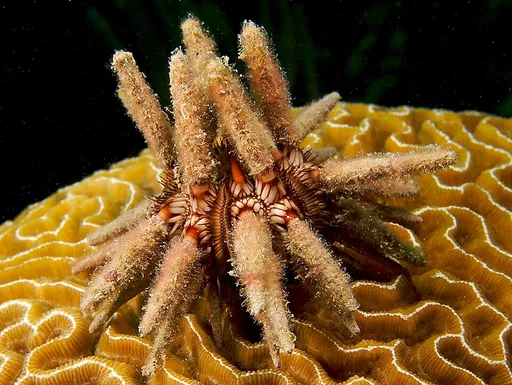
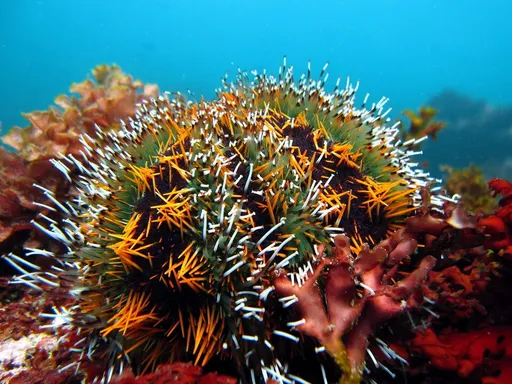
Eucidaris tribuloides is a cidaroid urchin in the family Cidaridae, one of the oldest urchin lineages alive today, and it looks the part: short, blunt, pencil-thick primary spines in place of the thin needle spines most other urchins carry. Adults reach roughly 13 cm across the spines, with a dark brown to reddish test that is usually hidden completely under the spine cover. Like other echinoids it grazes with a five-toothed jaw structure called Aristotle's lantern and moves on rows of tube feet, and its spawning tracks lunar and seasonal cycles, with Florida populations reproducing heaviest in late summer and early fall.
Did you know
Its stubby, blunt spines are a holdover from an ancient urchin lineage that has barely changed in millions of years, and they double as a grip: the urchin wedges them into a crevice like a chock and can be almost impossible to pry loose without breaking one off.
Common questions
What size tank does a Slate pencil urchin need?
A Slate pencil urchin needs at least 20 gal (75 L). It spends most of its time in the bottom.
What temperature and pH does a Slate pencil urchin need?
A Slate pencil urchin is comfortable at 75–81°F (24–27°C) with a pH of 8.1–8.4.
How big does a Slate pencil urchin get?
An adult Slate pencil urchin reaches about 5.1 in (13 cm).
Related species
- 3.9 in (10 cm)79 gal (300 L)72–81°F (22–27°C)
Sputnik urchin
Phyllacanthus imperialis
3.9 in (10 cm) · 79 gal (300 L)
 5.1 in (13 cm)20 gal (75 L)75–81°F (24–27°C)
Coco worm
Protula bispiralis
5.1 in (13 cm) · 20 gal (75 L)
 5.1 in (13 cm)53 gal (200 L)75–81°F (24–27°C)
Multicolor sea star
Linckia multifora
5.1 in (13 cm) · 53 gal (200 L)
 4.7 in (12 cm)53 gal (200 L)75–81°F (24–27°C)
Sand-sifting star
Archaster typicus
4.7 in (12 cm) · 53 gal (200 L)
 5.9 in (15 cm)20 gal (75 L)75–81°F (24–27°C)
Collector urchin
Tripneustes gratilla
5.9 in (15 cm) · 20 gal (75 L)
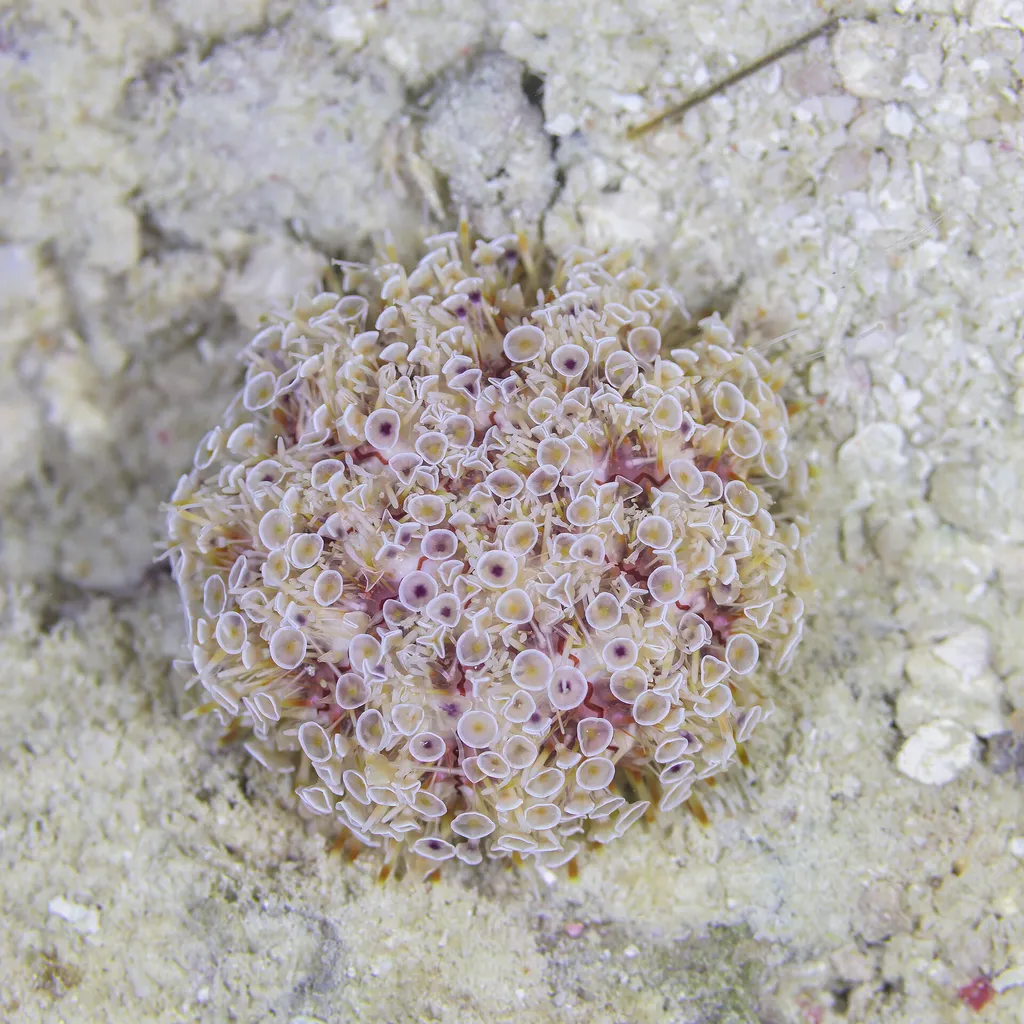 5.9 in (15 cm)100 gal (380 L)72–82°F (22–28°C)
Flower urchin
Toxopneustes pileolus
5.9 in (15 cm) · 100 gal (380 L)