Lawnmower blenny
Salarias fasciatus
Also known as Algae blenny, Sailfin blenny, Jeweled rockskipper, Sailfin algae blenny
SaltwaterFish
Care at a glance
- Temperature
- 72–79°F
- 22–26°C
- pH
- 8.1–8.4
- Adult size
- 5.1 in
- 13 cm
- Minimum tank
- 29 gal
- 110 L
- Temperament
- Mostly peaceful
- Social behavior
- Solitary
- Own kind
- One per tank
- Tankmates
- With caution
- Swim level
- Bottom
- Difficulty
- Easy
- Breeding
- Hard
- Rarity
- Very common
- Reef safe
- Reef safe with caution
- Family
- Blenniidae
- Origin
- Indo-Pacific reefs and lagoons from the Red Sea and East Africa to the western Pacific
Overview
Keep one per tank, since lawnmower blennies are solitary and squabble with their own kind and with other algae-grazing blennies unless the tank is very large. They are mostly peaceful toward unrelated fish and spend their time perched on the bottom and hopping from rock to rock grazing. The reef-safe picture needs a caveat: they are usually safe with corals, but a hungry blenny in a tank without enough algae has been reported to nip clam mantles and pick at SPS and fleshy coral polyps, so keep them well fed. Hold stable marine water at a pH of 8.1 to 8.4 and 22 to 26 C. Their main food is algae and biofilm, supplemented with dried marine and blue-green algae (nori, spirulina) plus the occasional meaty food, and a tank with too little natural algae will not sustain one.
In the wild
Lawnmower blennies live on shallow reef flats, rubble zones, and lagoon bottoms across the Indo-Pacific, from the Red Sea and East Africa to the western Pacific, where they perch on rock and graze film algae off hard surfaces. They are bottom-oriented perching fish, not open-water swimmers, so they want a mature tank with lots of live rock and a good growth of algae to work over rather than a lot of swimming length. Keep them in stable marine water at a pH of 8.1 to 8.4 and a temperature of 22 to 26 C. A well-established system with real algae growth is close to a requirement, since a bare, spotless tank will slowly starve them.
Good to know
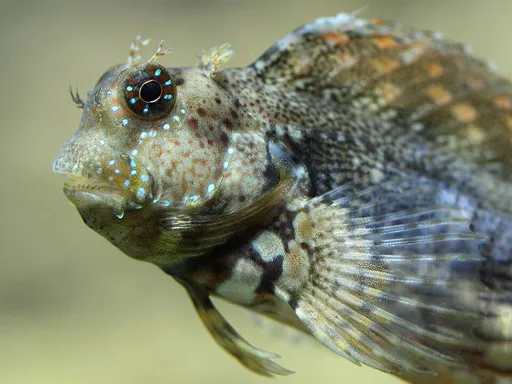
This is a combtooth blenny in the family Blenniidae, reaching about 13 cm, with a blunt-nosed frog-like face, feathery cirri over the eyes, and a mottled brown pattern that shifts to match the rock. It scrapes algae and detritus with rows of fine comb-like teeth, which is where the family name comes from. It has been bred in captivity only rarely, so nearly all fish in the trade are wild-caught.
Did you know
It earns the name lawnmower by mowing film algae off rock all day, one patch at a time, and it is one of the few marine fish people add specifically as a cleanup crew for nuisance algae. The catch is that a really clean tank starves it, so the fish that is supposed to fix an algae problem needs an algae problem to eat.
Common questions
What size tank does a Lawnmower blenny need?
A Lawnmower blenny needs at least 29 gal (110 L). It spends most of its time in the bottom.
What temperature and pH does a Lawnmower blenny need?
A Lawnmower blenny is comfortable at 72–79°F (22–26°C) with a pH of 8.1–8.4.
How big does a Lawnmower blenny get?
An adult Lawnmower blenny reaches about 5.1 in (13 cm).
Related species
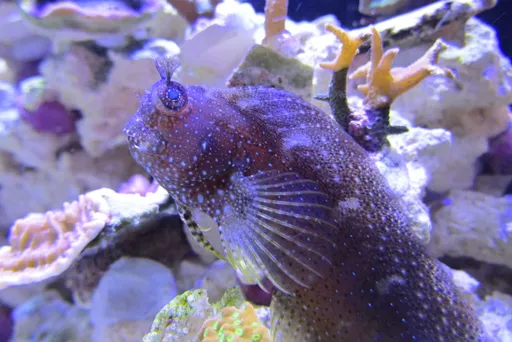 5.5 in (14 cm)30 gal (114 L)72–79°F (22–26°C)
Starry blenny
Salarias ramosus
5.5 in (14 cm) · 30 gal (114 L)
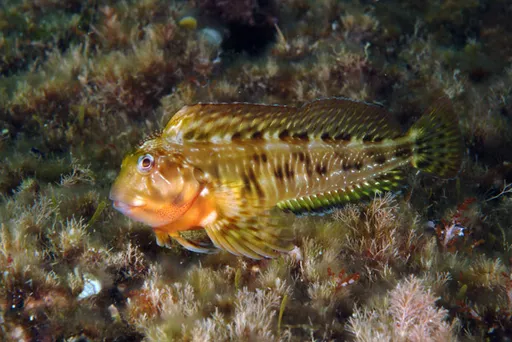 4.7 in (12 cm)30 gal (114 L)72–79°F (22–26°C)
Molly Miller blenny
Scartella cristata
4.7 in (12 cm) · 30 gal (114 L)
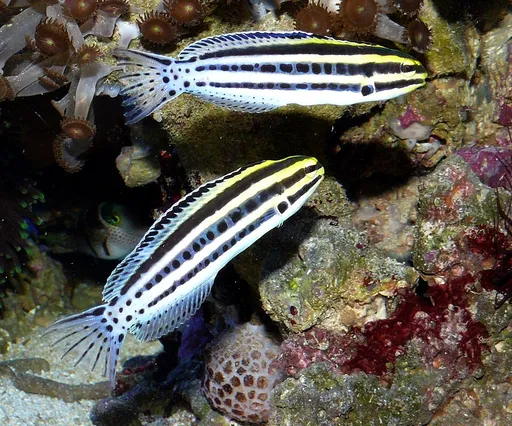 4.3 in (11 cm)29 gal (110 L)73–79°F (23–26°C)
Striped poison-fang blenny
Meiacanthus grammistes
4.3 in (11 cm) · 29 gal (110 L)
 3.9 in (10 cm)29 gal (110 L)72–79°F (22–26°C)
Bicolor blenny
Ecsenius bicolor
3.9 in (10 cm) · 29 gal (110 L)
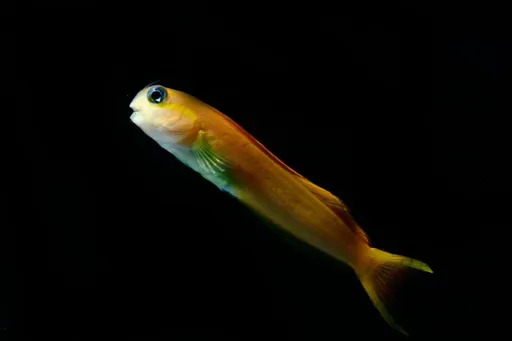 5.1 in (13 cm)29 gal (110 L)72–79°F (22–26°C)
Midas blenny
Ecsenius midas
5.1 in (13 cm) · 29 gal (110 L)
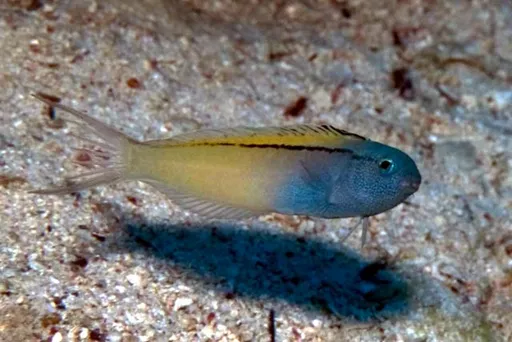 3.5 in (9 cm)20 gal (75 L)75–81°F (24–27°C)
Blackline fang blenny
Meiacanthus nigrolineatus
3.5 in (9 cm) · 20 gal (75 L)