Green spotted puffer
Dichotomyctere nigroviridis
BrackishSaltwaterFish
Care at a glance
- Temperature
- 75–82°F
- 24–28°C
- pH
- 7.5–8.5
- Adult size
- 5.9 in
- 15 cm
- Minimum tank
- 32 gal
- 120 L
- Temperament
- Aggressive
- Social behavior
- Solitary
- Tankmates
- With caution
- Swim level
- Middle
- Difficulty
- Difficult
- Breeding
- No record
- Rarity
- Very rare
- Reef safe
- Not reef safe
- Family
- Tetraodontidae
- Origin
- South Asia, South East Asia
Overview
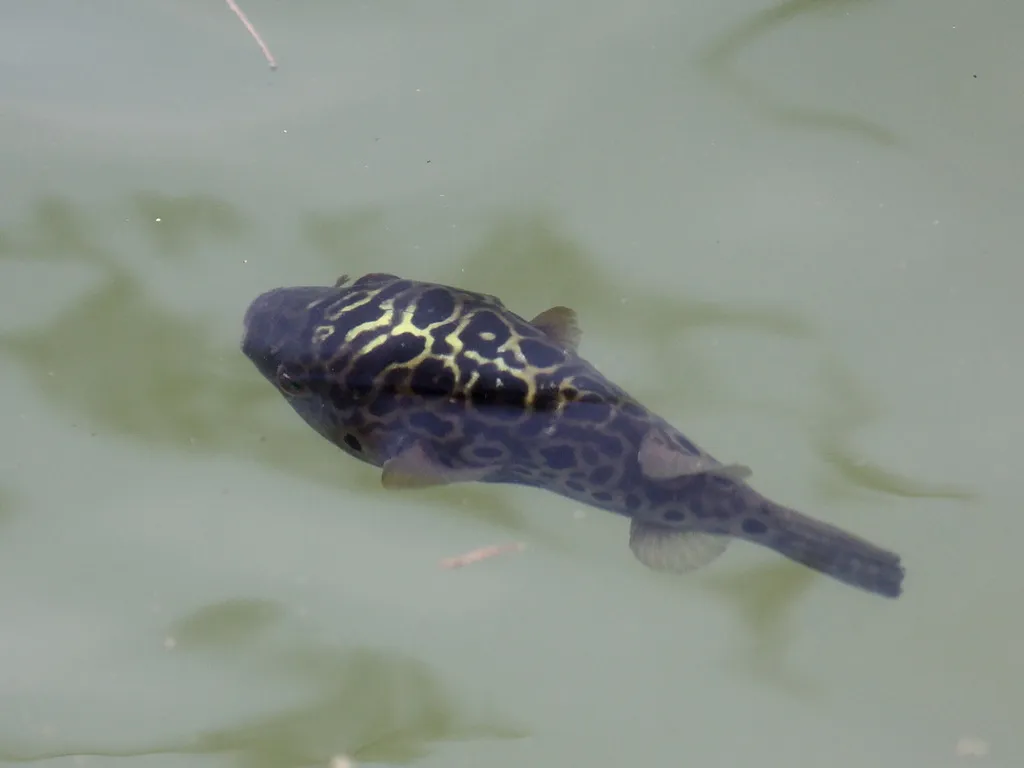
The green spotted puffer is an aggressive, territorial fish that is best kept alone, despite its harmless looks. It will nip and attack tankmates, so treat it as a solitary species-tank fish rather than a community member. Young fish live in fresh to lightly brackish water, but they must be moved to strongly brackish and eventually near-marine water as they mature, or they slowly decline. Its teeth grow throughout life, so feed hard-shelled foods such as snails, clams, mussels, and shell-on shrimp. Give it clean, salty water and swimming space. A single adult needs a tank of around 120 liters or larger.
In the wild
The green spotted puffer is found across South and Southeast Asia in coastal rivers, estuaries, and mangroves, where the water shifts from fresh to fully marine with the tides. It is euryhaline, and its needs change with age. Juveniles start in fresh or slightly brackish water, but adults are healthiest in high-end brackish to marine conditions. Raise the salt gradually as the fish grows, keep the pH high between 7.5 and 8.5, and hold the temperature from 24 to 28 C. Use hard, alkaline water, a mature filter, and open swimming space with some rock or wood.
Good to know
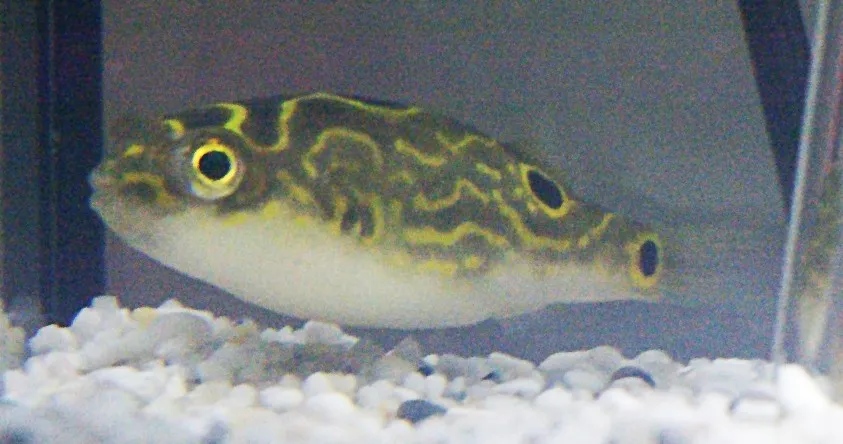
The green spotted puffer belongs to the family Tetraodontidae and was long known as Tetraodon nigroviridis. Adults reach about 15 cm, with a bright green back covered in dark spots and a clean white belly. Like all true puffers it has four fused, beak-like teeth and can swallow water to inflate into a ball. Its skin and organs carry tetrodotoxin, a powerful natural poison. Aquarium breeding is essentially undocumented, and the fish in shops are wild caught from brackish coastal waters.
Did you know
The green spotted puffer has one of the most compact genomes of any backboned animal, packing a similar set of genes into far less DNA than most vertebrates. Because of that, scientists sequenced it as a reference to help make sense of the much larger human genome.
Common questions
What size tank does a Green spotted puffer need?
A Green spotted puffer needs at least 32 gal (120 L). It spends most of its time in the middle.
What temperature and pH does a Green spotted puffer need?
A Green spotted puffer is comfortable at 75–82°F (24–28°C) with a pH of 7.5–8.5.
How big does a Green spotted puffer get?
An adult Green spotted puffer reaches about 5.9 in (15 cm).
Related species
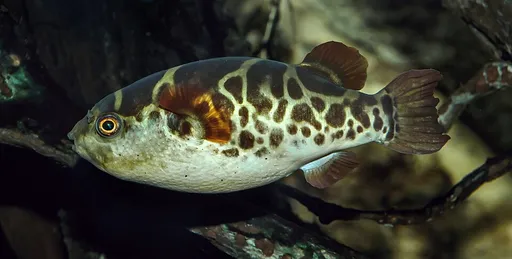 6.7 in (17 cm)34 gal (130 L)75–82°F (24–28°C)
Ceylon puffer
Dichotomyctere fluviatilis
6.7 in (17 cm) · 34 gal (130 L)
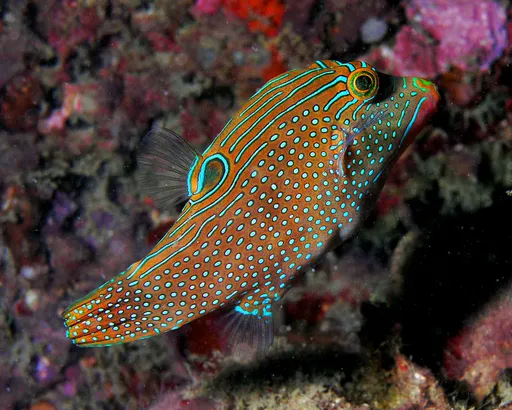 4.7 in (12 cm)50 gal (189 L)75–81°F (24–27°C)
Blue-spotted toby
Canthigaster solandri
4.7 in (12 cm) · 50 gal (189 L)
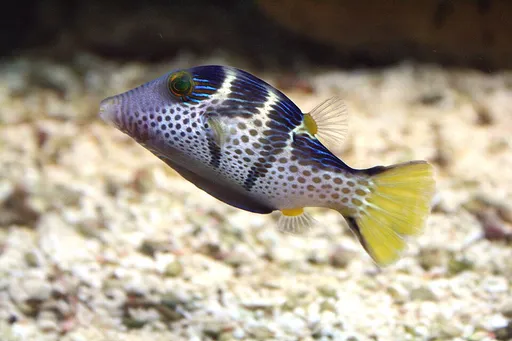 4.3 in (11 cm)30 gal (114 L)75–81°F (24–27°C)
Valentini puffer
Canthigaster valentini
4.3 in (11 cm) · 30 gal (114 L)
 3.1 in (8 cm)20 gal (75 L)72–79°F (22–26°C)
Figure eight puffer
Tetraodon biocellatus
3.1 in (8 cm) · 20 gal (75 L)
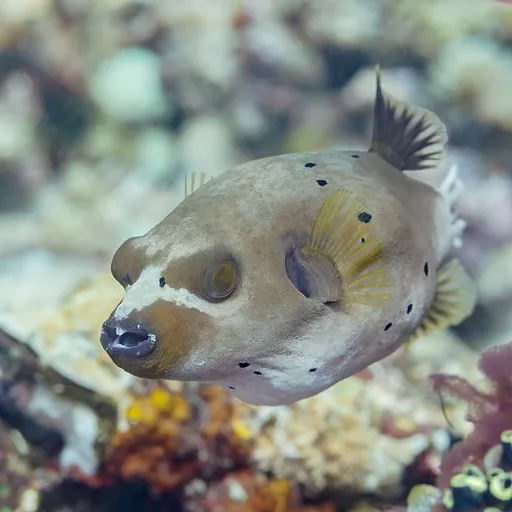 13 in (33 cm)151 gal (570 L)75–81°F (24–27°C)
Dogface puffer
Arothron nigropunctatus
13 in (33 cm) · 151 gal (570 L)
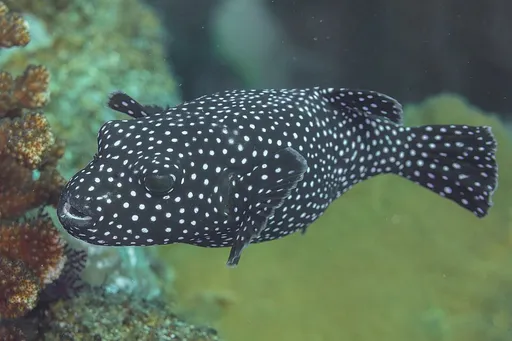 19.7 in (50 cm)180 gal (680 L)75–81°F (24–27°C)
Guineafowl puffer
Arothron meleagris
19.7 in (50 cm) · 180 gal (680 L)