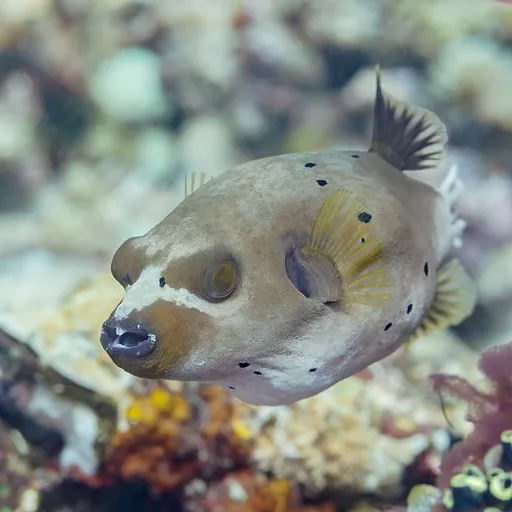
Dogface puffer
Arothron nigropunctatus
Also known as Blackspotted Puffer, Black-Spotted Toadfish, Spotted Toado
SaltwaterFish
Care at a glance
- Temperature
- 75–81°F
- 24–27°C
- pH
- 8.1–8.4
- Adult size
- 13 in
- 33 cm
- Minimum tank
- 151 gal
- 570 L
- Temperament
- Mostly peaceful
- Social behavior
- Solitary
- Tankmates
- With caution
- Swim level
- Middle
- Difficulty
- Medium
- Breeding
- No record
- Rarity
- Common
- Reef safe
- Not reef safe
- Family
- Tetraodontidae
- Origin
- Indo-Pacific reefs, from East Africa to Micronesia and Samoa, north to southern Japan
Overview
Mostly peaceful and known for a curious, almost dog-like personality that will often follow its keeper along the glass, but it eats snails, hermit crabs, small shrimp, and coral polyps on sight, so it is not reef safe and belongs in a fish-only or FOWLR tank. Keep it singly unless the aquarium is very large, since it will spar with other puffers. Its beak never stops growing, so feed hard-shelled foods such as snails, clams, crab legs, and shell-on shrimp regularly, not just soft frozen fare, or the beak can overgrow and keep it from eating normally. Use a container rather than a net to move it, since puffers can gulp air when netted and struggle to release it again.
In the wild
Found on Indo-Pacific reefs from East Africa to Samoa and Micronesia, usually on coastal and outer reef slopes with rich invertebrate growth down to about 60 m. It moves slowly and deliberately around the reef, picking at sponges, tunicates, and coral rather than chasing prey, and does best with plenty of live rock to explore plus open sand or gravel for cruising. Give it at least 570 litres (150 US gal), since despite its unhurried pace it needs real swimming room as an adult.
Good to know
Like every member of the puffer family Tetraodontidae, its jaw teeth are fused into four broad plates that form a permanent, parrot-like beak (the family name literally means four-toothed), and that beak keeps growing for the fish's whole life. It also carries tetrodotoxin, concentrated mainly in the liver, skin, and gonads, one of the most potent toxins known and with no antidote if eaten. The toxin is a last-resort defense against predators, not something the fish releases into the water the way a boxfish does.
Did you know
Despite the name, its black-spotted pattern is only part of the picture: individuals turn up in grey, half-yellow, solid yellow, and blue-tinted color phases that all belong to the same species and are not linked to sex, so two dogface puffers from the same reef can look almost nothing alike.
Common questions
What size tank does a Dogface puffer need?
A Dogface puffer needs at least 151 gal (570 L). It spends most of its time in the middle.
What temperature and pH does a Dogface puffer need?
A Dogface puffer is comfortable at 75–81°F (24–27°C) with a pH of 8.1–8.4.
How big does a Dogface puffer get?
An adult Dogface puffer reaches about 13 in (33 cm).
Related species
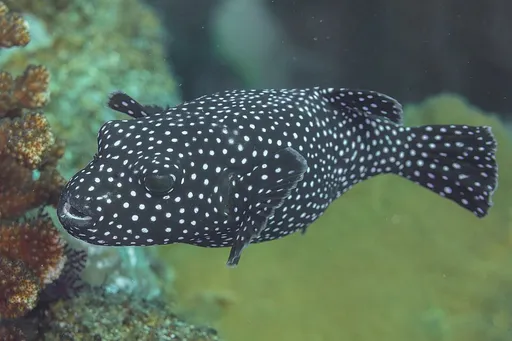 19.7 in (50 cm)180 gal (680 L)75–81°F (24–27°C)
Guineafowl puffer
Arothron meleagris
19.7 in (50 cm) · 180 gal (680 L)
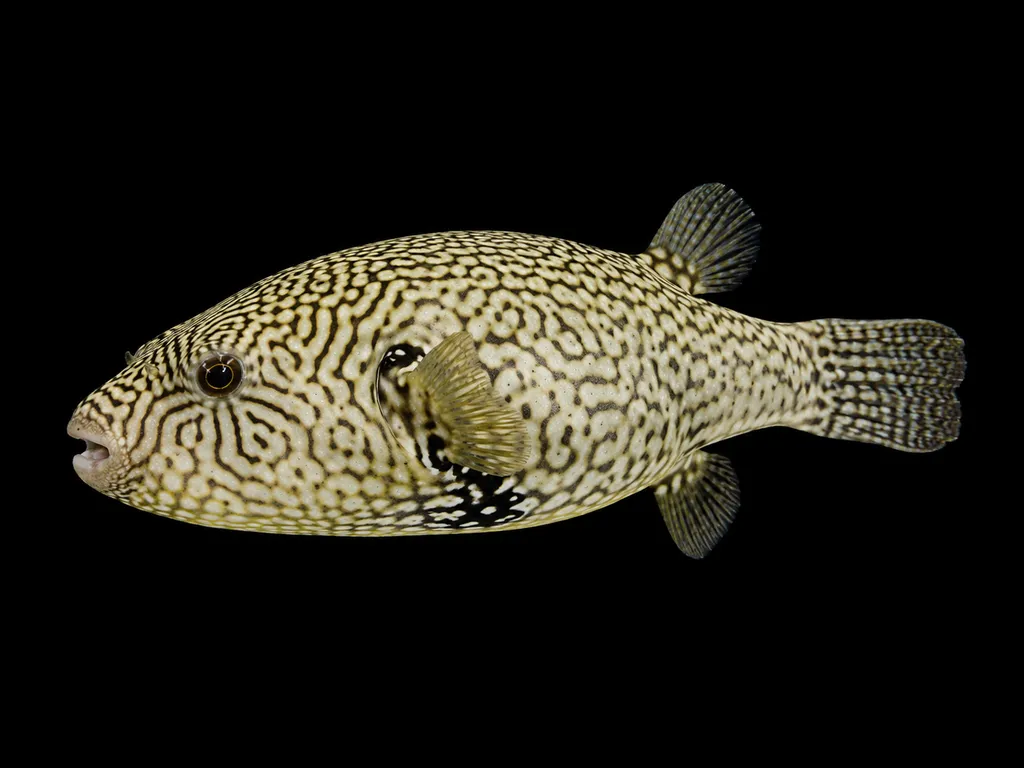 23.6 in (60 cm)238 gal (900 L)75–81°F (24–27°C)
Map puffer
Arothron mappa
23.6 in (60 cm) · 238 gal (900 L)
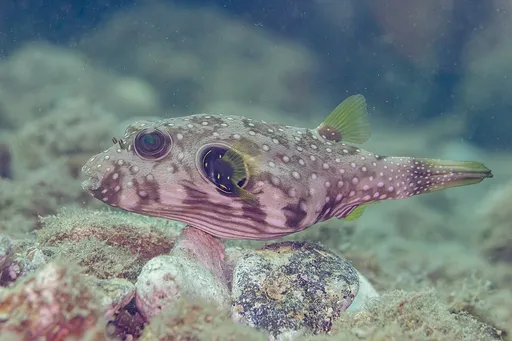 19.7 in (50 cm)180 gal (680 L)75–81°F (24–27°C)
Stars-and-stripes puffer
Arothron hispidus
19.7 in (50 cm) · 180 gal (680 L)
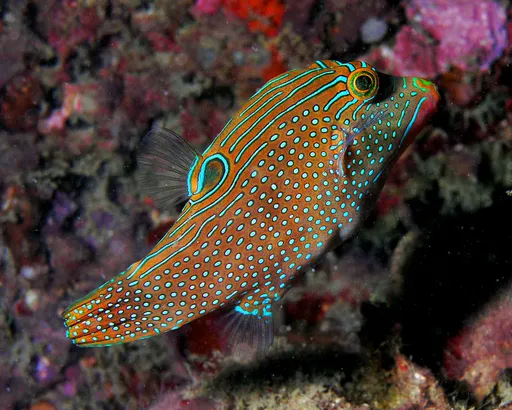 4.7 in (12 cm)50 gal (189 L)75–81°F (24–27°C)
Blue-spotted toby
Canthigaster solandri
4.7 in (12 cm) · 50 gal (189 L)
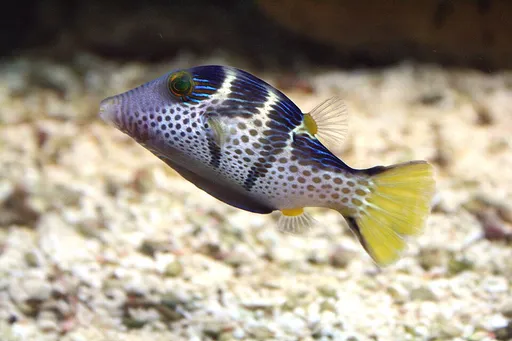 4.3 in (11 cm)30 gal (114 L)75–81°F (24–27°C)
Valentini puffer
Canthigaster valentini
4.3 in (11 cm) · 30 gal (114 L)
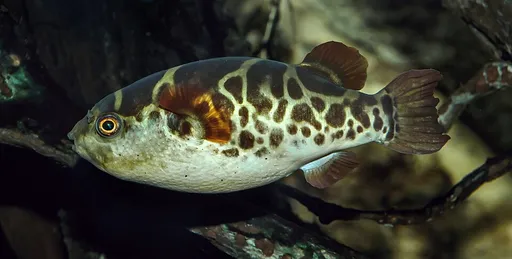 6.7 in (17 cm)34 gal (130 L)75–82°F (24–28°C)
Ceylon puffer
Dichotomyctere fluviatilis
6.7 in (17 cm) · 34 gal (130 L)