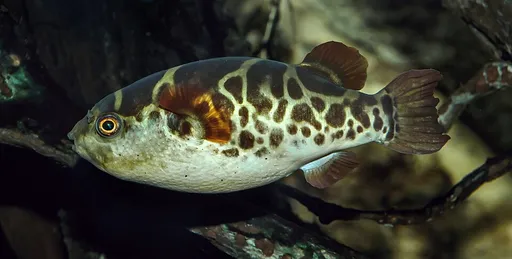
Ceylon puffer
Dichotomyctere fluviatilis
Also known as Topaz puffer, Ceylon green puffer, Tetraodon fluviatilis
BrackishSaltwaterFish
Care at a glance
- Temperature
- 75–82°F
- 24–28°C
- pH
- 7.5–8.5
- Adult size
- 6.7 in
- 17 cm
- Minimum tank
- 34 gal
- 130 L
- Temperament
- Aggressive
- Social behavior
- Solitary
- Tankmates
- With caution
- Swim level
- Middle
- Difficulty
- Medium
- Breeding
- Hard
- Rarity
- Common
- Family
- Tetraodontidae
- Origin
- Found from India and Sri Lanka through parts of Southeast Asia, in slow fresh and brackish coastal rivers, estuaries and lagoons.
Overview
Keep one puffer in a tank of about 130 litres or more with brackish water, a pH of 7.5 to 8.5 and 24 to 28 C. It is aggressive and a fin nipper, so it is safest kept alone or only with cautious selection of robust brackish tankmates. Feed a snail heavy diet of ramshorn, pond and other hard shelled snails to keep the teeth worn down, along with frozen shrimp, mussel and bloodworm. Kept long term in pure fresh water it tends to decline, so brackish conditions are strongly preferred.
In the wild
The Ceylon puffer lives in slow moving fresh and brackish coastal waters, from river mouths to estuaries and lagoons. Young fish are often found in fresher water, but adults do best and live longest in brackish conditions. Give it a planted tank of 130 litres or more with a specific gravity around 1.005 to 1.015, gentle flow and some shade. It is a messy, greedy feeder, so strong filtration is important.
Good to know
Dichotomyctere fluviatilis was long known as Tetraodon fluviatilis before being moved to the genus Dichotomyctere. Like all puffers it lacks scales, can inflate with water to deter predators, and carries the powerful toxin tetrodotoxin in its body. Its four fused teeth form a beak that grows continuously and must be worn down on hard shelled prey.
Did you know
If it cannot crunch enough hard shelled snails, its beak like teeth overgrow and eventually stop it from eating, so a steady snail supply is part of its basic care.
Common questions
What size tank does a Ceylon puffer need?
A Ceylon puffer needs at least 34 gal (130 L). It spends most of its time in the middle.
What temperature and pH does a Ceylon puffer need?
A Ceylon puffer is comfortable at 75–82°F (24–28°C) with a pH of 7.5–8.5.
How big does a Ceylon puffer get?
An adult Ceylon puffer reaches about 6.7 in (17 cm).
Related species
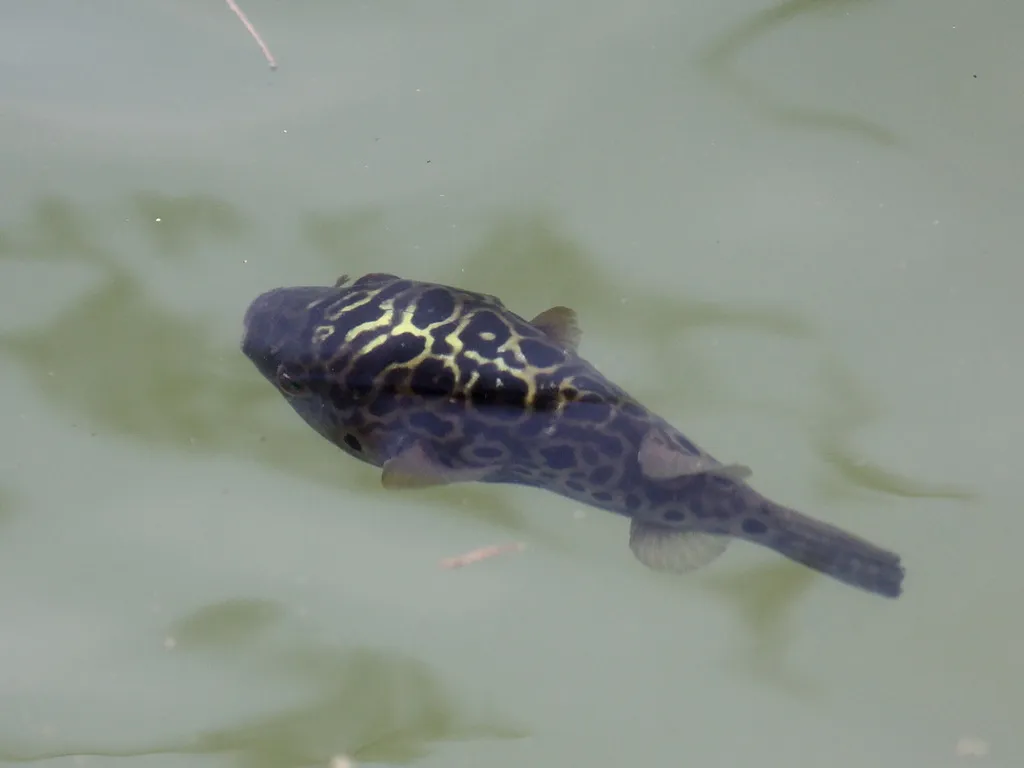 5.9 in (15 cm)32 gal (120 L)75–82°F (24–28°C)
Green spotted puffer
Dichotomyctere nigroviridis
5.9 in (15 cm) · 32 gal (120 L)
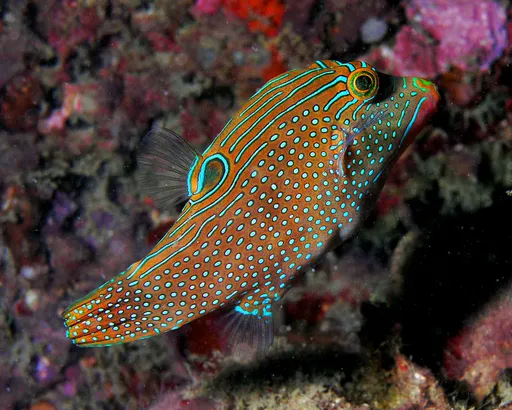 4.7 in (12 cm)50 gal (189 L)75–81°F (24–27°C)
Blue-spotted toby
Canthigaster solandri
4.7 in (12 cm) · 50 gal (189 L)
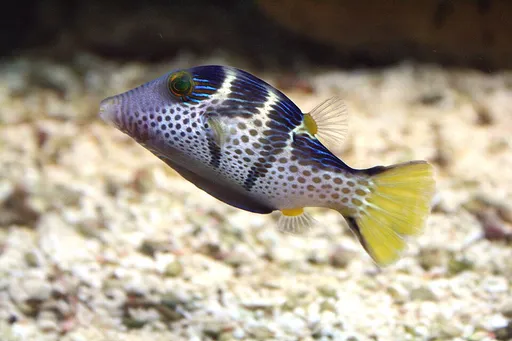 4.3 in (11 cm)30 gal (114 L)75–81°F (24–27°C)
Valentini puffer
Canthigaster valentini
4.3 in (11 cm) · 30 gal (114 L)
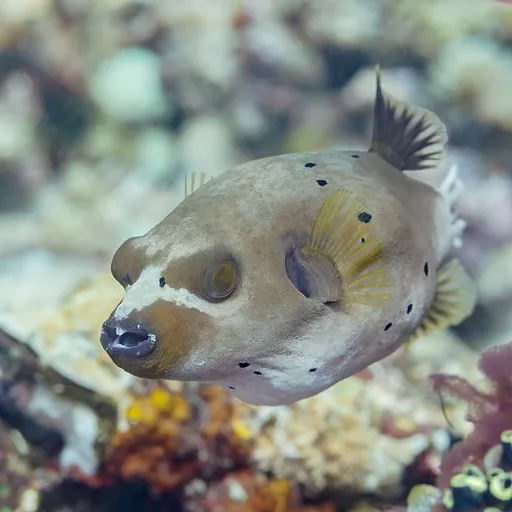 13 in (33 cm)151 gal (570 L)75–81°F (24–27°C)
Dogface puffer
Arothron nigropunctatus
13 in (33 cm) · 151 gal (570 L)
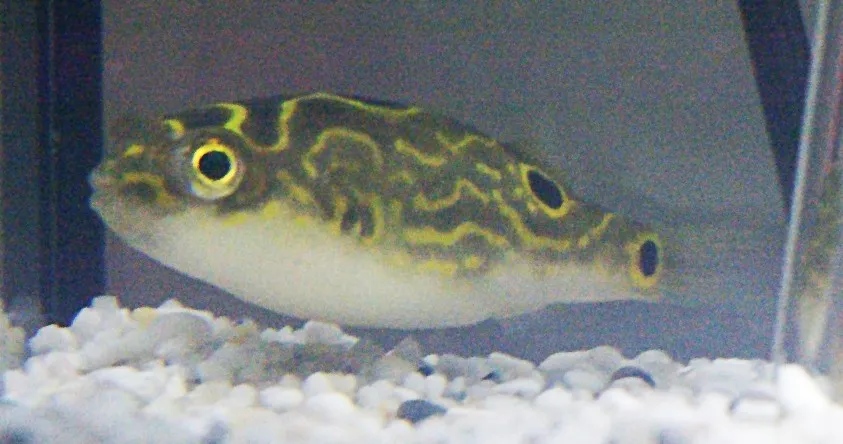 3.1 in (8 cm)20 gal (75 L)72–79°F (22–26°C)
Figure eight puffer
Tetraodon biocellatus
3.1 in (8 cm) · 20 gal (75 L)
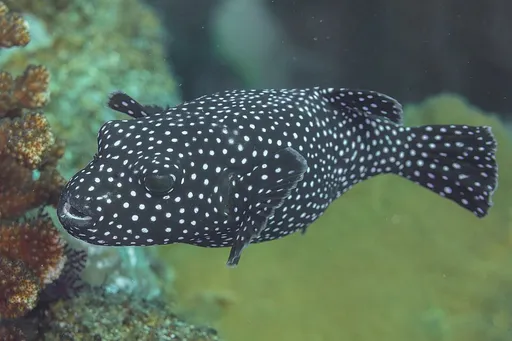 19.7 in (50 cm)180 gal (680 L)75–81°F (24–27°C)
Guineafowl puffer
Arothron meleagris
19.7 in (50 cm) · 180 gal (680 L)