Arc-eye hawkfish
Paracirrhites arcatus
Also known as Ringeye Hawkfish, Horseshoe Hawkfish, Whiteline Hawkfish
SaltwaterFish
Care at a glance
- Temperature
- 72–79°F
- 22–26°C
- pH
- 8.1–8.4
- Adult size
- 7.9 in
- 20 cm
- Minimum tank
- 40 gal
- 150 L
- Temperament
- Aggressive
- Social behavior
- Solitary
- Own kind
- One per tank
- Tankmates
- With caution
- Swim level
- Bottom
- Difficulty
- Easy
- Breeding
- No record
- Rarity
- Common
- Reef safe
- Reef safe with caution
- Family
- Cirrhitidae
- Origin
- Indo-Pacific reefs, from East Africa to Hawaii, the Line Islands, and Mangareva, north to southern Japan
Overview
One of the more pugnacious hawkfish in the trade: it stakes out a perch and defends it hard, and it is well known for harassing or outright killing smaller or more timid fish added after it, so it should always go into the tank last. It is reef safe with caution, since it leaves corals alone but will eat small ornamental shrimp, tiny crabs, and any fish small enough to fit in its mouth. Feed a varied carnivore diet of mysis, krill, and chopped seafood; it feeds eagerly and rarely needs coaxing.
In the wild
Found across the Indo-Pacific from East Africa to Hawaii and the Line and Mangareva islands, usually perched in the branches of small stony corals like Pocillopora on shallow reef flats and lagoons, mostly less than 20 m deep. It sits motionless on a favored coral head for hours, watching the water around it, then darts out to grab passing prey before returning to the same perch. Give it plenty of live rock with coral rubble or branching coral to claim as a lookout, plus a tight-fitting lid, since hawkfish are proven jumpers. A tank of at least 150 litres (40 US gal) suits a single fish long term.
Good to know
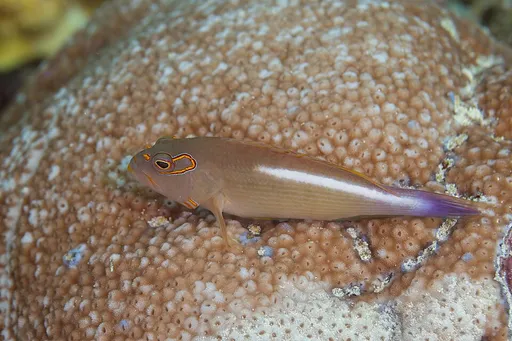
Like other hawkfish it has no swim bladder, so instead of hovering in open water it rests directly on rock or coral and moves in short hops between perches. Thickened, stiffened rays on the lower part of each pectoral fin act almost like little legs, propping it up while it watches for food. It is named for the broken orange-red ring that circles each eye over a mottled reddish-brown body, and reaches about 20 cm, making it one of the larger hawkfish commonly kept.
Did you know
Like most hawkfish it is a protogynous hermaphrodite: every fish starts out female, and the largest, most dominant individual in a group switches to male, which is how a mated pair can form from two fish that started out the same sex.
Common questions
What size tank does an Arc-eye hawkfish need?
An Arc-eye hawkfish needs at least 40 gal (150 L). It spends most of its time in the bottom.
What temperature and pH does an Arc-eye hawkfish need?
An Arc-eye hawkfish is comfortable at 72–79°F (22–26°C) with a pH of 8.1–8.4.
How big does an Arc-eye hawkfish get?
An adult Arc-eye hawkfish reaches about 7.9 in (20 cm).
Related species
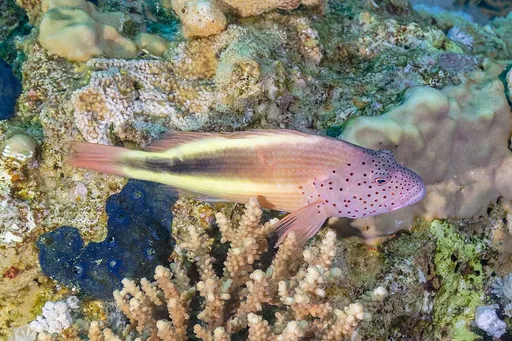 8.7 in (22 cm)70 gal (265 L)73–81°F (23–27°C)
Freckled hawkfish
Paracirrhites forsteri
8.7 in (22 cm) · 70 gal (265 L)
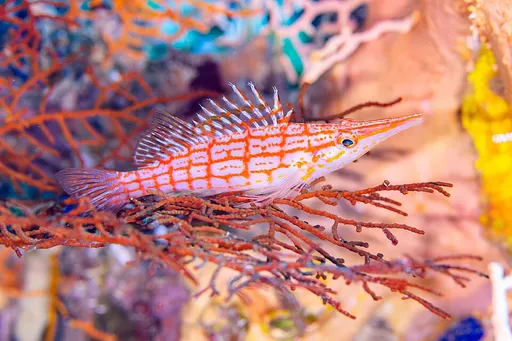 5.1 in (13 cm)29 gal (110 L)72–79°F (22–26°C)
Longnose hawkfish
Oxycirrhites typus
5.1 in (13 cm) · 29 gal (110 L)
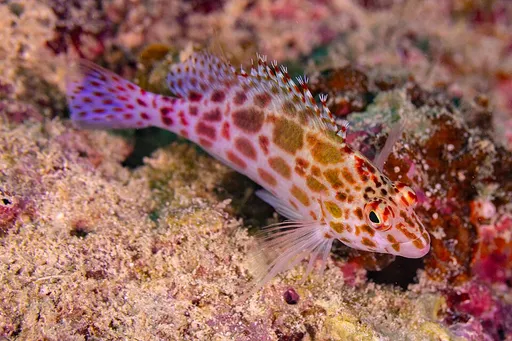 3.9 in (10 cm)29 gal (110 L)72–79°F (22–26°C)
Pixy hawkfish
Cirrhitichthys oxycephalus
3.9 in (10 cm) · 29 gal (110 L)
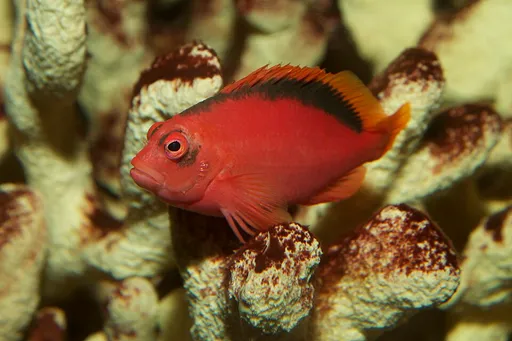 3.5 in (9 cm)29 gal (110 L)72–79°F (22–26°C)
Flame hawkfish
Neocirrhites armatus
3.5 in (9 cm) · 29 gal (110 L)
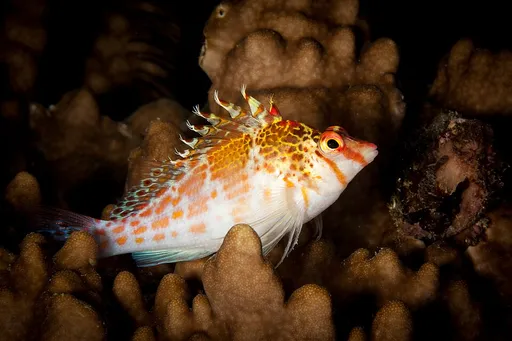 2.8 in (7 cm)29 gal (110 L)72–79°F (22–26°C)
Falco hawkfish
Cirrhitichthys falco
2.8 in (7 cm) · 29 gal (110 L)
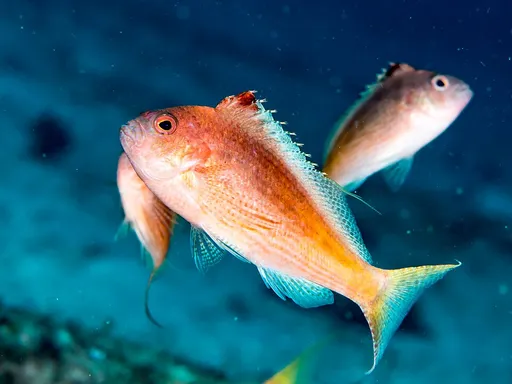 5.9 in (15 cm)40 gal (150 L)72–79°F (22–26°C)
Lyretail hawkfish
Cyprinocirrhites polyactis
5.9 in (15 cm) · 40 gal (150 L)