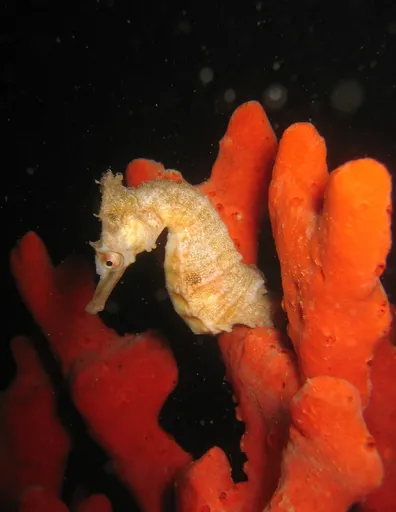
White's seahorse
Hippocampus whitei
Also known as Sydney Seahorse, Crowned Seahorse
SaltwaterFish
Care at a glance
- Temperature
- 68–75°F
- 20–24°C
- pH
- 8.1–8.4
- Adult size
- 6.3 in
- 16 cm
- Minimum tank
- 30 gal
- 114 L
- Temperament
- Peaceful
- Social behavior
- Social
- Tankmates
- With caution
- Swim level
- Middle
- Diet
- Carnivore
- Difficulty
- Difficult
- Breeding
- Pouch brooder · Medium
- Rarity
- Very rare
- Reef safe
- Reef safe with caution
- Family
- Syngnathidae
- Origin
- Eastern Australia, Queensland to New South Wales
Overview
White's seahorse is a peaceful, cool-water seahorse for a calm tank. It needs an experienced keeper.
Did you know
White's seahorse has help from Australian conservation teams, which now anchor artificial seahorse hotels for it. The teams also release hatchery-raised young to rebuild wild numbers.
Caring for the White's seahorse
Give White's seahorse a calm tank of at least 30 gal (114 L), with plenty of anchor points for its tail. It prefers water a touch cooler than a typical reef display, at 68 to 75°F (20 to 24°C). Keep the pH at 8.1 to 8.4.
Like other seahorses, it hitches to a holdfast with its tail and ambushes tiny crustaceans. Feed several small meals of frozen mysis a day.
White's seahorse is peaceful and fine alone or in a group, but choose its tank mates with caution. It is reef safe with caution.
Pairs stay together through the spring to autumn breeding season. The male broods 100 to 250 eggs in his pouch for roughly three weeks, then releases fully formed young. Breeding them is moderately difficult.
Good to know
White's seahorse belongs to the family Syngnathidae and wears a tall, five-pointed coronet on its head. It is endangered in the wild, where New South Wales populations have been hit hard by the loss of seagrass and soft coral. Only captive-bred stock is traded.
In the wild
White's seahorse is endemic to eastern Australia, from southern Queensland to the New South Wales coast. It lives in estuaries and bays among seagrass, macroalgae, sponges, gorgonians and soft corals. It also settles on jetty pylons and the mesh of harbor swimming nets, and Sydney's harbor is one of its strongholds.
Common questions
What size tank does a White's seahorse need?
A White's seahorse needs at least 30 gal (114 L). It spends most of its time in the middle.
What temperature and pH does a White's seahorse need?
A White's seahorse is comfortable at 68–75°F (20–24°C) with a pH of 8.1–8.4.
What does a White's seahorse eat?
A White's seahorse ambushes tiny crustaceans, and in the tank it eats frozen mysis. Offer several small feeds a day.
How big does a White's seahorse get?
An adult White's seahorse reaches about 6.3 in (16 cm).
How can you tell a male White's seahorse from a female?
Males have a brood pouch, where they carry the eggs, and females do not.
How does a White's seahorse breed?
White's seahorse pairs stay together through the spring to autumn breeding season. The male broods 100 to 250 eggs in his pouch for about three weeks, then releases fully formed young. Breeding them is moderately difficult.
Related species
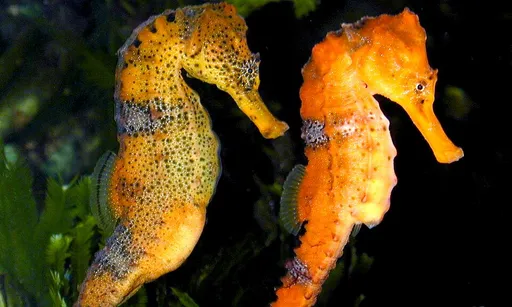 6.7 in (17 cm)29 gal (110 L)72–81°F (22–27°C)
Brazilian seahorse
Hippocampus reidi
6.7 in (17 cm) · 29 gal (110 L)
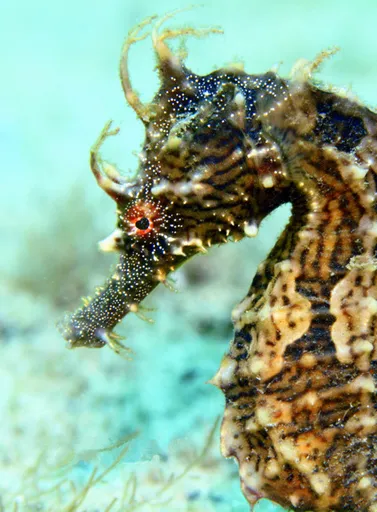 7.1 in (18 cm)29 gal (110 L)68–79°F (20–26°C)
Lined seahorse
Hippocampus erectus
7.1 in (18 cm) · 29 gal (110 L)
 7.9 in (20 cm)40 gal (150 L)72–81°F (22–27°C)
Yellow seahorse
Hippocampus kuda
7.9 in (20 cm) · 40 gal (150 L)
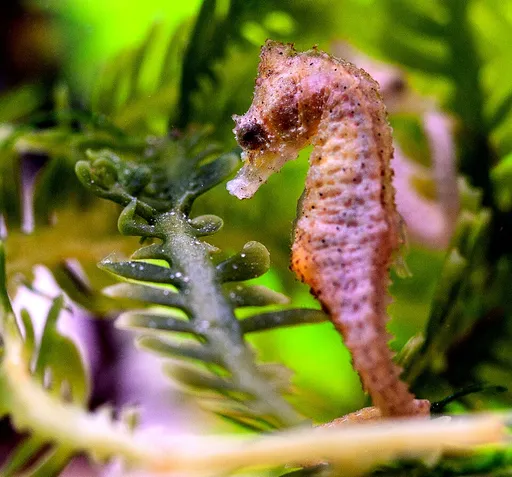 1.4 in (3.5 cm)5 gal (20 L)68–79°F (20–26°C)
Dwarf seahorse
Hippocampus zosterae
1.4 in (3.5 cm) · 5 gal (20 L)
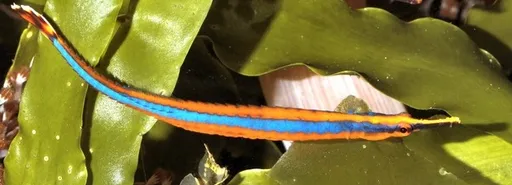 2.8 in (7 cm)26 gal (100 L)75–81°F (24–27°C)
Bluestripe pipefish
Doryrhamphus excisus
2.8 in (7 cm) · 26 gal (100 L)
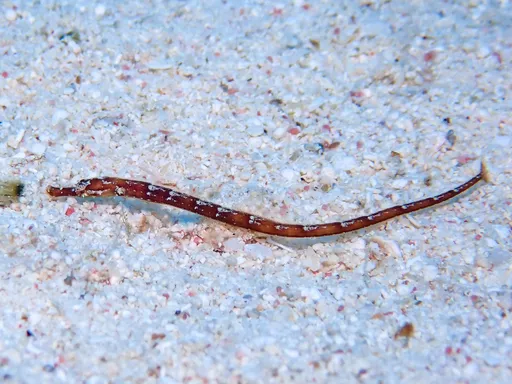 5.9 in (15 cm)20 gal (76 L)68–75°F (20–24°C)
Shortfin pipefish
Cosmocampus elucens
5.9 in (15 cm) · 20 gal (76 L)