Strawberry crab
Neoliomera pubescens
Also known as Red boxing crab, Hawaiian strawberry crab
SaltwaterCrab
Care at a glance
- Temperature
- 72–81°F
- 22–27°C
- pH
- 8.1–8.4
- Adult size
- 1.2 in
- 3 cm
- Minimum tank
- 20 gal
- 75 L
- Temperament
- Mostly peaceful
- Social behavior
- Solitary
- Tankmates
- With caution
- Swim level
- Bottom
- Difficulty
- Easy
- Breeding
- Hard
- Rarity
- Common
- Reef safe
- Reef safe with caution
- Family
- Xanthidae
- Origin
- Hawaii and the tropical Indo-Pacific, including French Polynesia and Mauritius
Overview
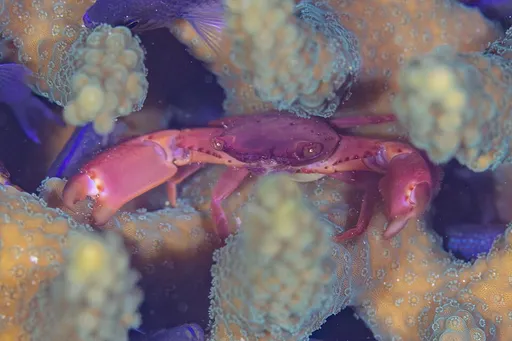
A shy, mostly nocturnal bottom dweller that spends its days wedged in the rock. It is mostly peaceful and ignores fish, but a hungry one will pick at polyps and can take a small shrimp, which is why it gets a reef safe with caution verdict rather than a yes. Feed it well and it rarely causes trouble: offer dried seaweed plus meaty foods such as mysis, krill, or chopped prawn a few times a week rather than relying on algae alone. More than one can share a large tank with enough hides, at roughly one crab per 75 liters, at 22 to 27 C and pH 8.1 to 8.4. It has spawned in aquariums, but the planktonic larvae have not been raised.
In the wild
Strawberry crabs are collected on shallow rocky reefs and coral rubble, mostly in Hawaii, and the species is also recorded from French Polynesia and Mauritius. They hide in holes in the rock by day and come out at night to graze. Give one a mature tank of 75 liters or more with plenty of live rock, caves, and a film of algae to pick at. Keep the water at 22 to 27 C, pH 8.1 to 8.4, and specific gravity 1.023 to 1.025, and never treat the tank with copper.
Good to know
Neoliomera pubescens is a xanthid crab, the same family as the pom pom crab, first described by Henri Milne Edwards in 1834 as Zozymus pubescens. The carapace is about 3 cm wide in the largest animals, and the 5 cm quoted by retailers is across the legs. It is bright pink to red with small white bumps, and the blunt, flat claws are shaped for scraping algae off rock rather than cutting. Its identity is not settled. WoRMS notes that only animals from Mauritius can be assigned to this species with certainty, and a 2014 paper described a new lookalike Neoliomera from Guam, Taiwan, and Hawaii, so the Hawaiian animals in the trade may be that species or the very similar N. demani.
Did you know
LiveAquaria sells this crab as the red boxing crab, but it is not a boxing crab and carries no anemones in its claws. The name mixup runs deeper than the trade. WoRMS says only Mauritius specimens can be identified as Neoliomera pubescens with certainty, and in 2014 Ho and Ng described a new Neoliomera from Guam, Taiwan, and Hawaii that looks much like it, so the pink crab in your tank may not be the species on the label.
Common questions
What size tank does a Strawberry crab need?
A Strawberry crab needs at least 20 gal (75 L). It spends most of its time in the bottom.
What temperature and pH does a Strawberry crab need?
A Strawberry crab is comfortable at 72–81°F (22–27°C) with a pH of 8.1–8.4.
How big does a Strawberry crab get?
An adult Strawberry crab reaches about 1.2 in (3 cm).
Related species
 1 in (2.5 cm)11 gal (40 L)75–81°F (24–27°C)
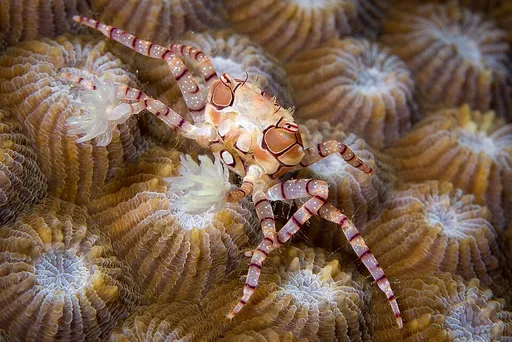
Pom-pom crab
Lybia tessellata
1 in (2.5 cm) · 11 gal (40 L)
 1.2 in (3 cm)20 gal (75 L)72–79°F (22–26°C)
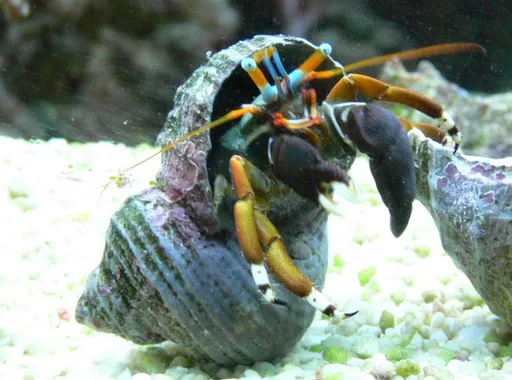
Scarlet zebra hermit crab
Calcinus laevimanus
1.2 in (3 cm) · 20 gal (75 L)
- 1.2 in (3 cm)26 gal (100 L)72–81°F (22–27°C)
Decorator crab
Camposcia retusa
1.2 in (3 cm) · 26 gal (100 L)
 1 in (2.5 cm)11 gal (40 L)72–79°F (22–26°C)
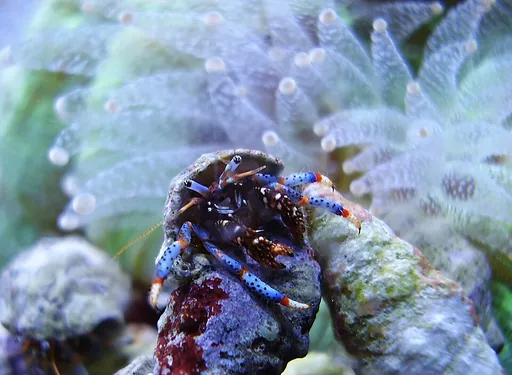
Blue-leg hermit crab
Clibanarius tricolor
1 in (2.5 cm) · 11 gal (40 L)
 1 in (2.5 cm)11 gal (40 L)72–81°F (22–27°C)
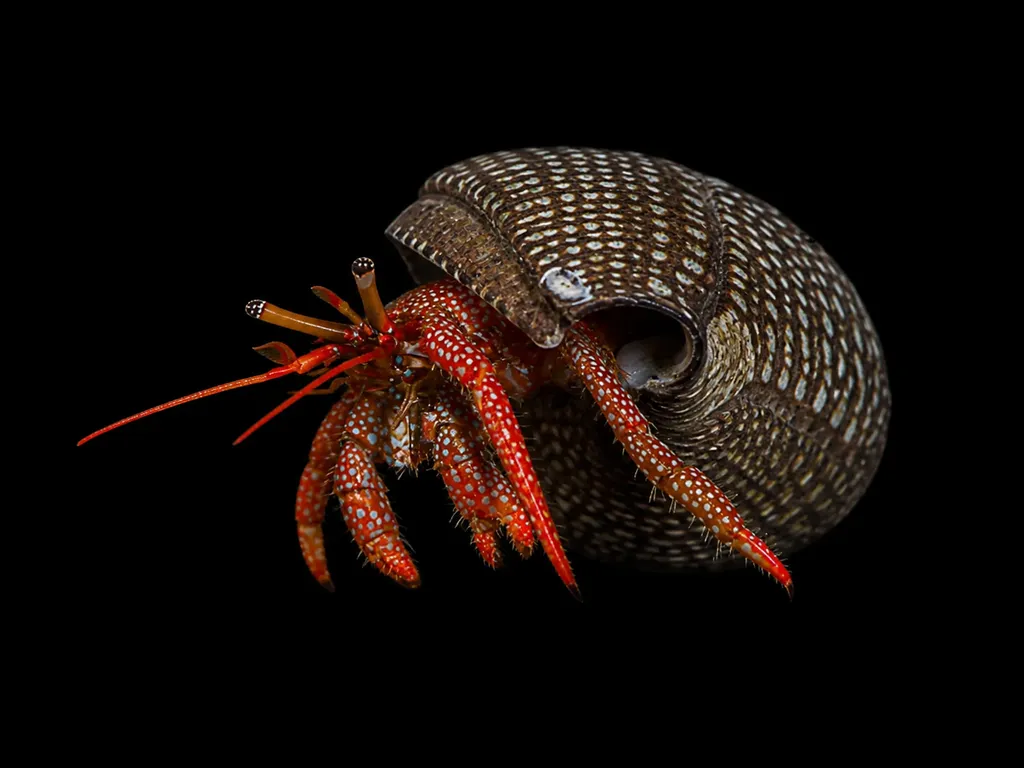
Mexican red-leg hermit crab
Clibanarius digueti
1 in (2.5 cm) · 11 gal (40 L)
 0.8 in (2 cm)11 gal (40 L)75–81°F (24–27°C)
Coral guard crab
Trapezia cymodoce
0.8 in (2 cm) · 11 gal (40 L)