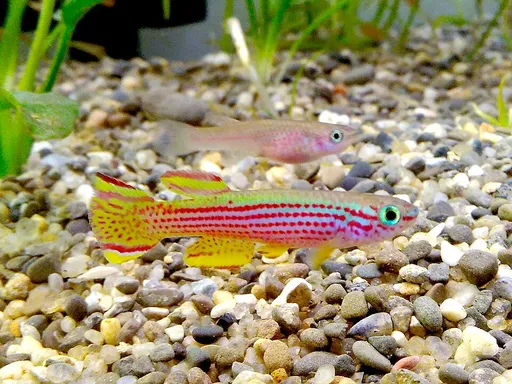
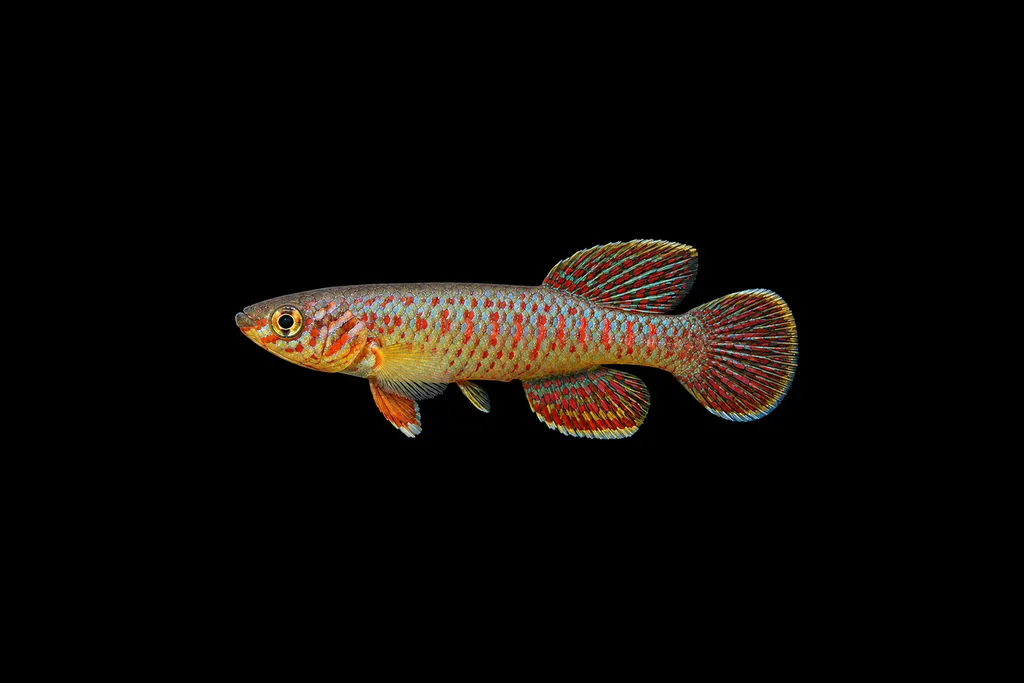
Red-striped killifish
Aphyosemion striatum
Also known as Red-striped killi
FreshwaterFish
Care at a glance
- Temperature
- 70–77°F
- 21–25°C
- pH
- 6.5–7.5
- Adult size
- 2 in
- 5 cm
- Minimum tank
- 11 gal
- 40 L
- Temperament
- Peaceful
- Social behavior
- Social
- Tankmates
- With caution
- Swim level
- Middle
- Difficulty
- Easy
- Breeding
- Easy
- Rarity
- Common
- Family
- Nothobranchiidae
- Origin
- West/Central Africa: Equatorial Guinea and Gabon (coastal forest streams)
Overview
Keep them as a single pair or one male with a few females in a tank of 40 liters or larger, dimly lit and well planted. They are peaceful and shy fish that hold to the middle of the water column and are easily pushed off food, so skip anything boisterous or large. Good company is small peaceful tetras, rasboras, pencilfish, Corydoras, or dwarf cichlids. Water should run soft and slightly acidic to neutral, pH 6.5 to 7.5, and on the cool side, ideally around 22 to 23 C and no higher than 25 C, which often means no heater at all. They are strong jumpers, so a tight-fitting lid is essential. Feed small live and frozen foods like daphnia, baby brine, and bloodworms.
In the wild
Red-striped killifish live in shaded, slow-moving forest streams along the coast of Equatorial Guinea and Gabon in West and Central Africa. These are dim, soft-water pools under heavy canopy, often littered with leaves and submerged roots. To match that, give them a small tank of 40 liters or up with dark substrate, driftwood, plenty of dense planting, and floating plants to cut the light. They settle in best when the water stays soft, slightly acidic to neutral around pH 6.5 to 7.5, and on the cool side at 21 to 25 C.
Good to know
This is a killifish in the family Nothobranchiidae, reaching about 5 cm. Unlike the annual killis that lay eggs in soil, it is a non-annual, plant-spawning species, so its eggs are laid on mops or Java moss and hatch in roughly 10 to 14 days with no resting period needed. That makes it one of the easier killis to keep and breed. Most live around 2 to 3 years, sometimes up to 5.
Did you know
These are non-annual killis, which sets them apart from the better-known annual species that race through a single rainy season and leave drought-proof eggs in the mud. Red-striped killifish come from streams that hold water year round, so their eggs hatch on a normal schedule with no dry rest in between. That quirk is exactly why beginners can breed them in a tank with nothing more than a spawning mop.
Common questions
What size tank does a Red-striped killifish need?
A Red-striped killifish needs at least 11 gal (40 L). It spends most of its time in the middle.
What temperature and pH does a Red-striped killifish need?
A Red-striped killifish is comfortable at 70–77°F (21–25°C) with a pH of 6.5–7.5.
How big does a Red-striped killifish get?
An adult Red-striped killifish reaches about 2 in (5 cm).
Related species
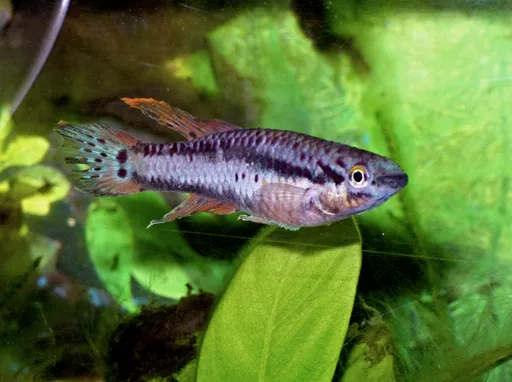 2 in (5 cm)11 gal (40 L)72–79°F (22–26°C)
Two-striped aphyosemion
Aphyosemion bivittatum
2 in (5 cm) · 11 gal (40 L)
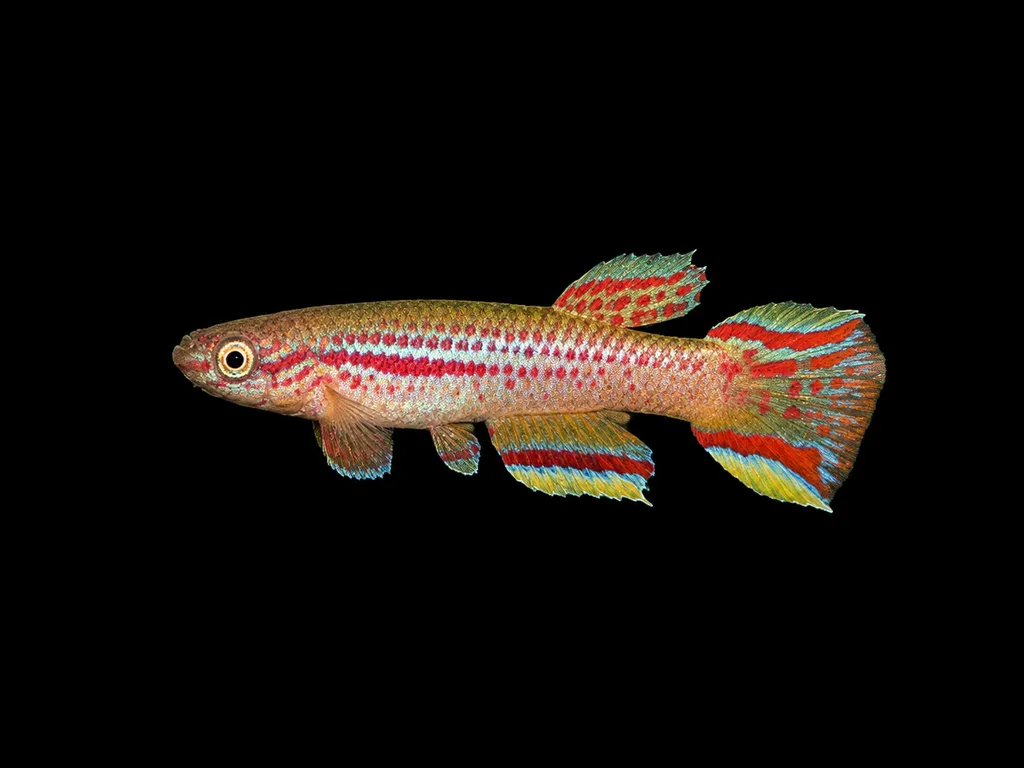 2.2 in (5.5 cm)20 gal (75 L)75–82°F (24–28°C)
Red-seam killifish
Aphyosemion calliurum
2.2 in (5.5 cm) · 20 gal (75 L)
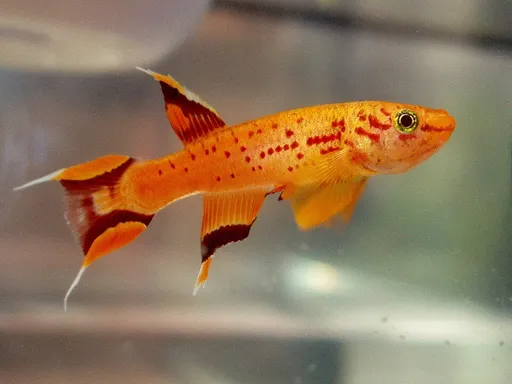 2.4 in (6 cm)10 gal (38 L)70–75°F (21–24°C)
Golden lyretail killifish
Aphyosemion australe
2.4 in (6 cm) · 10 gal (38 L)
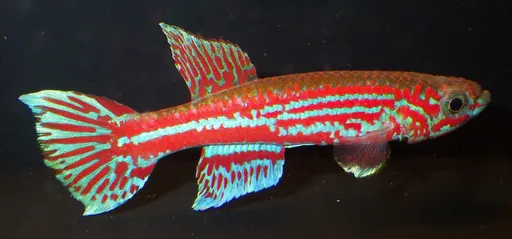
 2 in (5 cm)11 gal (40 L)68–77°F (20–25°C)
Darge's killifish
Aphyosemion dargei
2 in (5 cm) · 11 gal (40 L)
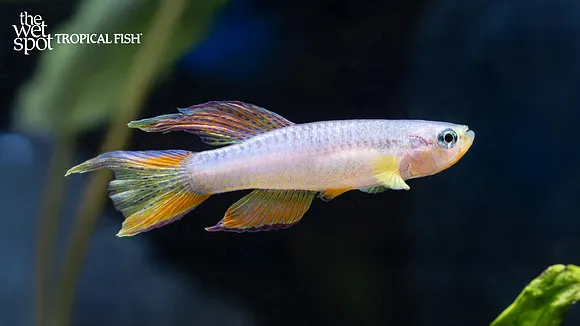
 2 in (5 cm)11 gal (40 L)64–73°F (18–23°C)
Ogowe killifish
Aphyosemion ogoense
2 in (5 cm) · 11 gal (40 L)
 2.2 in (5.5 cm)11 gal (40 L)68–77°F (20–25°C)
Splendid killifish
Aphyosemion splendopleure
2.2 in (5.5 cm) · 11 gal (40 L)