Red slate pencil urchin
Heterocentrotus mamillatus
Also known as Red pencil urchin, Red slate pencil sea urchin, Heterocentrotus mammillatus
SaltwaterInvertebrate
Care at a glance
- Temperature
- 72–81°F
- 22–27°C
- pH
- 8.1–8.4
- Adult size
- 3.1 in
- 8 cm
- Minimum tank
- 50 gal
- 190 L
- Temperament
- Peaceful
- Social behavior
- Solitary
- Tankmates
- With caution
- Swim level
- Bottom
- Difficulty
- Easy
- Breeding
- No record
- Rarity
- Common
- Reef safe
- Not reef safe
- Family
- Echinometridae
- Origin
- Indo-Pacific reef crests and surge zones, most abundant in Hawaii
Overview
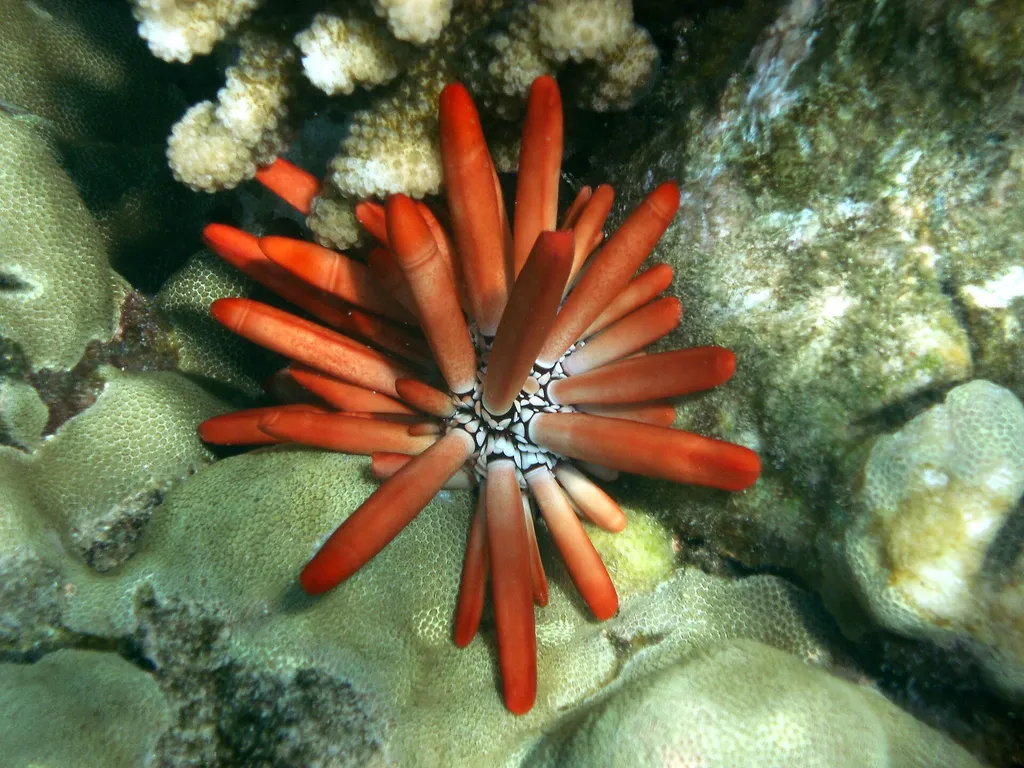
Peaceful toward fish and a hardy, easy urchin to keep alive, but not reef safe. It is heavy, it bulldozes rock and frags, and when the coralline runs out it turns to coral tissue, bivalves, and snails. Keep one in a fish-only or rubble tank at 22 to 27 C, pH 8.1 to 8.4, feed dried seaweed when the rock is clean, drip acclimate it, and keep nitrate low and copper out. Triggers and large wrasses will eat it.
In the wild
The red slate pencil urchin lives on shallow reef crests and surge zones across the tropical Indo-Pacific, from East Africa and the Red Sea to the Pacific islands, and it is especially common in Hawaii, where it wedges into holes in basalt and coral rock at 8 to 25 m. It hides by day and grazes at night. In a tank it needs heavy, well-locked rock with holes it can back into, strong flow, and 190 liters or more of floor to cover, because it moves around far more than most urchins. This is a different animal from the Caribbean slate pencil urchin (Eucidaris tribuloides) already in the catalog.
Good to know
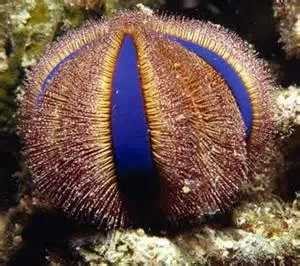
Heterocentrotus mamillatus is a regular urchin in the family Echinometridae. The test reaches about 8 cm across and carries a few dozen thick, blunt, solid spines up to 10 cm long, usually brick red but sometimes brown or purple, with a fringe of short flattened spines below them. The spines are solid enough that they were once used as pencils on slate writing boards, which gave the trade name. In the wild it eats mostly encrusting coralline algae with some turf and Ulva. Field studies clock it moving about a metre a night, and the red spines fade to chalky pink in the dark.
Did you know
Its thick spines have been strung into wind chimes and jewellery in Hawaii for generations. They also once served as chalk pencils on slate writing boards, which is how a Hawaiian reef urchin ended up named after a classroom.
Common questions
What size tank does a Red slate pencil urchin need?
A Red slate pencil urchin needs at least 50 gal (190 L). It spends most of its time in the bottom.
What temperature and pH does a Red slate pencil urchin need?
A Red slate pencil urchin is comfortable at 72–81°F (22–27°C) with a pH of 8.1–8.4.
How big does a Red slate pencil urchin get?
An adult Red slate pencil urchin reaches about 3.1 in (8 cm).
Related species
 3.1 in (8 cm)20 gal (75 L)72–81°F (22–27°C)
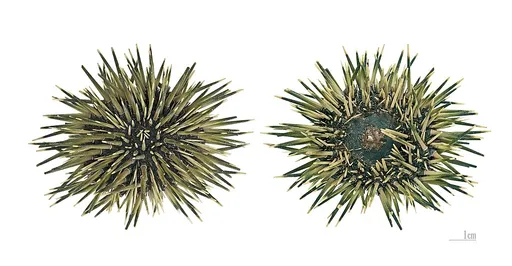
Rock-boring urchin
Echinometra mathaei
3.1 in (8 cm) · 20 gal (75 L)
- 3.9 in (10 cm)53 gal (200 L)73–82°F (23–28°C)
Shingle urchin
Colobocentrotus atratus
3.9 in (10 cm) · 53 gal (200 L)
 3.1 in (8 cm)50 gal (190 L)72–79°F (22–26°C)
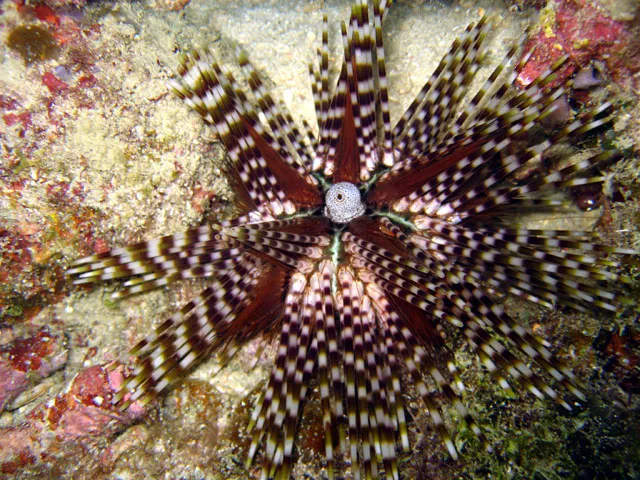
Banded urchin
Echinothrix calamaris
3.1 in (8 cm) · 50 gal (190 L)
 3.1 in (8 cm)20 gal (75 L)68–81°F (20–27°C)
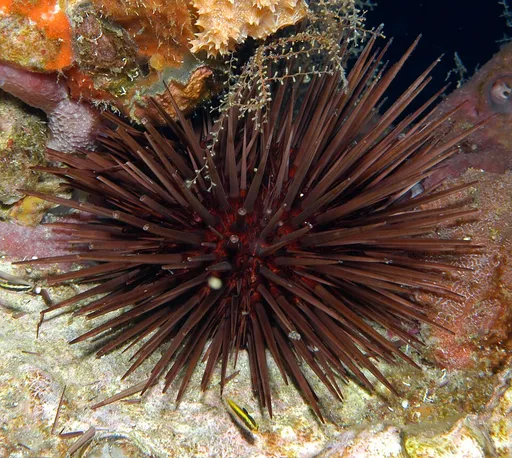
Purple urchin
Arbacia punctulata
3.1 in (8 cm) · 20 gal (75 L)
 3.1 in (8 cm)20 gal (75 L)72–79°F (22–26°C)
Tuxedo urchin
Mespilia globulus
3.1 in (8 cm) · 20 gal (75 L)
 3 in (7.5 cm)11 gal (40 L)68–81°F (20–27°C)
Spurilla nudibranch
Spurilla neapolitana
3 in (7.5 cm) · 11 gal (40 L)