Banded urchin
Echinothrix calamaris
Also known as Banded longspine urchin, Double spined urchin, Banded sea urchin, Hatpin urchin
SaltwaterInvertebrate
Care at a glance
- Temperature
- 72–79°F
- 22–26°C
- pH
- 8.1–8.4
- Adult size
- 3.1 in
- 8 cm
- Minimum tank
- 50 gal
- 190 L
- Temperament
- Peaceful
- Social behavior
- Solitary
- Tankmates
- With caution
- Swim level
- Bottom
- Difficulty
- Medium
- Breeding
- No record
- Rarity
- Common
- Reef safe
- Reef safe with caution
- Family
- Diadematidae
- Origin
- Indo-Pacific lagoons and reef slopes, East Africa to Hawaii and French Polynesia
Overview
Peaceful, nocturnal, and a very good algae grazer that takes hair algae and coralline alike. It is a reef caution: when the rock runs clean it may nip at coral tissue and clams, and its size and stiff spines knock unglued frags off the rock. Keep one per tank at 22 to 26 C, pH 8.1 to 8.4, drip acclimate it slowly, and feed dried seaweed when the algae is gone. Spine loss means the water is wrong; copper, high nitrate, and salinity swings all cause it. Handle it with tongs or a cup and keep it away from triggers, puffers, and large wrasses.
In the wild
The banded urchin lives in lagoons, channels, and on outer reef slopes throughout the tropical Indo-Pacific, from East Africa and the Red Sea to Hawaii and French Polynesia, from the surface to about 70 m. It wedges into crevices and under ledges by day and comes out to graze at night. Set the tank up with solid, well-locked rock and cave gaps big enough for a spine span of 30 cm, in 190 liters or more. It needs a mature tank with film algae on the rock and low nitrate.
Good to know
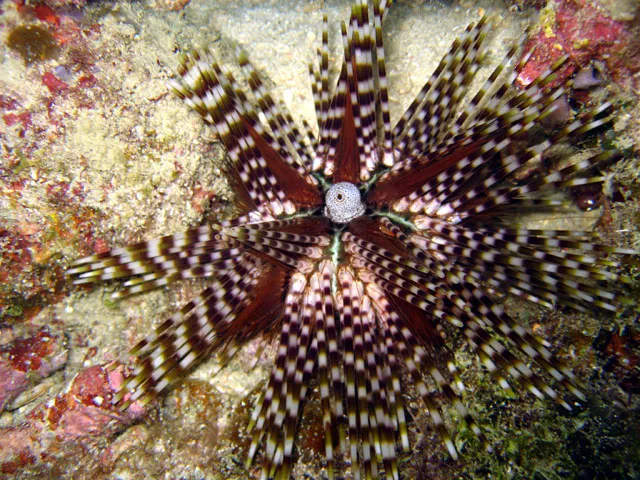
Echinothrix calamaris is a diadematid urchin with two kinds of spines. The long, thick, hollow primary spines reach 10 to 15 cm and are usually banded light and dark, and between them sit shorter, needle-fine secondary spines that are dark and carry the venom. The test is 5 to 10 cm across, often with a blue or green iridescent pattern between the spine bands. Juvenile cardinalfish shelter among the spines, and in Hawaii it hosts the small crab Echinoecus pentagonus. A sting feels like a bee sting and is not dangerous, but the thin spines break off in skin.
Did you know
The two spine types have different jobs. The long banded ones are blunt and hollow and work as levers and armour, while the short dark ones are the weapons, so divers who brush one get stung by spines they never saw.
Common questions
What size tank does a Banded urchin need?
A Banded urchin needs at least 50 gal (190 L). It spends most of its time in the bottom.
What temperature and pH does a Banded urchin need?
A Banded urchin is comfortable at 72–79°F (22–26°C) with a pH of 8.1–8.4.
How big does a Banded urchin get?
An adult Banded urchin reaches about 3.1 in (8 cm).
Related species
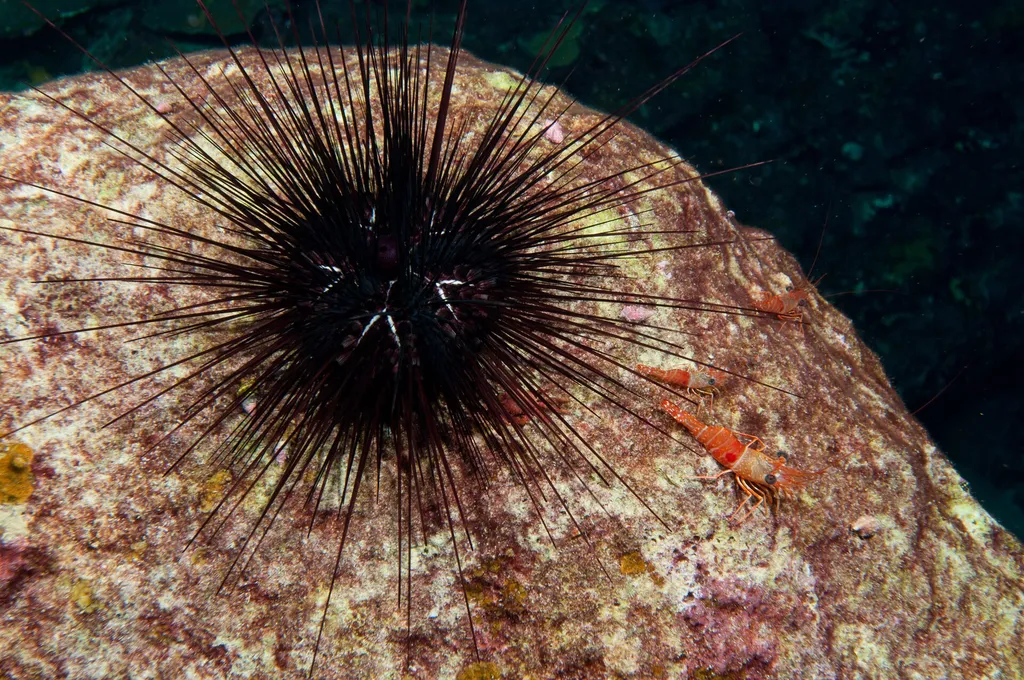 3.9 in (10 cm)79 gal (300 L)72–81°F (22–27°C)
Caribbean long-spined urchin
Diadema antillarum
3.9 in (10 cm) · 79 gal (300 L)
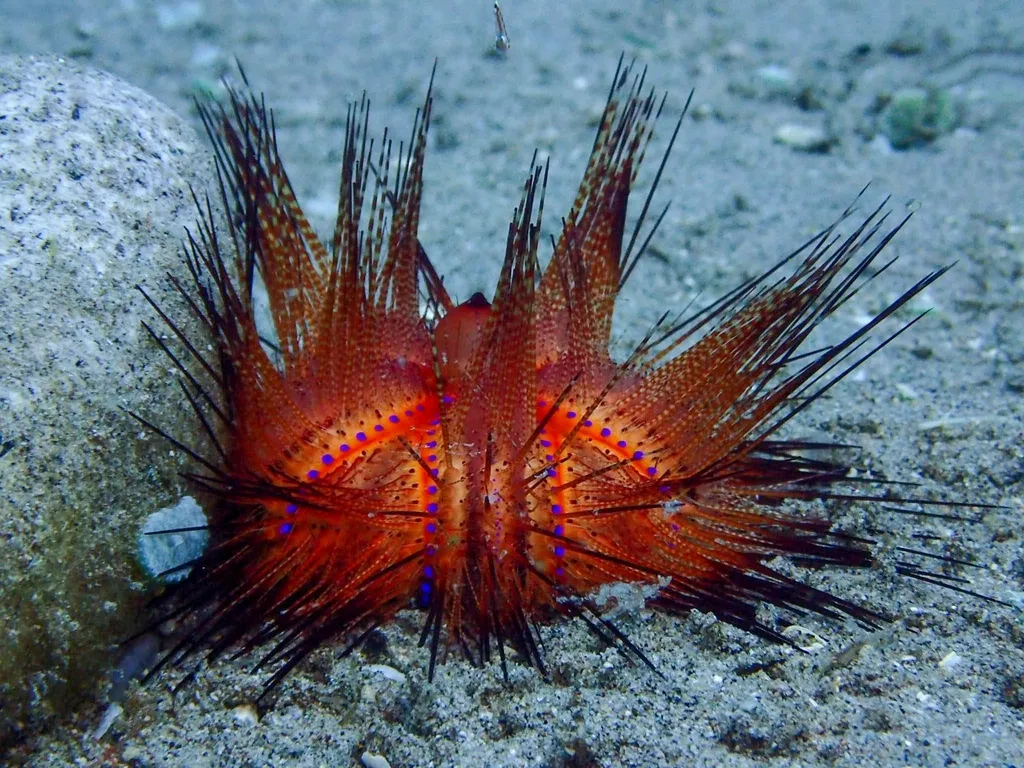 7.9 in (20 cm)100 gal (380 L)72–82°F (22–28°C)
Blue spot urchin
Astropyga radiata
7.9 in (20 cm) · 100 gal (380 L)
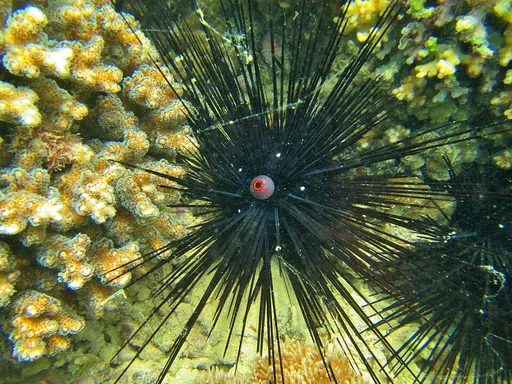 9.8 in (25 cm)50 gal (190 L)72–79°F (22–26°C)
Long-spine urchin
Diadema setosum
9.8 in (25 cm) · 50 gal (190 L)
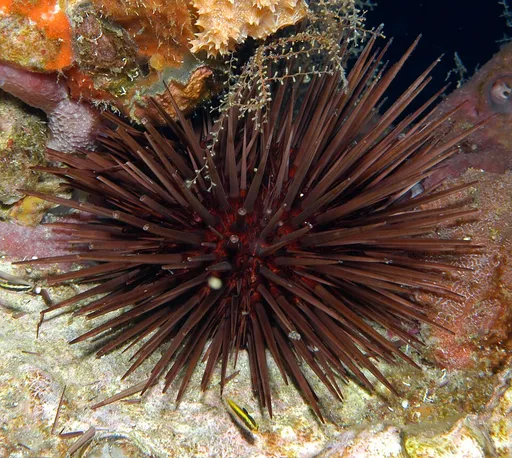 3.1 in (8 cm)20 gal (75 L)68–81°F (20–27°C)
Purple urchin
Arbacia punctulata
3.1 in (8 cm) · 20 gal (75 L)
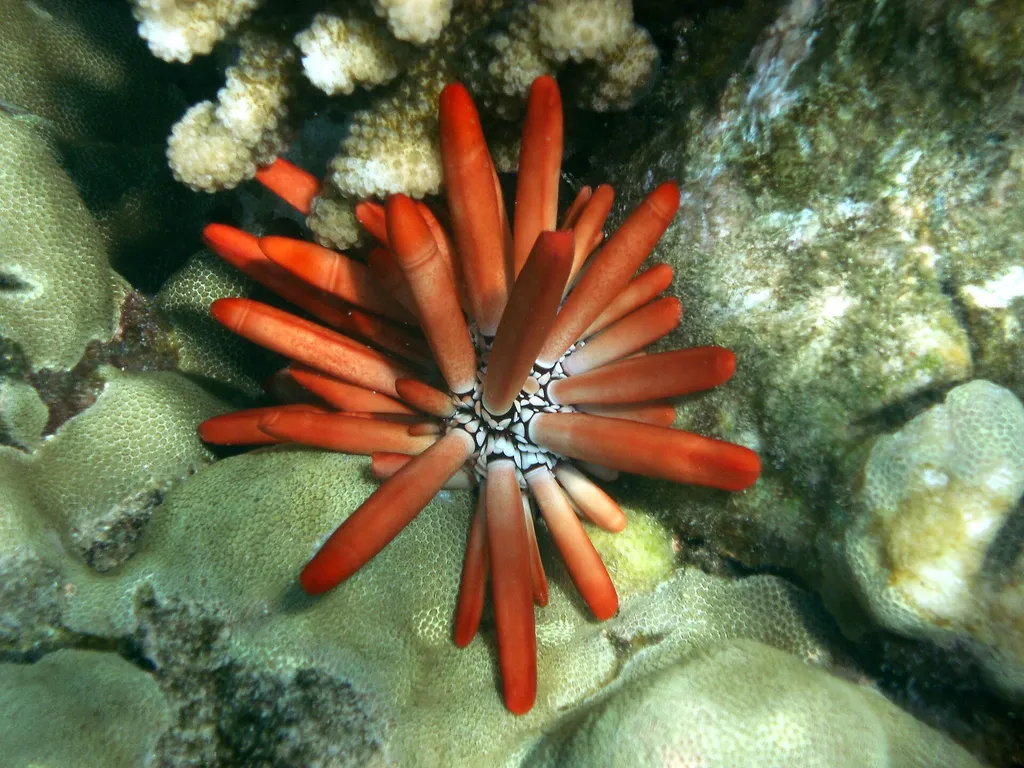 3.1 in (8 cm)50 gal (190 L)72–81°F (22–27°C)
Red slate pencil urchin
Heterocentrotus mamillatus
3.1 in (8 cm) · 50 gal (190 L)
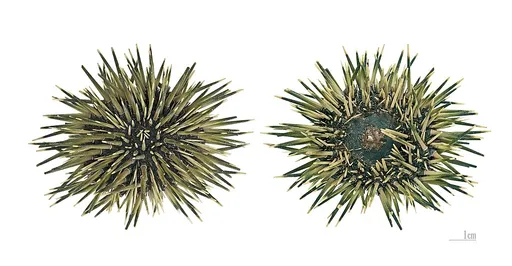 3.1 in (8 cm)20 gal (75 L)72–81°F (22–27°C)
Rock-boring urchin
Echinometra mathaei
3.1 in (8 cm) · 20 gal (75 L)