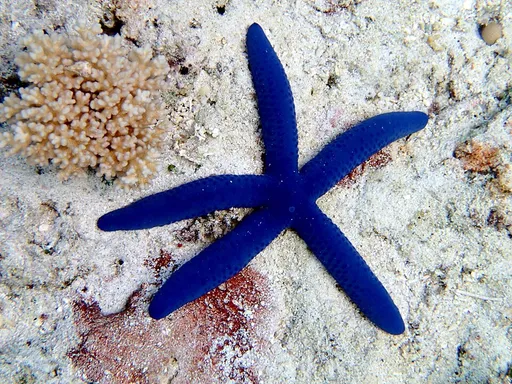
Blue linckia star
Linckia laevigata
Also known as Blue Starfish, Blue Sea Star, Blue Star, Linckia Starfish
SaltwaterInvertebrate
Care at a glance
- Temperature
- 75–81°F
- 24–27°C
- pH
- 8.1–8.4
- Adult size
- 11.8 in
- 30 cm
- Minimum tank
- 53 gal
- 200 L
- Temperament
- Peaceful
- Social behavior
- Solitary
- Swim level
- Bottom
- Difficulty
- Difficult
- Breeding
- No record
- Rarity
- Very common
- Reef safe
- Reef safe
- Family
- Ophidiasteridae
- Origin
- tropical Indo-Pacific coral reefs, from the Red Sea and East Africa to Hawaii and French Polynesia, north to southern Japan
Overview
Reef safe in the sense that it never touches coral, but this is the classic case of a beautiful animal that is a poor match for most home aquariums: it feeds almost entirely on biofilm grazed straight off live rock, nobody has worked out a reliable way to feed it in captivity, and a large share of the blue linckias sold in the trade slowly starve over six to twelve months even in decent tanks. Stress from starvation, cramped quarters, or unstable water quality also leaves it prone to a bacterial 'melting' that turns patches of an arm white and mushy, which is usually fatal once it starts. Give it the largest, oldest, most rock-packed reef tank available, resist adding more than one, and expect to lose thin-looking individuals even with good care; this is not a star for a first reef tank. Acclimate it over at least two hours of slow drip and never let it touch air, since a stressed linckia is a dying linckia.
In the wild
Common on shallow reef flats, rubble zones, and seagrass beds across the tropical Indo-Pacific, from the Red Sea and East Africa to Hawaii and French Polynesia, north to southern Japan, usually in water less than 20 m deep. It creeps slowly over rock and coral rubble grazing on the thin biofilm growing there, covering roughly 8 cm a minute, and in the aquarium it needs a large, old system with rock surfaces that have been left undisturbed long enough to build up that same film. A tank of at least 200 litres (53 US gal) with years, not months, of maturity behind it gives this star the best chance of finding enough food.
Good to know
Named laevigata, meaning smooth, for its evenly rounded, cylindrical arms, and best known for its saturated blue color, which comes from a large carotenoid-protein pigment called linckiacyanin in the body wall. Each arm tip carries a cluster of light-sensing eyespots, and like other Ophidiasteridae it can slowly regrow a damaged or lost arm. It has one dedicated parasite in the wild, a small snail called Thyca crystallina that attaches permanently to the underside of an arm and feeds on the star's fluids, leaving a visible scar where it sits.
Did you know
A close relative, Linckia multifora, can regrow an entire new sea star from a single detached arm, a stage so strange it has its own common name, the comet, since the tiny new body trailing its long original arm looks like a comet with a tail; Linckia laevigata shares the same regenerative powers but has not been confirmed to reproduce this way in the wild.
Common questions
What size tank does a Blue linckia star need?
A Blue linckia star needs at least 53 gal (200 L). It spends most of its time in the bottom.
What temperature and pH does a Blue linckia star need?
A Blue linckia star is comfortable at 75–81°F (24–27°C) with a pH of 8.1–8.4.
How big does a Blue linckia star get?
An adult Blue linckia star reaches about 11.8 in (30 cm).
Related species
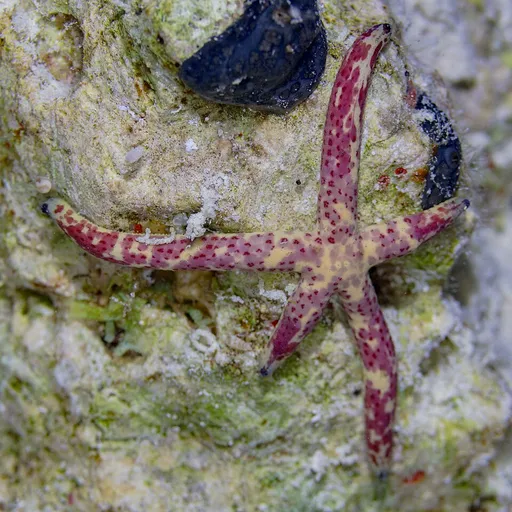 5.1 in (13 cm)53 gal (200 L)75–81°F (24–27°C)
Multicolor sea star
Linckia multifora
5.1 in (13 cm) · 53 gal (200 L)
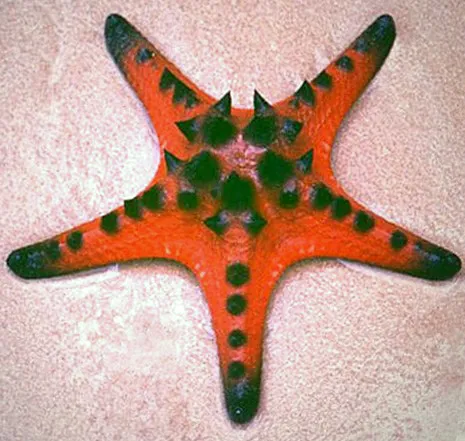 11.8 in (30 cm)53 gal (200 L)75–81°F (24–27°C)
Chocolate chip star
Protoreaster nodosus
11.8 in (30 cm) · 53 gal (200 L)
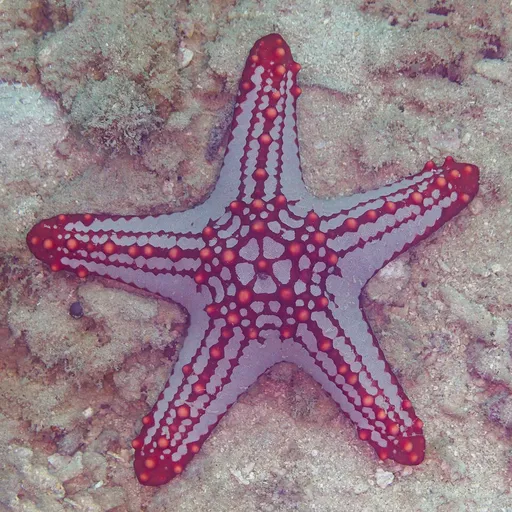 11.8 in (30 cm)53 gal (200 L)75–81°F (24–27°C)
Red knob sea star
Protoreaster linckii
11.8 in (30 cm) · 53 gal (200 L)
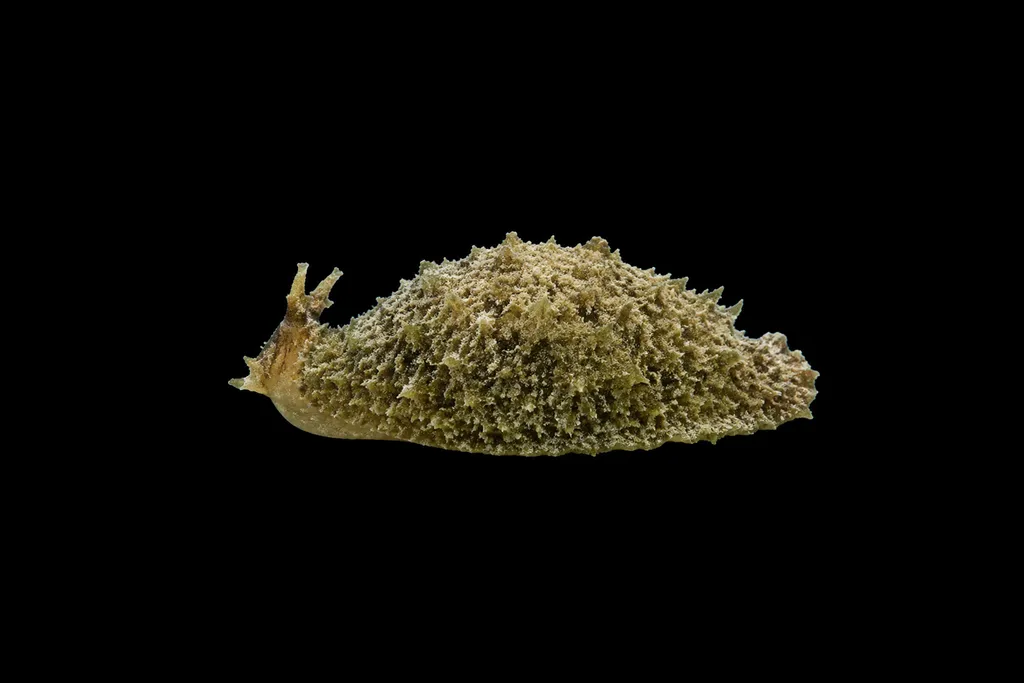 11.8 in (30 cm)50 gal (190 L)75–81°F (24–27°C)
Wedge sea hare
Dolabella auricularia
11.8 in (30 cm) · 50 gal (190 L)
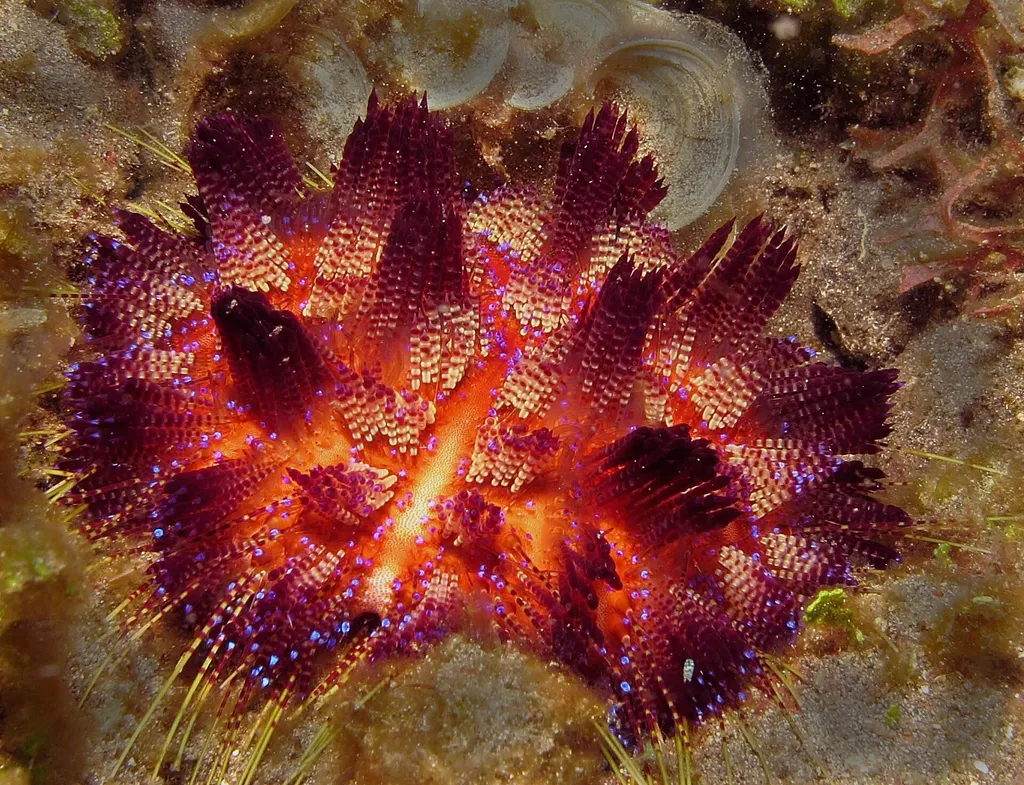 9.8 in (25 cm)201 gal (760 L)72–81°F (22–27°C)
Fire urchin
Asthenosoma varium
9.8 in (25 cm) · 201 gal (760 L)
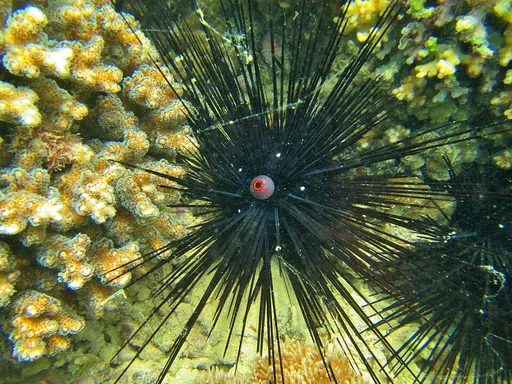 9.8 in (25 cm)50 gal (190 L)72–79°F (22–26°C)
Long-spine urchin
Diadema setosum
9.8 in (25 cm) · 50 gal (190 L)