Giant duckweed
Spirodela polyrhiza
Also known as Greater duckweed, Great duckweed, Common duckmeat, Lemna polyrhiza, Spirodela polyrrhiza
FreshwaterFloatingdivisionfragmentation
Care at a glance
- Light
- Low light
- CO2
- No CO₂ needed
- Temperature
- 59–82°F
- 15–28°C
- Max height
- 0.4 in
- 1 cm
- Growth rate
- Fast
- Placement
- Floating
- Type
- Floating
- pH
- 6.0–8.0
- Hardness
- 2–18 dGH
- Spread
- 11.8 in (30 cm)
- Nutrient uptake
- Water column
- Growth region
- Submersed or emersed
- Difficulty
- Easy
- Family
- Araceae
- Origin
- A free floating duckweed found on still and slow fresh water across most of the world, forming green films on sheltered ponds and backwaters.
Overview
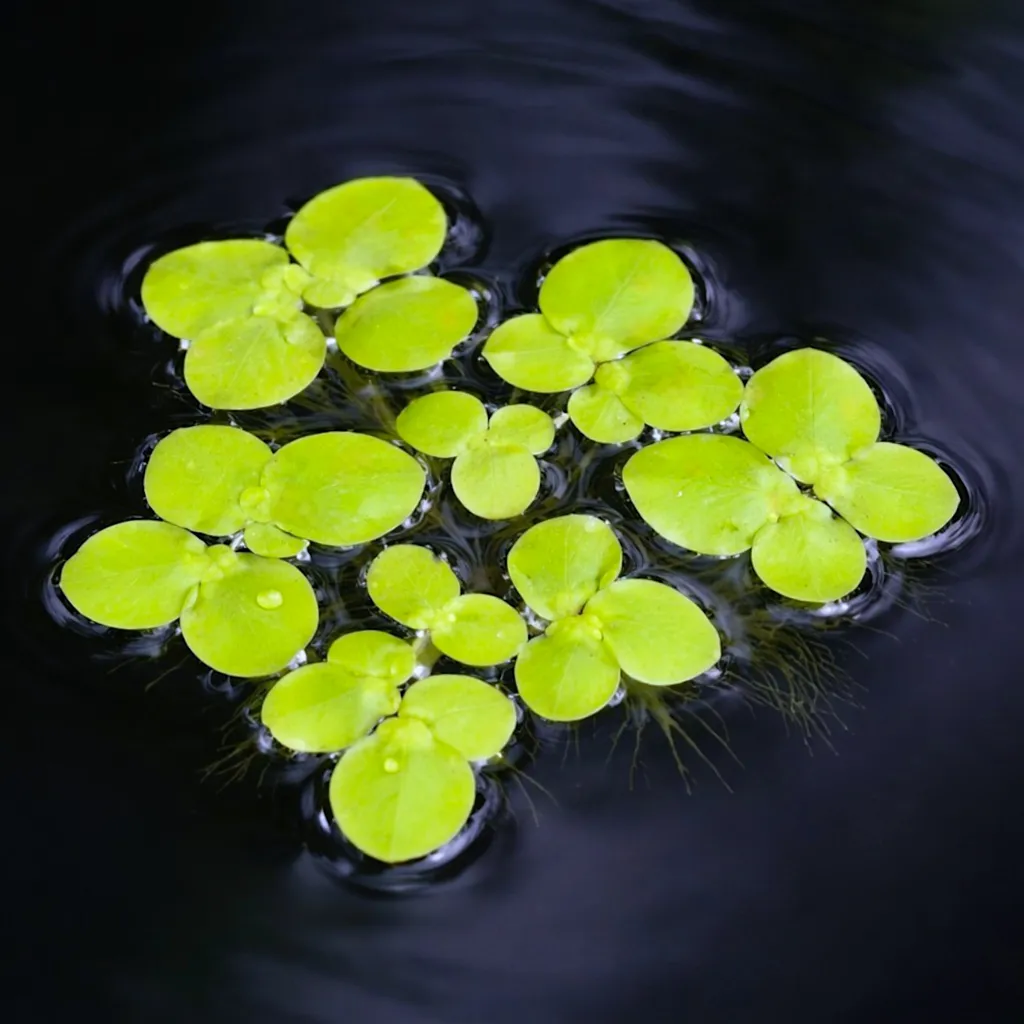
Just float it on the surface in low to moderate light, with no CO2 or substrate needed. It soaks up nitrate and phosphate quickly, which makes it useful for controlling nutrients, but it also shades the tank and clogs filters, so skim off the excess often. Be aware that a few fronds are almost impossible to fully remove once introduced.
In the wild
Giant duckweed is the larger cousin of common duckweed, with rounded green fronds up to about a centimeter across. The top is bright green while the underside often shows a reddish purple tint, and each frond trails a small cluster of roots. It floats and multiplies fast, forming a living blanket across calm water.
Good to know
Duckweeds are among the smallest and simplest flowering plants, reduced to a flat frond and roots with rarely seen tiny flowers. Spirodela polyrhiza is set apart from Lemna by carrying many roots per frond instead of a single one.
Did you know
When conditions turn cold it makes dense starch filled buds called turions that sink to the bottom to overwinter, then rise and sprout again in spring.
Related plants
 Low lightFloating0.4 in (1 cm)
Star duckweed
Lemna trisulca
Low light · Floating
 Medium lightFloating3.9 in (10 cm)
Dwarf water lettuce
Pistia stratiotes
Medium light · Floating
 Medium lightFloating0 in (0.1 cm)
Watermeal
Wolffia globosa
Medium light · Floating
 Low lightEpiphyte0.8 in (2 cm)
Anubias Pangolino
Anubias barteri var. nana 'Pangolino'
Low light · Epiphyte
- Low lightEpiphyte1.2 in (3 cm)
Anubias Micro
Anubias barteri var. nana 'Micro'
Low light · Epiphyte
- Low lightEpiphyte1.6 in (4 cm)
Bucephalandra Mini Coin
Bucephalandra sp. 'Mini Coin'
Low light · Epiphyte