Bucephalandra belindae
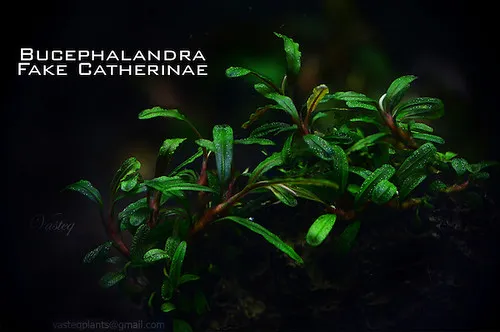
Also known as Buce Belindae, Bucephalandra 'Belinda', Bucephalandra 'Fake Catherinae'
FreshwaterRhizomeRhizome division
Care at a glance
- Light
- Low light
- CO2
- CO₂ beneficial
- Temperature
- 72–82°F
- 22–28°C
- Max height
- 2.4 in
- 6 cm
- Growth rate
- Slow
- Placement
- Epiphyte
- Type
- Rhizome
- pH
- 6.0–7.5
- Hardness
- 4–12 dGH
- Spread
- 3.9 in (10 cm)
- Nutrient uptake
- Root + water column
- Growth region
- Submersed or emersed
- Difficulty
- Easy
- Family
- Araceae
- Origin
- Borneo (south of Nanga Pinoh, Melawi regency, West Kalimantan, Indonesia)
Overview
Glue small portions of Bucephalandra belindae to rock or wood, and keep the thin stems out of the substrate. Wild plants stand about 3 cm tall and tank plants reach 5 to 10 cm, so it suits the foreground. The creeping stems branch, and a portion slowly knits into a dense mat. Low light is enough, and CO2 with regular liquid fertilizer speeds the slow growth. Keep light and water chemistry steady, since sudden changes are the usual cause of melt. Snip branched stems apart to start new plants.
In the wild
Bucephalandra belindae is known from a single granite cascade, a little over 100 m long, 33 km south of Nanga Pinoh in West Kalimantan. Water runs over the rock constantly, under humid hill forest at 260 to 350 m. The plants form wide mats of tangled, weakly rooted stems, and much of each mat hangs in the current.
Good to know
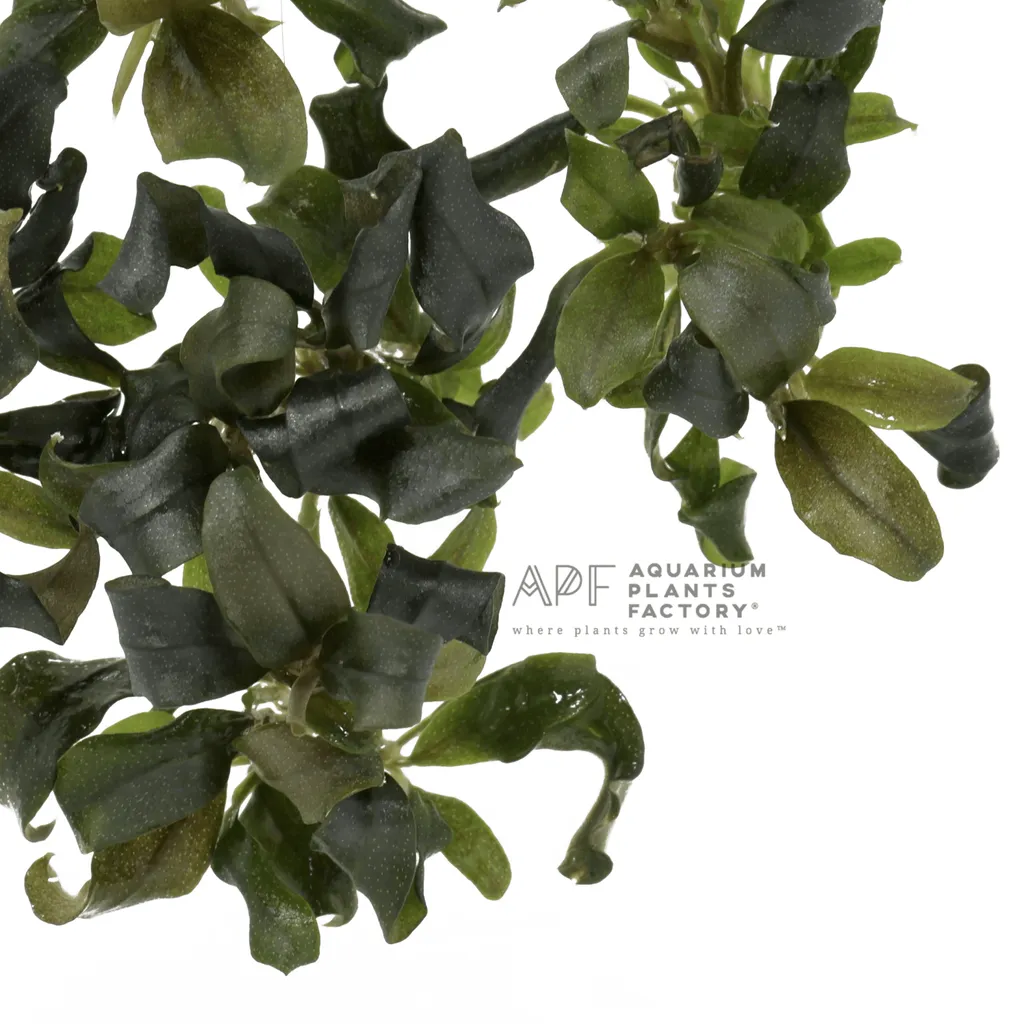
Wong and Boyce named Bucephalandra belindae in 2014, one of 19 new species in their revision of the genus. The name honors Belinda Tan Cho Hiang, wife of the plant collector Kazuya Nakamoto. The leaves are very narrow, 2.5 to 3 cm long and about 2 mm wide, with tightly crisped edges. They are dark green above and reddish beneath, in rosettes at the tips of branching stems. The paper lists 'Belinda' and 'Fake Catherinae' as trade names, and B. catherineae is the species it most resembles.
Did you know
Bucephalandra belindae often flowers in tanks. Its flower stalks reach 4 to 5 cm, taller than the leafy plant, and Wong and Boyce suggest they let it bloom while submerged.
Related plants
 Medium lightEpiphyte2.4 in (6 cm)
Bucephalandra brownie ghost
Bucephalandra sp. 'Brownie Ghost'
Medium light · Epiphyte
 Low lightEpiphyte2.4 in (6 cm)
Bucephalandra Brownie Kapuas
Bucephalandra sp. 'Brownie Kapuas'
Low light · Epiphyte
 Low lightEpiphyte2.4 in (6 cm)
Bucephalandra catherineae
Low light · Epiphyte
- Low lightEpiphyte2.4 in (6 cm)
Bucephalandra Arrogant Blue
Bucephalandra sp. 'Arrogant Blue'
Low light · Epiphyte
- Low lightEpiphyte2.4 in (6 cm)
Bucephalandra Brownie Phoenix
Bucephalandra sp. 'Brownie Phoenix'
Low light · Epiphyte
- Low lightEpiphyte2.4 in (6 cm)
Bucephalandra Brownie Purple
Bucephalandra sp. 'Brownie Purple'
Low light · Epiphyte