Tube anemone
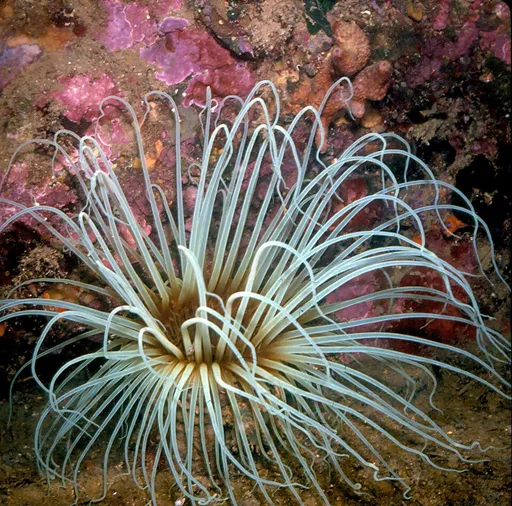
Cerianthus sp.
Also known as Cerianthid, Colored Tube Anemone, Fire Tube Anemone
SaltwaterAnemone
Care at a glance
- Temperature
- 75–81°F
- 24–27°C
- pH
- 8.1–8.4
- Adult size
- 7.9 in
- 20 cm
- Minimum tank
- 20 gal
- 75 L
- Temperament
- Aggressive
- Social behavior
- Solitary
- Tankmates
- With caution
- Swim level
- Bottom
- Difficulty
- Medium
- Breeding
- No record
- Rarity
- Common
- Reef safe
- Not reef safe
- Family
- Cerianthidae
- Origin
- Soft sand and mud seafloors worldwide (tropical to temperate seas)
Overview
Because it is not photosynthetic, lighting is not a requirement, though many keepers run actinic blue light in the evening since the tentacles fluoresce strongly under it. Light to moderate flow that carries food past the crown is enough; feed it small meaty foods like mysis or brine shrimp several times a week since it has no other energy source. This is not a reef-safe animal: its outer tentacle crown extends much wider than it looks and carries a real sting, and hobbyists regularly report it catching and eating small, slow moving fish, especially gobies, blennies, and firefish that settle too close, along with ornamental shrimp. It does not host clownfish and is more of a predation risk to a small or juvenile clownfish than a benefit. Give it its own patch of sand well away from other fish and invertebrates, with no coral anywhere near its full reach, and acclimate it gently since it does not tolerate being handled out of water.
In the wild
Cerianthus species live worldwide on soft sand and mud seafloors, burrowing deep and building a felt-like tube from secreted mucus and specialized stinging threads that they retreat into instantly when disturbed. In the aquarium it needs a very deep sand bed, ideally 10 cm or more, or a dedicated deep sand patch built into the rockwork, placed somewhere it will not be disturbed by digging fish or foraging crabs. It is not a true anemone and does not host clownfish at all.
Good to know
Despite the common name, Cerianthus is not a true sea anemone; it belongs to its own order, Ceriantharia, a separate lineage of hexacorals that never evolved a pedal disc and instead builds a permanent tube to live in. It carries two rings of tentacles, a long outer crown used for stinging and capturing food and a short inner ring around the mouth used to move that food inward, and unlike a true anemone it cannot fully retract its oral disc, only withdraw into its tube. It is azooxanthellate, meaning it has no symbiotic algae and gets no meaningful energy from light.
Did you know
A tube anemone can vanish into its tube almost instantly when startled, faster than any true anemone can close up, which is exactly the reflex that makes it good at ambushing a fish that gets too curious about those feathery tentacles.
Common questions
What size tank does a Tube anemone need?
A Tube anemone needs at least 20 gal (75 L). It spends most of its time in the bottom.
What temperature and pH does a Tube anemone need?
A Tube anemone is comfortable at 75–81°F (24–27°C) with a pH of 8.1–8.4.
How big does a Tube anemone get?
An adult Tube anemone reaches about 7.9 in (20 cm).
Related species
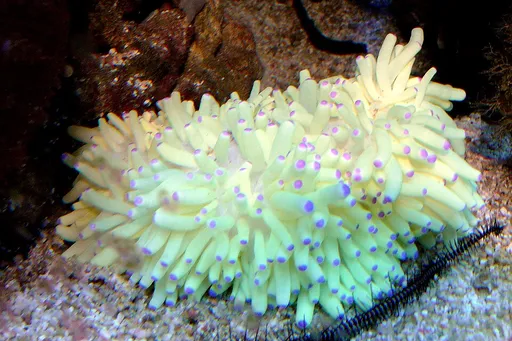 7.9 in (20 cm)40 gal (150 L)75–81°F (24–27°C)
Malu anemone
Heteractis malu
7.9 in (20 cm) · 40 gal (150 L)
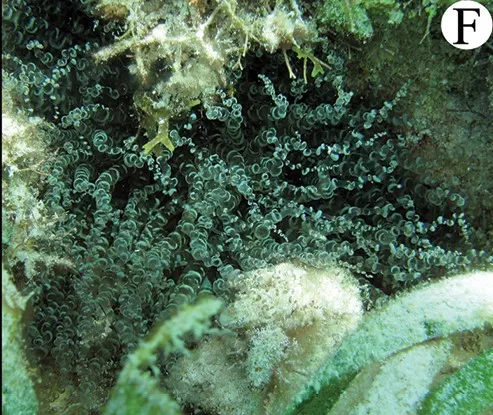 5.9 in (15 cm)20 gal (75 L)75–81°F (24–27°C)
Curlyque anemone
Bartholomea annulata
5.9 in (15 cm) · 20 gal (75 L)
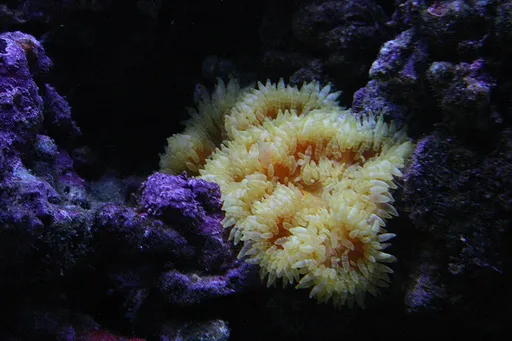 11.8 in (30 cm)50 gal (190 L)72–79°F (22–26°C)
Aurora anemone
Heteractis aurora
11.8 in (30 cm) · 50 gal (190 L)
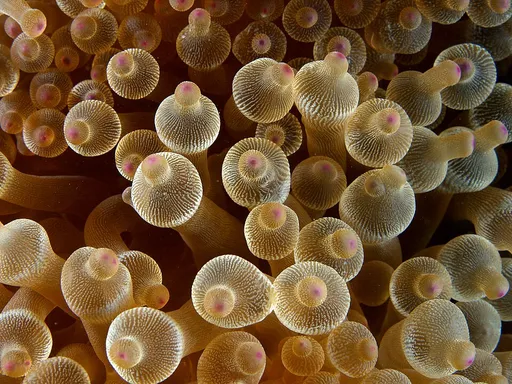 11.8 in (30 cm)30 gal (115 L)75–81°F (24–27°C)
Bubble tip anemone
Entacmaea quadricolor
11.8 in (30 cm) · 30 gal (115 L)
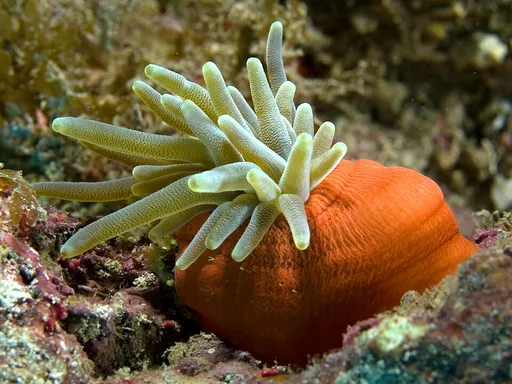 11.8 in (30 cm)40 gal (150 L)75–81°F (24–27°C)
Condy anemone
Condylactis gigantea
11.8 in (30 cm) · 40 gal (150 L)
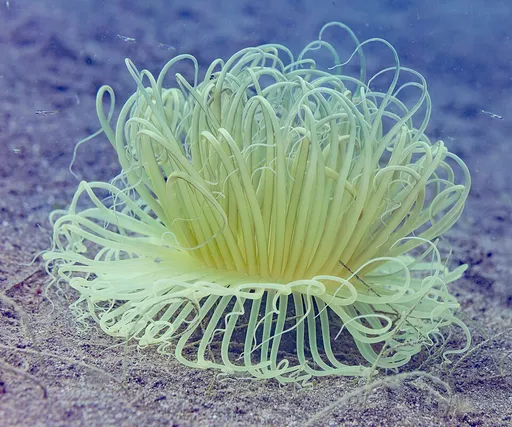 15.7 in (40 cm)40 gal (150 L)75–81°F (24–27°C)
Long tentacle anemone
Macrodactyla doreensis
15.7 in (40 cm) · 40 gal (150 L)