Spiketail paradisefish
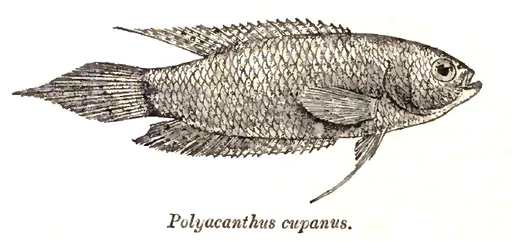
Pseudosphromenus cupanus
Also known as Spike-tailed paradisefish, Spiketail paradise gourami, Cupanus gourami, Polyacanthus cupanus, Brown tail spiketail paradise fish
FreshwaterFish
Care at a glance
- Temperature
- 68–82°F
- 20–28°C
- pH
- 6.0–7.5
- Adult size
- 2.6 in
- 6.5 cm
- Minimum tank
- 12 gal
- 45 L
- Temperament
- Peaceful
- Social behavior
- Social
- Tankmates
- With caution
- Swim level
- Middle
- Difficulty
- Easy
- Breeding
- Easy
- Rarity
- Rare
- Family
- Osphronemidae
- Origin
- Southern India and Sri Lanka, in sluggish or still lowland waters such as ponds, ditches, and slow streams thick with plants.
Overview
A pair or a small group is comfortable in a 45 litre planted tank kept at 20 to 28 C with a pH of 6.0 to 7.5. Feed small live and frozen foods such as daphnia, brine shrimp, grindal worm, and white worm, since dried food is often ignored. It is peaceful but timid, so keep it with small calm tankmates like pygmy rasboras or leave it in a species tank. Gentle filtration and floating plants help it feel secure.
In the wild
Found in shallow, heavily vegetated lowland waters that are often soft and stained by leaf litter. These waters warm up and hold little oxygen, so the fish relies on its labyrinth organ to gulp air at the surface. It sticks close to the cover of plants and submerged roots rather than open water. Wild fish tolerate a fairly wide range of conditions across their range.
Good to know
Pseudosphromenus cupanus was described by Cuvier in 1831 and belongs to the family Osphronemidae. It is named for the pointed, extended rays of its tail fin that give the spiketail its shape. It was long confused with its close relative Pseudosphromenus dayi in the hobby.
Did you know
Males build a bubble nest tucked into a cave or under an overhang and guard the eggs and fry on their own.
Common questions
What size tank does a Spiketail paradisefish need?
A Spiketail paradisefish needs at least 12 gal (45 L). It spends most of its time in the middle.
What temperature and pH does a Spiketail paradisefish need?
A Spiketail paradisefish is comfortable at 68–82°F (20–28°C) with a pH of 6.0–7.5.
How big does a Spiketail paradisefish get?
An adult Spiketail paradisefish reaches about 2.6 in (6.5 cm).
Related species
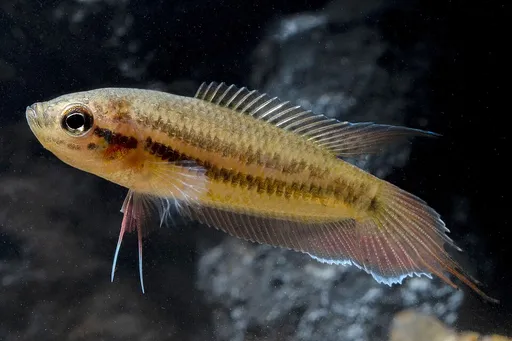 2.6 in (6.5 cm)12 gal (45 L)68–82°F (20–28°C)
Brown spiketail paradisefish
Pseudosphromenus dayi
2.6 in (6.5 cm) · 12 gal (45 L)
- 2.6 in (6.5 cm)16 gal (60 L)73–82°F (23–28°C)
Breviobesa betta
Betta breviobesa
2.6 in (6.5 cm) · 16 gal (60 L)
- 2.6 in (6.6 cm)20 gal (75 L)72–82°F (22–28°C)
Midas betta
Betta midas
2.6 in (6.6 cm) · 20 gal (75 L)
- 2.7 in (6.9 cm)20 gal (75 L)72–81°F (22–27°C)
Obscura betta
Betta obscura
2.7 in (6.9 cm) · 20 gal (75 L)
- 2.4 in (6.1 cm)16 gal (60 L)72–81°F (22–27°C)
Lehi betta
Betta lehi
2.4 in (6.1 cm) · 16 gal (60 L)
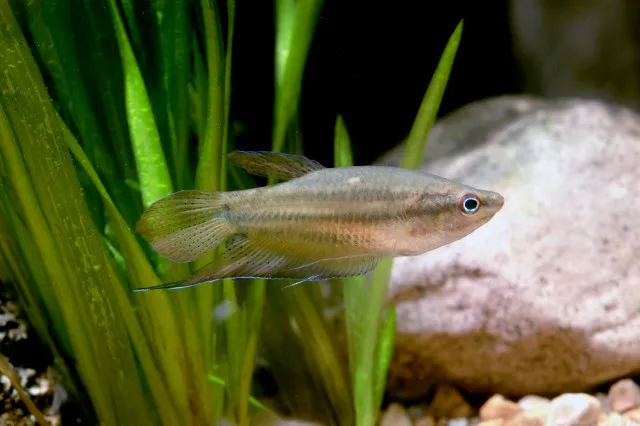 2.8 in (7 cm)25 gal (95 L)72–82°F (22–28°C)
Croaking gourami
Trichopsis vittata
2.8 in (7 cm) · 25 gal (95 L)