Brown spiketail paradisefish
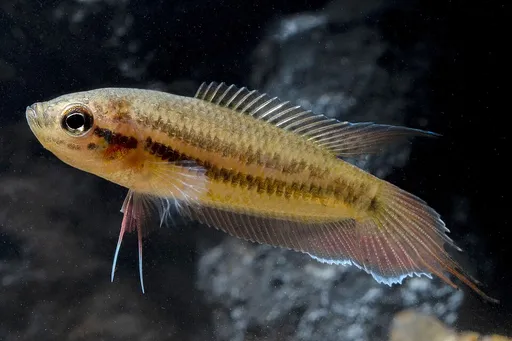
Pseudosphromenus dayi
Also known as Brown spike-tailed paradisefish, Day's paradisefish, Red-tailed spiketail gourami, Macropodus dayi
FreshwaterFish
Care at a glance
- Temperature
- 68–82°F
- 20–28°C
- pH
- 6.0–7.5
- Adult size
- 2.6 in
- 6.5 cm
- Minimum tank
- 12 gal
- 45 L
- Temperament
- Peaceful
- Social behavior
- Social
- Tankmates
- With caution
- Swim level
- Middle
- Diet
- Carnivore
- Difficulty
- Easy
- Breeding
- Bubble nester · Easy
- Rarity
- Rare
- Family
- Osphronemidae
- Origin
- Coastal river drainages of the Western Ghats in Kerala, southern India, in slow, shaded, plant-choked waters.
Overview
The brown spiketail paradisefish is a small, shy labyrinth fish for a calm, planted tank. It is easy to keep.
Did you know
A male brown spiketail paradisefish turns dark and colorful while he guards his nest.
Caring for the brown spiketail paradisefish
House a pair of brown spiketail paradisefish in a planted tank of 12 gal (45 L) or more. Dim lighting and floating cover bring out their color and confidence.
Keep the water soft and slightly acidic, at 68 to 82°F (20 to 28°C) and a pH of 6.0 to 7.5. Offer small live and frozen foods such as daphnia, cyclops and grindal worm, with frozen bloodworm as a treat.
The brown spiketail paradisefish is peaceful but shy. Keep few or no boisterous tank mates with it.
Males show more red in the tail and longer fin extensions. The male builds a bubble nest, often hidden inside a cave or a curled leaf, and guards it. Breeding is easy.
Good to know
The brown spiketail paradisefish, Pseudosphromenus dayi, sits in the family Osphronemidae. It is the browner, redder-finned relative of Pseudosphromenus cupanus. The two look similar and were mixed up in the trade for decades.
In the wild
The brown spiketail paradisefish is native to the coastal river drainages of the Western Ghats in Kerala, southern India. It lives in soft, often tea-colored streams and backwaters, shaded by forest and packed with vegetation. The water is warm and low in oxygen, so it breathes air at the surface using its labyrinth organ. It spends most of its time near cover such as roots, leaf litter and plant thickets. Populations were once wrongly reported from Vietnam.
Common questions
What size tank does a brown spiketail paradisefish need?
A brown spiketail paradisefish needs at least 12 gal (45 L). It spends most of its time in the middle.
What temperature and pH does a brown spiketail paradisefish need?
A brown spiketail paradisefish is comfortable at 68–82°F (20–28°C) with a pH of 6.0–7.5.
What does a brown spiketail paradisefish eat?
A brown spiketail paradisefish eats small live and frozen foods such as daphnia, cyclops and grindal worm. Frozen bloodworm makes a treat.
How big does a brown spiketail paradisefish get?
An adult brown spiketail paradisefish reaches about 2.6 in (6.5 cm).
How can you tell a male brown spiketail paradisefish from a female?
Males show more red in the tail than females, along with longer fin extensions.
How does a brown spiketail paradisefish breed?
A brown spiketail paradisefish is a bubble nester. The male often builds the nest inside a cave or a curled leaf, and breeding is easy.
Related species
 2.6 in (6.5 cm)12 gal (45 L)68–82°F (20–28°C)
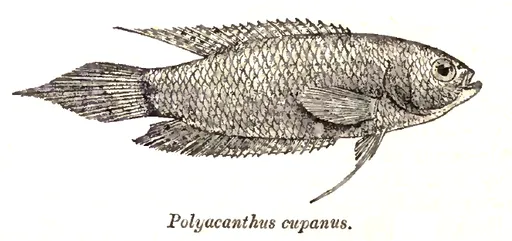
Spiketail paradisefish
Pseudosphromenus cupanus
2.6 in (6.5 cm) · 12 gal (45 L)
- 2.6 in (6.5 cm)16 gal (60 L)73–82°F (23–28°C)
Breviobesa betta
Betta breviobesa
2.6 in (6.5 cm) · 16 gal (60 L)
- 2.6 in (6.6 cm)20 gal (75 L)72–82°F (22–28°C)
Midas betta
Betta midas
2.6 in (6.6 cm) · 20 gal (75 L)
- 2.7 in (6.9 cm)20 gal (75 L)72–81°F (22–27°C)
Obscura betta
Betta obscura
2.7 in (6.9 cm) · 20 gal (75 L)
- 2.4 in (6.1 cm)16 gal (60 L)72–81°F (22–27°C)
Lehi betta
Betta lehi
2.4 in (6.1 cm) · 16 gal (60 L)
 2.8 in (7 cm)18 gal (67 L)72–82°F (22–28°C)
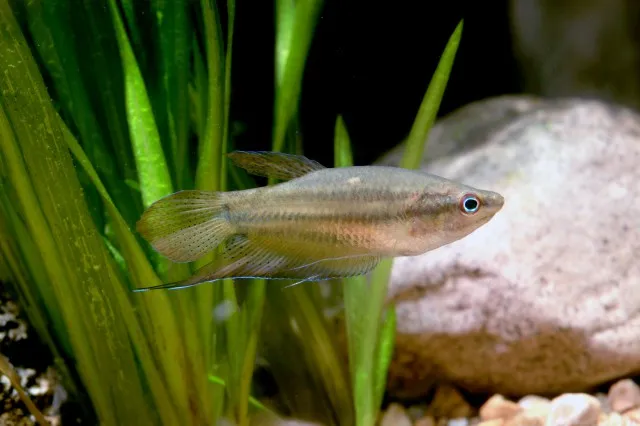
Croaking gourami
Trichopsis vittata
2.8 in (7 cm) · 18 gal (67 L)