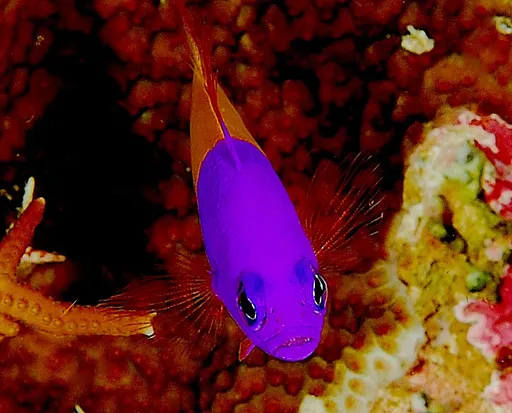
Bicolor dottyback
Pictichromis paccagnellae
Also known as Royal Dottyback, Bicolor Pseudochromis, Paccagnella's Dottyback, False Gramma
SaltwaterFish
Care at a glance
- Temperature
- 72–81°F
- 22–27°C
- pH
- 8.1–8.4
- Adult size
- 2.8 in
- 7 cm
- Minimum tank
- 29 gal
- 110 L
- Temperament
- Aggressive
- Social behavior
- Solitary
- Own kind
- One per tank
- Tankmates
- With caution
- Swim level
- Middle
- Difficulty
- Easy
- Breeding
- Medium
- Rarity
- Very common
- Reef safe
- Reef safe
- Family
- Pseudochromidae
- Origin
- Western Pacific, from Indonesia and the Philippines east to Vanuatu and Palau
Overview
This is one of the most strikingly colored dottybacks in the hobby and also one of the feistiest: it will stake out a territory and defend it against fish two to three times its own size, and it treats similarly shaped fish, including other dottybacks and basslets, as rivals on sight. Add it last, once its tankmates are established, and keep only one per tank unless the aquarium is very large. It is otherwise reef safe and leaves corals, clams, and most invertebrates alone, though a hungry individual may pick off tiny ornamental shrimp such as sexy shrimp. It is a hardy carnivore that takes frozen mysis, brine shrimp, and prepared marine foods without any fuss.
In the wild
Found on coral reefs across the western Pacific, from Indonesia and the Philippines east to Vanuatu and Palau, where it holds a small territory around a cave or ledge on shallow, current-swept reef flats. It rarely strays far from cover, darting out to grab food and retreating the instant it feels crowded. In the tank it wants a well-established system of at least 110 liters with heavy rockwork broken into caves, since a fish this territorial needs somewhere to call its own.
Good to know
Pictichromis paccagnellae was long classified in the genus Pseudochromis before Pictichromis was split off in 2004 for a group of small, sharply two-toned dottybacks that share a distinct fin-ray count; several of its close relatives made the same move. Like other dottybacks it is a protogynous hermaphrodite, starting life as a female, and the dominant fish in a pairing develops into the male. It has been captive bred on a limited scale, though most specimens in the trade are still wild caught.
Did you know
Its purple front half and yellow rear half give it a passing resemblance to the royal gramma, which is why it is sometimes sold under the name false gramma, but the two are not close relatives and a bicolor dottyback will happily bully the real thing.
Common questions
What size tank does a Bicolor dottyback need?
A Bicolor dottyback needs at least 29 gal (110 L). It spends most of its time in the middle.
What temperature and pH does a Bicolor dottyback need?
A Bicolor dottyback is comfortable at 72–81°F (22–27°C) with a pH of 8.1–8.4.
How big does a Bicolor dottyback get?
An adult Bicolor dottyback reaches about 2.8 in (7 cm).
Related species
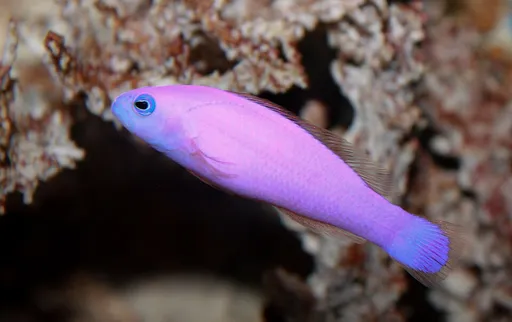 2.4 in (6 cm)20 gal (75 L)72–79°F (22–26°C)
Magenta dottyback
Pictichromis porphyrea
2.4 in (6 cm) · 20 gal (75 L)
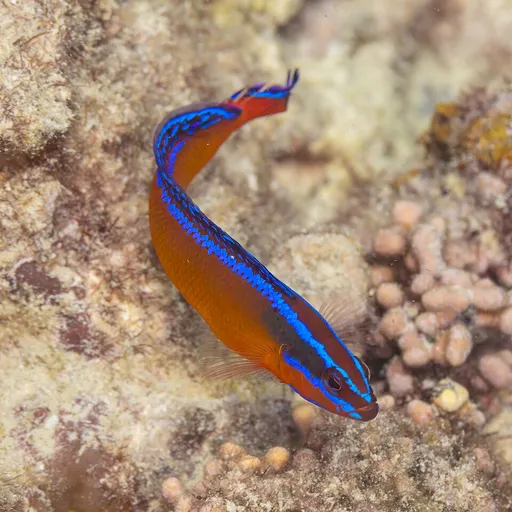 3.5 in (9 cm)29 gal (110 L)72–79°F (22–26°C)
Neon dottyback
Pseudochromis aldabraensis
3.5 in (9 cm) · 29 gal (110 L)
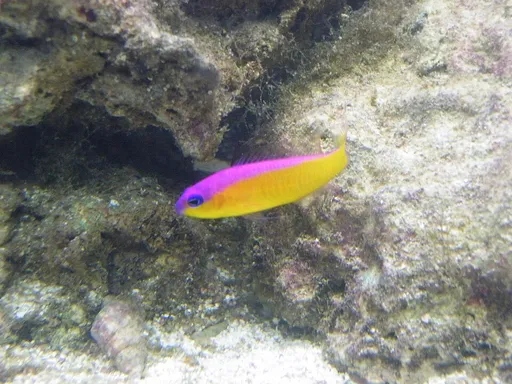 2.8 in (7 cm)20 gal (75 L)73–81°F (23–27°C)
Diadem dottyback
Pseudochromis diadema
2.8 in (7 cm) · 20 gal (75 L)
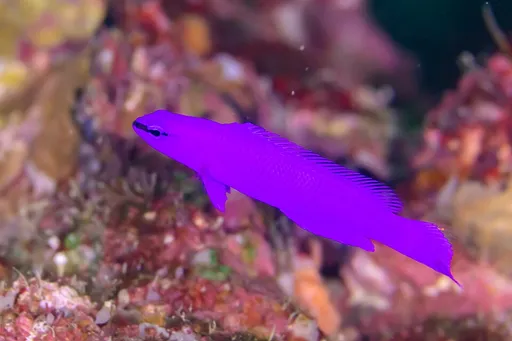 2.8 in (7 cm)29 gal (110 L)72–79°F (22–26°C)
Orchid dottyback
Pseudochromis fridmani
2.8 in (7 cm) · 29 gal (110 L)
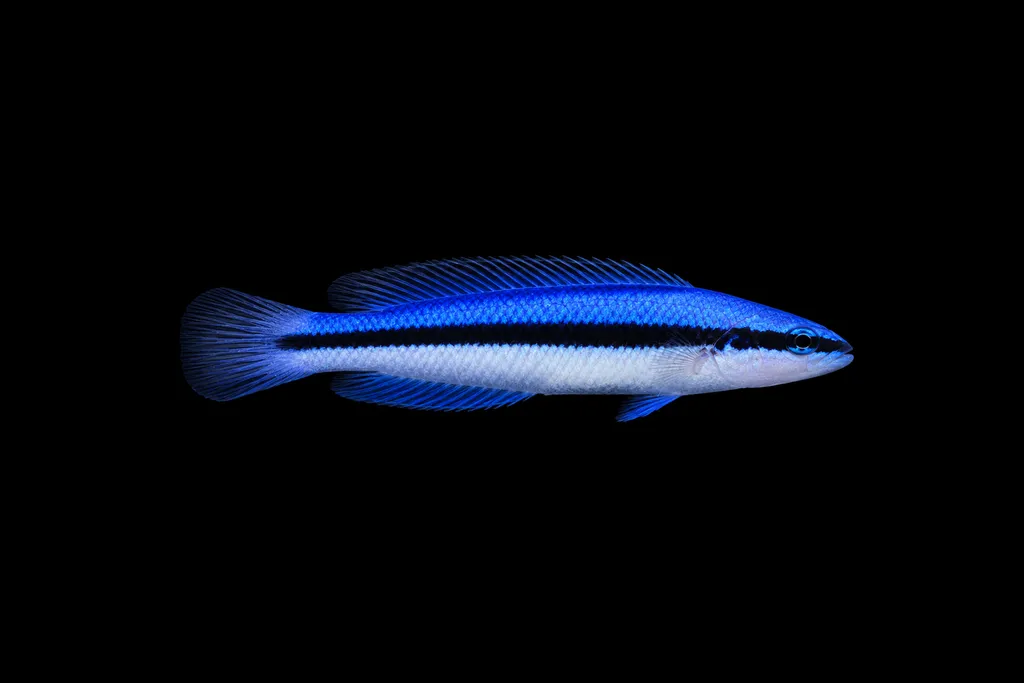 3 in (7.5 cm)29 gal (110 L)73–81°F (23–27°C)
Indigo dottyback
Pseudochromis hybrid
3 in (7.5 cm) · 29 gal (110 L)
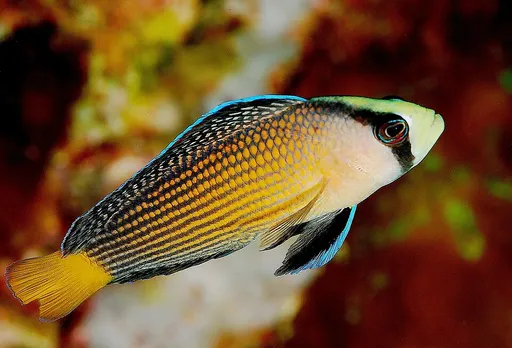 5.1 in (13 cm)53 gal (200 L)75–81°F (24–27°C)
Splendid dottyback
Manonichthys splendens
5.1 in (13 cm) · 53 gal (200 L)