Clown triggerfish
Balistoides conspicillum
Also known as Bigspotted Triggerfish, Yellow-blotched Triggerfish, Clown Trigger
SaltwaterFish
Care at a glance
- Temperature
- 72–79°F
- 22–26°C
- pH
- 8.1–8.4
- Adult size
- 19.7 in
- 50 cm
- Minimum tank
- 300 gal
- 1,135 L
- Temperament
- Aggressive
- Social behavior
- Solitary
- Own kind
- One per tank
- Tankmates
- With caution
- Swim level
- Middle
- Difficulty
- Difficult
- Breeding
- No record
- Rarity
- Rare
- Reef safe
- Not reef safe
- Family
- Balistidae
- Origin
- Indo-Pacific, from East Africa to Samoa, north to southern Japan, south to New Caledonia
Overview
Clown triggerfish are relatively docile as small juveniles but become steadily more territorial and aggressive as they grow past about 20 cm, and a full grown adult is one of the most aggressive fish commonly kept in the hobby, needing large, robust tankmates like groupers or big angelfish rather than anything small or docile. It is not reef safe in any sense: it eats crustaceans, mollusks, and sea urchins as a matter of course and will treat a reef tank's cleanup crew as a menu. Offer a varied diet of squid, krill, clams, crab, and other meaty foods, including hard-shelled items to keep its continuously growing teeth in check. It is not venomous, but it bites hard and has been known to chip acrylic panels and scratch glass, so tank material and equipment placement matter, and hands should stay well clear of an adult's territory.
In the wild
Found along the inner and outer edges of coral reefs across the Indo-Pacific, usually from about 1 to 75 meters deep, wherever shellfish and other invertebrates are abundant. Juveniles stay hidden in caves and crevices, while adults range more widely to forage. A tank for this species needs to be large enough for a genuine territory, with heavy rockwork secured well enough to withstand a fish that will rearrange it.
Good to know
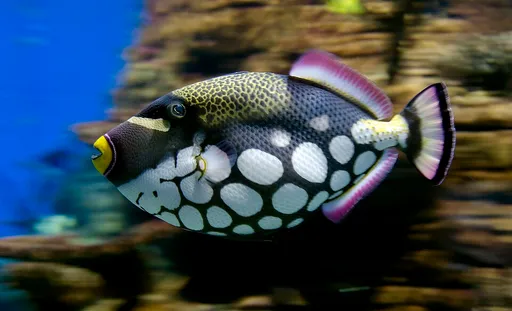
Balistoides conspicillum is a triggerfish in the family Balistidae and one of the largest and most recognizable in the hobby, reaching about 50 cm. Its pattern changes dramatically with age: juveniles are black and densely covered in small white spots with a yellow-tinged snout, while adults develop large white spots concentrated on the lower body, a yellow-netted back, and a bold white band across the mouth that gives the species its name, conspicillum, Latin for spectacles. A breeding pair digs a nest in sand or rubble, and the female fans and blows bubbles over the eggs to keep them oxygenated while both parents guard the nest for about a week.
Did you know
A juvenile clown trigger barely resembles the adult it will become: the small, crowded white spots and mostly black body of a young fish gradually shift into the bold, widely spaced white polka dots and yellow-netted back of the adult over a year or more.
Common questions
What size tank does a Clown triggerfish need?
A Clown triggerfish needs at least 300 gal (1,135 L). It spends most of its time in the middle.
What temperature and pH does a Clown triggerfish need?
A Clown triggerfish is comfortable at 72–79°F (22–26°C) with a pH of 8.1–8.4.
How big does a Clown triggerfish get?
An adult Clown triggerfish reaches about 19.7 in (50 cm).
Related species
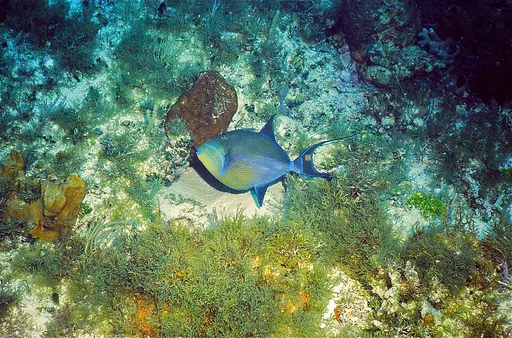 19.7 in (50 cm)238 gal (900 L)72–81°F (22–27°C)
Queen triggerfish
Balistes vetula
19.7 in (50 cm) · 238 gal (900 L)
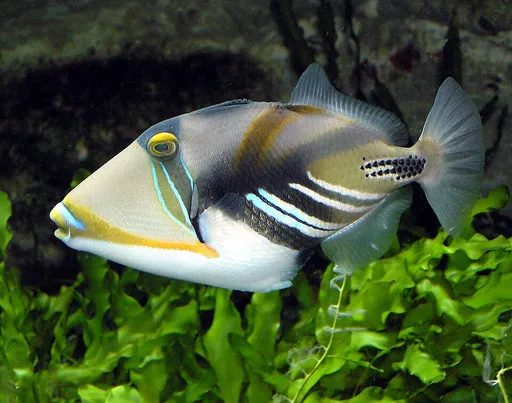 11.8 in (30 cm)180 gal (680 L)72–79°F (22–26°C)
Picasso triggerfish
Rhinecanthus aculeatus
11.8 in (30 cm) · 180 gal (680 L)
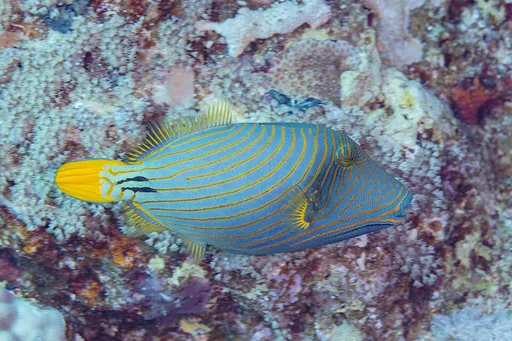 11.8 in (30 cm)180 gal (680 L)75–81°F (24–27°C)
Undulated triggerfish
Balistapus undulatus
11.8 in (30 cm) · 180 gal (680 L)
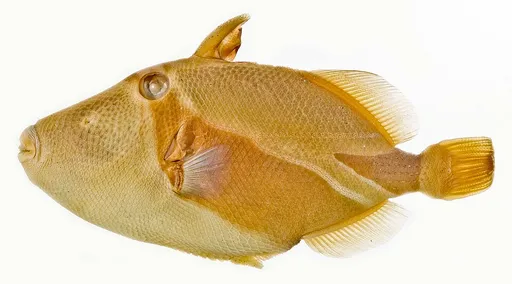 11.8 in (30 cm)106 gal (400 L)75–81°F (24–27°C)
Wedgetail triggerfish
Rhinecanthus rectangulus
11.8 in (30 cm) · 106 gal (400 L)
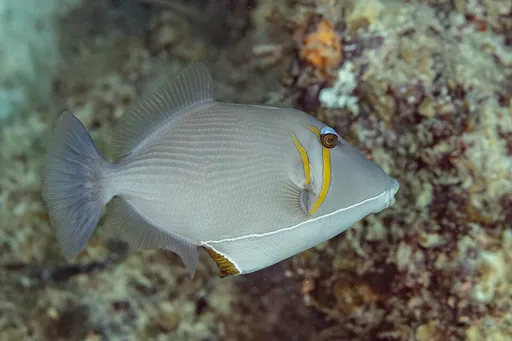 9.8 in (25 cm)125 gal (473 L)72–79°F (22–26°C)
Bursa triggerfish
Sufflamen bursa
9.8 in (25 cm) · 125 gal (473 L)
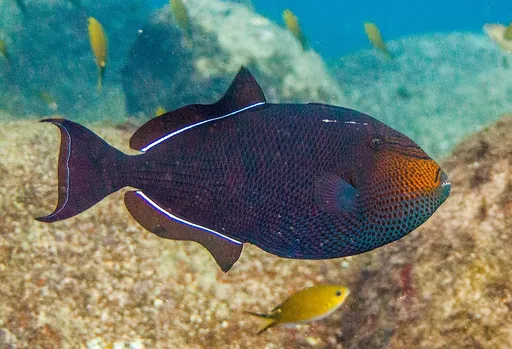 15.7 in (40 cm)124 gal (470 L)75–81°F (24–27°C)
Black durgon
Melichthys niger
15.7 in (40 cm) · 124 gal (470 L)