Banded betta
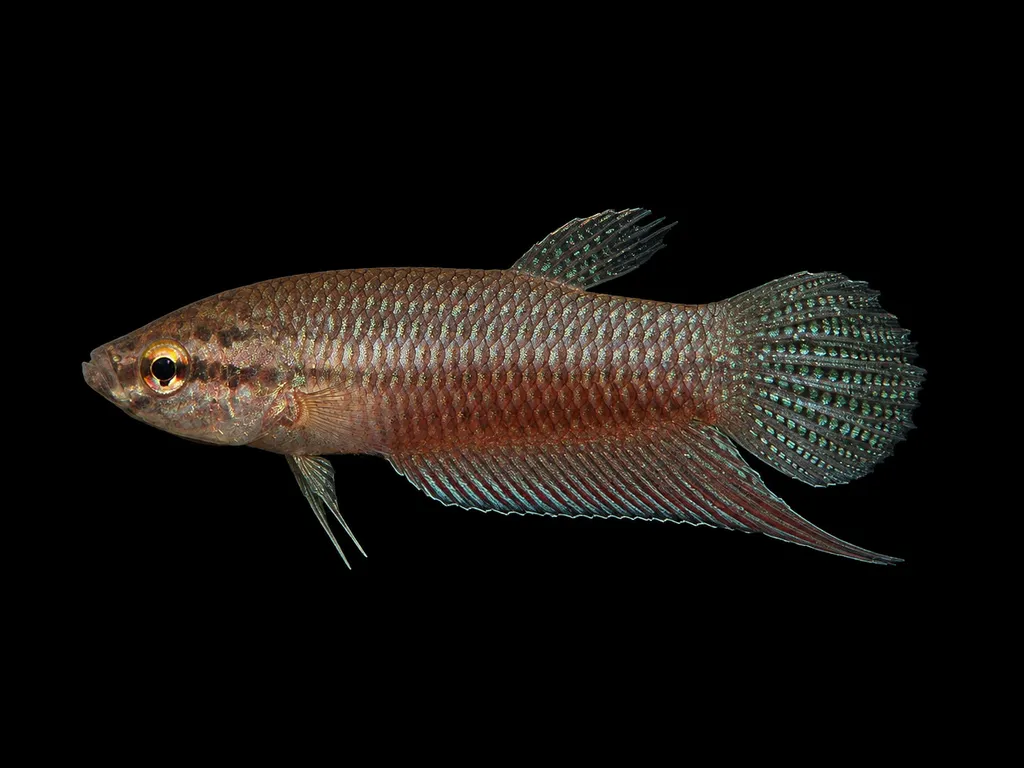
Betta taeniata
Also known as Banded fighting fish, Borneo betta, Striped betta, Borneo fighting fish
FreshwaterFish
Care at a glance
- Temperature
- 72–81°F
- 22–27°C
- pH
- 6.0–7.5
- Adult size
- 2.2 in
- 5.5 cm
- Minimum tank
- 16 gal
- 60 L
- Temperament
- Peaceful
- Social behavior
- Social
- Tankmates
- With caution
- Swim level
- Middle
- Difficulty
- Medium
- Breeding
- Mouthbrooder · Medium
- Rarity
- Very rare
- Family
- Osphronemidae
- Origin
- Southern Sarawak and the upper Kapuas basin, Borneo
Overview
The banded betta is a small, peaceful mouthbrooding betta for a quiet tank. It is very shy and best kept by someone with a little experience.
Did you know
The banded betta's name has been pinned on the wrong fish for a century. Herre reported Betta taeniata from Singapore and the Malay Peninsula in 1940, but Tan and Ng later found his specimens were all Betta pugnax. Records from Thailand and Vietnam are just as doubtful, and the true banded betta is found only on Borneo.
Caring for the banded betta
Keep a banded betta alone, as a pair or in a small group, in a tank of 16 gal (60 L) or more. Give it sand or fine gravel, driftwood roots, leaf litter and plenty of cover. Dim light suits it, with Cryptocoryne or Java fern for planting. A sponge filter adds some current, and a tight lid is essential.
Hold the water at 72 to 81°F (22 to 27°C), around neutral at a pH of 6.0 to 7.5. It comes from clear, neutral streams rather than peat swamp, though Seriously Fish allows a pH down to 5. Feed live and frozen daphnia, brine shrimp and bloodworm, with dried food once the fish accepts it.
The banded betta is peaceful but very timid, and it spends its time in the middle of the tank. Never house it with boisterous fish that will outcompete it. Small, calm tank mates from similar water are fine, but shrimp are food.
The sexes are hard to tell apart, since both carry blue to green iridescent scales on the gill cover. Males color up only when they are undisturbed. The male broods the eggs in his mouth for 9 to 12 days, and breeding is moderately hard.
Good to know
The banded betta belongs to the Betta picta group in the family Osphronemidae. This group of small mouthbrooders with rounded fins and dark fin margins also holds Betta picta, Betta falx and Betta simplex. Regan described it in 1910 from four syntypes collected at Sungai Senah in Sarawak. The Iban call it ikan t'pachi. The IUCN lists it as Data Deficient, with logging and agriculture the main pressures.
In the wild
The banded betta is a hill stream fish from southern Sarawak and the northern part of the Kapuas basin in West Kalimantan, Borneo. Tan and Ng collected most of their fresh material from a clear, fast stream near Serian with a pH of 7. The stream had a bed of quartz gravel and rocks, no water plants, and depths of 5 to 80 cm. They netted the fish from the slack stretches among leaf litter, tree roots and overhanging bank growth.
Common questions
What size tank does a banded betta need?
A banded betta needs at least 16 gal (60 L). It spends most of its time in the middle.
What temperature and pH does a banded betta need?
A banded betta is comfortable at 72–81°F (22–27°C) with a pH of 6.0–7.5.
What does a banded betta eat?
A banded betta eats live and frozen daphnia, brine shrimp and bloodworm. It takes dried food too, once it has learned to accept it.
How big does a banded betta get?
An adult banded betta reaches about 2.2 in (5.5 cm).
How can you tell a male banded betta from a female?
Males and females look much alike, and both carry blue to green iridescent scales on the gill cover. Males color up, but only when they are undisturbed.
How does a banded betta breed?
A banded betta is a mouthbrooder, and the male broods the eggs in his mouth for 9 to 12 days. Breeding it is moderately hard.
Related species
- 2.1 in (5.4 cm)16 gal (60 L)72–81°F (22–27°C)
Chini betta
Betta chini
2.1 in (5.4 cm) · 16 gal (60 L)
- 2.4 in (6 cm)16 gal (60 L)70–77°F (21–25°C)
Kuehnei betta
Betta kuehnei
2.4 in (6 cm) · 16 gal (60 L)
 2 in (5 cm)16 gal (60 L)72–81°F (22–27°C)
Balunga betta
Betta balunga
2 in (5 cm) · 16 gal (60 L)
- 2 in (5 cm)16 gal (60 L)72–81°F (22–27°C)
Antoni betta
Betta antoni
2 in (5 cm) · 16 gal (60 L)
- 2.4 in (6.1 cm)16 gal (60 L)72–81°F (22–27°C)
Lehi betta
Betta lehi
2.4 in (6.1 cm) · 16 gal (60 L)
- 2.6 in (6.5 cm)16 gal (60 L)73–82°F (23–28°C)
Breviobesa betta
Betta breviobesa
2.6 in (6.5 cm) · 16 gal (60 L)