Chini betta
Betta chini
FreshwaterFish
Care at a glance
- Temperature
- 72–81°F
- 22–27°C
- pH
- 4.5–6.5
- Adult size
- 2.1 in
- 5.4 cm
- Minimum tank
- 16 gal
- 60 L
- Temperament
- Peaceful
- Social behavior
- Social
- Own kind
- One male per tank
- Tankmates
- With caution
- Swim level
- Middle
- Difficulty
- Medium
- Breeding
- Mouthbrooder · Medium
- Rarity
- Very rare
- Family
- Osphronemidae
- Origin
- Beaufort peat swamps, western Sabah, Borneo
Overview
The Chini betta is a quiet, peaceful mouthbrooding betta for a soft, acidic tank with plenty of cover. It suits a keeper with a little experience.
Did you know
Chini betta spawning ends with what one breeder called a ball game. After the embrace, the female spits single eggs at the male, sometimes one to eight times, and he catches and holds them.
Caring for the Chini betta
Give a pair or a small group of Chini bettas at least 16 gal (60 L), with plenty of cover. Only one male belongs in a tank this size. Use a dark substrate, leaf litter and botanicals for tannins, plus floating plants to cut the light, which this species dislikes. Fit a tight lid, since like every wild betta it jumps.
Keep the water soft and acidic, at a pH of 4.5 to 6.5 and 72 to 81°F (22 to 27°C). Feed small live and frozen foods such as daphnia, brine shrimp and bloodworm, and a good dried food once the fish has settled.
It holds the middle of the water and stays calm when the tank has cover. Tank mates should be small and calm, and dwarf shrimp will be eaten.
The male is a paternal mouthbrooder. A brood of 40 to 50 eggs comes out as 6 mm fry about 12 days later, and the parents leave their young alone. Breeding is moderately difficult.
Good to know
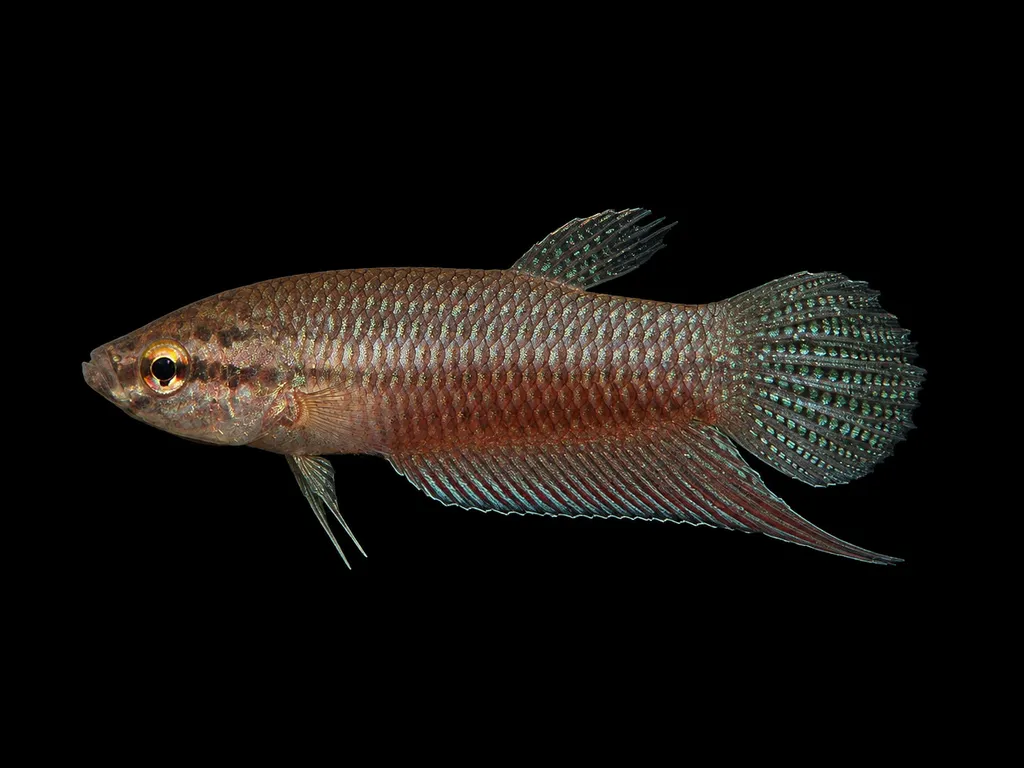
The Chini betta, Betta chini, is one of the smallest members of the Betta akarensis group, in the family Osphronemidae. Peter Ng described it in 1993 and named it for the Sabah ichthyologist Datuk Chin Phui Kong. It has a yellow eye in life and an interrupted second stripe behind the eye that separates it from its relatives. The IUCN lists it as Endangered because its peat swamps are being converted to plantations and burned.
In the wild
The Chini betta comes from shallow peat swamps around Beaufort in western Sabah. It was collected in water less than half a meter deep, over leaves, detritus and peat. Much of that water lay in logged and badly disturbed forest.
Common questions
What size tank does a Chini betta need?
A Chini betta needs at least 16 gal (60 L). It spends most of its time in the middle.
What temperature and pH does a Chini betta need?
A Chini betta is comfortable at 72–81°F (22–27°C) with a pH of 4.5–6.5.
What does a Chini betta eat?
A Chini betta eats small live and frozen foods such as daphnia, brine shrimp and bloodworm. Once settled, it also takes a good dried food.
How big does a Chini betta get?
An adult Chini betta reaches about 2.1 in (5.4 cm).
How does a Chini betta breed?
A Chini betta is a paternal mouthbrooder. A brood of 40 to 50 eggs comes out as 6 mm fry about 12 days later, and the parents leave their young alone.
Related species
- 2.2 in (5.5 cm)16 gal (60 L)72–81°F (22–27°C)
Banded betta
Betta taeniata
2.2 in (5.5 cm) · 16 gal (60 L)
 2 in (5 cm)16 gal (60 L)72–81°F (22–27°C)
Balunga betta
Betta balunga
2 in (5 cm) · 16 gal (60 L)
- 2 in (5 cm)16 gal (60 L)72–81°F (22–27°C)
Antoni betta
Betta antoni
2 in (5 cm) · 16 gal (60 L)
- 2.4 in (6 cm)16 gal (60 L)70–77°F (21–25°C)
Kuehnei betta
Betta kuehnei
2.4 in (6 cm) · 16 gal (60 L)
- 2.4 in (6.1 cm)16 gal (60 L)72–81°F (22–27°C)
Lehi betta
Betta lehi
2.4 in (6.1 cm) · 16 gal (60 L)
- 1.8 in (4.5 cm)16 gal (60 L)75–84°F (24–29°C)
Schalleri betta
Betta schalleri
1.8 in (4.5 cm) · 16 gal (60 L)