Achilles tang
Acanthurus achilles
Also known as Achilles Surgeonfish, Redtail Surgeonfish, Redspot Surgeonfish
SaltwaterFish
Care at a glance
- Temperature
- 75–81°F
- 24–27°C
- pH
- 8.1–8.4
- Adult size
- 9.4 in
- 24 cm
- Minimum tank
- 180 gal
- 680 L
- Temperament
- Aggressive
- Social behavior
- Solitary
- Own kind
- One per tank
- Tankmates
- With caution
- Swim level
- Middle
- Difficulty
- Difficult
- Breeding
- No record
- Rarity
- Rare
- Reef safe
- Reef safe
- Family
- Acanthuridae
- Origin
- Western and central Pacific reefs, from Oceania to Hawaii and Pitcairn Island
Overview
This tang ranks among the more aggressive surgeonfish in the hobby, not just toward its own kind but toward other tangs in general, so it should be the only Acanthurus or Naso species in the tank. It's reef safe and needs a diet built around marine algae and nori to stay healthy. Achilles tangs are considered one of the toughest tangs to keep long term and are a well known ich magnet that reacts badly to any dip in water quality, so this is an expert-only fish that calls for a mature, stable tank, strong flow, and a long quarantine before it ever reaches the display.
In the wild
Achilles tangs live in the surge zones of Pacific reefs, the shallow, wave battered edges where oxygen-rich water crashes over the reef crest. They range from Oceania and the Hawaiian Islands out to Pitcairn Island, usually alone or in small loose groups picking algae off rock in the wash. This background makes strong water movement essential in the aquarium, along with at least 680 litres (180 US gal) of swimming room.
Good to know
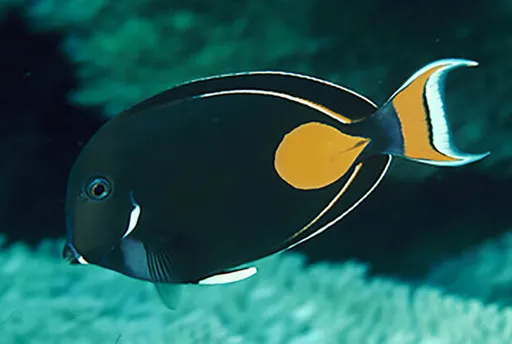
Acanthurus achilles is named for the bright orange-red teardrop marking near its tail, sitting just in front of the sharp scalpel spine that gives surgeonfish their name. The rest of the body is a deep blue-black with electric blue edging along the fins. Its surge-zone lifestyle means it evolved for strong, turbulent water flow and high dissolved oxygen, conditions that are hard to fully replicate in a closed aquarium.
Did you know
Wild achilles tangs live where breaking waves keep the water in constant, violent motion, which is why hobbyists aim extra powerheads at them. Recreating that home-reef turbulence is one of the few things that seems to keep this fish truly content in captivity.
Common questions
What size tank does an Achilles tang need?
An Achilles tang needs at least 180 gal (680 L). It spends most of its time in the middle.
What temperature and pH does an Achilles tang need?
An Achilles tang is comfortable at 75–81°F (24–27°C) with a pH of 8.1–8.4.
How big does an Achilles tang get?
An adult Achilles tang reaches about 9.4 in (24 cm).
Related species
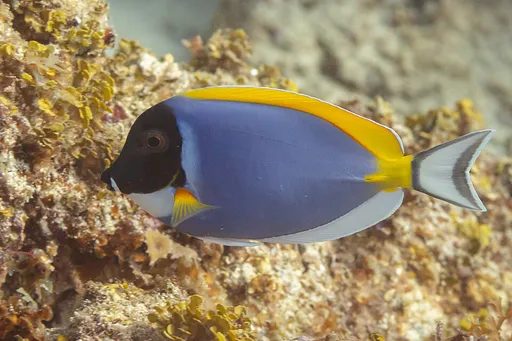 9.1 in (23 cm)124 gal (470 L)75–81°F (24–27°C)
Powder blue tang
Acanthurus leucosternon
9.1 in (23 cm) · 124 gal (470 L)
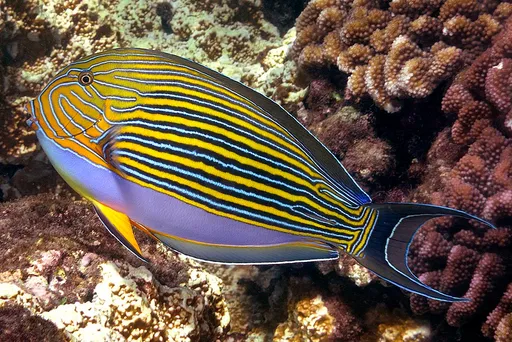 15 in (38 cm)238 gal (900 L)75–81°F (24–27°C)
Clown tang
Acanthurus lineatus
15 in (38 cm) · 238 gal (900 L)
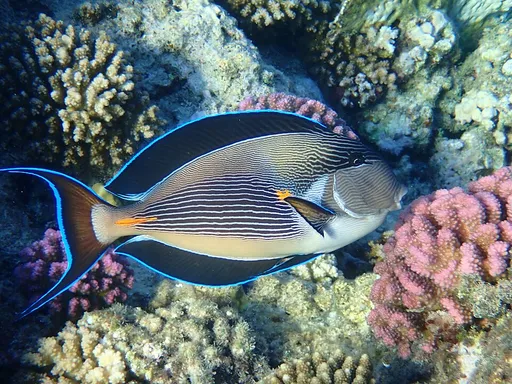 15.7 in (40 cm)180 gal (680 L)75–82°F (24–28°C)
Sohal tang
Acanthurus sohal
15.7 in (40 cm) · 180 gal (680 L)
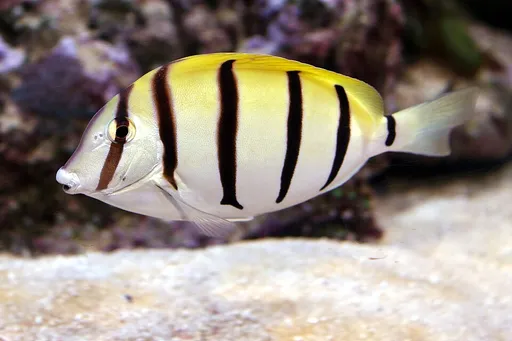 10.6 in (27 cm)124 gal (470 L)75–82°F (24–28°C)
Convict tang
Acanthurus triostegus
10.6 in (27 cm) · 124 gal (470 L)
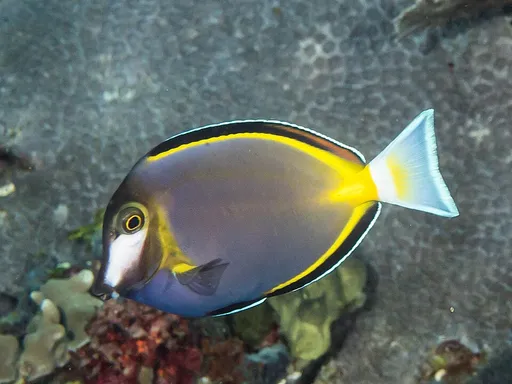 8.3 in (21 cm)129 gal (490 L)75–81°F (24–27°C)
Powder brown tang
Acanthurus japonicus
8.3 in (21 cm) · 129 gal (490 L)
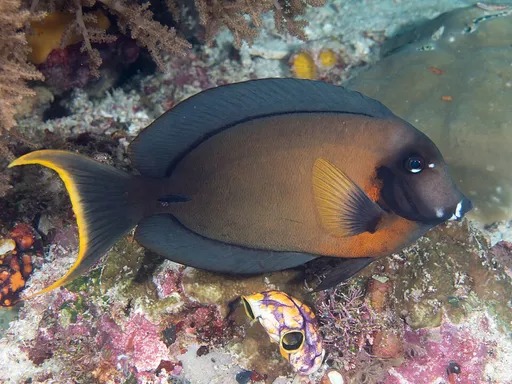 11.4 in (29 cm)129 gal (490 L)75–82°F (24–28°C)
Mimic tang
Acanthurus pyroferus
11.4 in (29 cm) · 129 gal (490 L)