Blyxa japonica
Also known as Japanese Blyxa, Blyxa, Bamboo plant, Hydrilla japonica
FreshwaterRosetteSide shoots
Care at a glance
- Light
- High light
- CO2
- CO₂ beneficial
- Temperature
- 72–82°F
- 22–28°C
- Max height
- 7.9 in
- 20 cm
- Growth rate
- Medium
- Placement
- Midground
- Type
- Rosette
- pH
- 5.5–7.0
- Hardness
- 1–12 dGH
- Spread
- 3.1 in (8 cm)
- Nutrient uptake
- Root + water column
- Growth region
- Submersed
- Difficulty
- Medium
- Family
- Hydrocharitaceae
- Origin
- East, South and Southeast Asia (India and Nepal east to Japan, south to New Guinea)
Overview
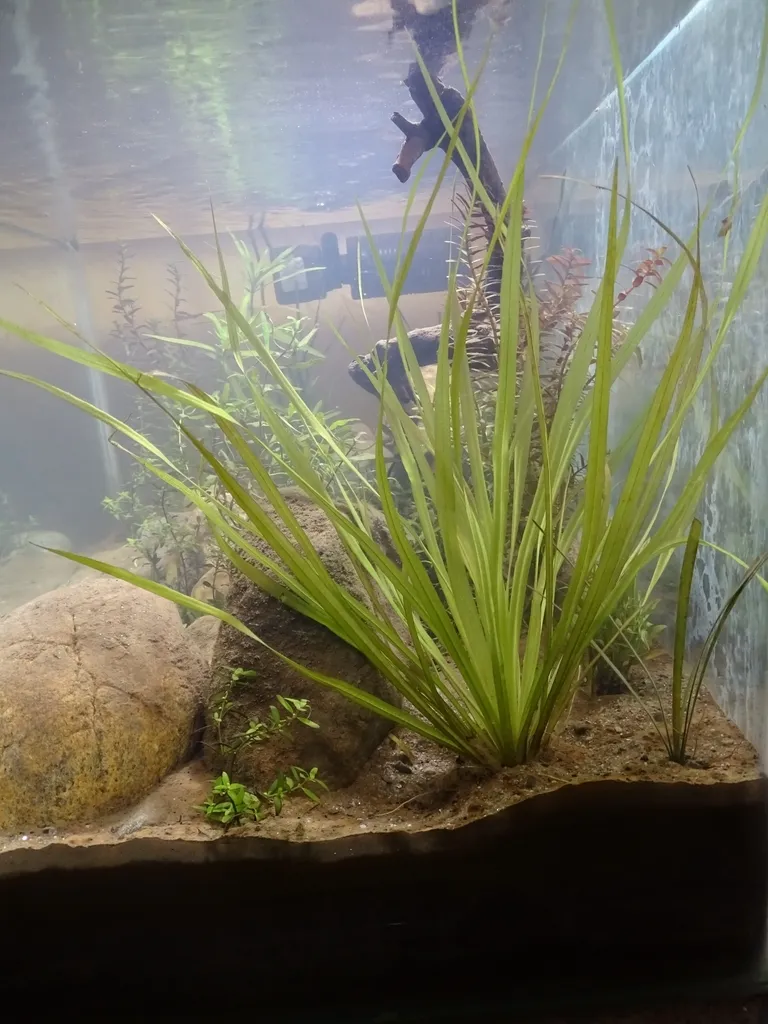
Blyxa japonica is a grass-like rosette plant for the midground, or the front of a larger scape. It is moderately demanding, mostly because it wants strong light and steady feeding.
Did you know
Blyxa japonica owes its popularity in the hobby to Takashi Amano. He used its flowing, grassy rosettes as a signature contrast plant in his Nature Aquarium layouts.
Caring for Blyxa japonica
Plant each rosette on its own, a few centimeters from the next, in a rich, iron-heavy substrate. Bury the roots and leave the crown, where the leaves join, just above the surface.
Blyxa japonica needs high light, which keeps it compact and gives it a golden to reddish tint. It feeds heavily through its roots as well as the water column, so pair root tabs or a rich substrate with a liquid fertilizer. It grows without injected CO2, but CO2 keeps it dense. Low-tech tanks tend to give leggy, pale growth instead.
It grows at a medium pace and branches from the base into small clumps. Split a clump, or cut off a side shoot once it has a few leaves, and plant each piece on its own. Keep it at 72 to 82°F (22 to 28°C) with a pH of 5.5 to 7.
Good to know
Blyxa japonica belongs to the tape-grass family, Hydrocharitaceae. Miquel first described it as Hydrilla japonica in 1866, and it moved to Blyxa in 1889. Tropica loosely lists it as a stem plant, but botanically it forms rosettes on a short, branching caudex rather than a true internodal stem. The accepted name is Blyxa japonica (Miq.) Maxim. ex Asch. and Gurke, and var. japonica is the recognized variety. It also goes by Japanese Blyxa and bamboo plant, and it is a submersed aquatic that stays fully underwater in cultivation.
In the wild
Blyxa japonica grows across East, South and Southeast Asia, from India and Nepal east to Japan and south to New Guinea. It lives in nutrient-rich shallow pools, swamps, marshes, slow-flowing streams and paddy edges. There it forms low, grassy rosettes rooted in soft, mineral-poor substrate.
Common questions
Does Blyxa japonica need to be planted in the substrate?
Yes. Bury the roots and leave the crown, where the leaves join, just above the substrate.
Does Blyxa japonica need CO2?
No, but it helps. Blyxa japonica can grow without injected CO2, and added CO2 makes it grow faster.
How much light does Blyxa japonica need?
Blyxa japonica needs high light from a strong planted-tank LED.
Does Blyxa japonica need root tabs?
They help. Blyxa japonica takes nutrients through both its roots and its leaves. Root tabs near its roots and a liquid fertilizer cover both.
How do you propagate Blyxa japonica?
Blyxa japonica propagates by side shoots. Cut a side shoot off once it has a few leaves and plant it on its own.
How tall does Blyxa japonica grow?
Blyxa japonica grows to about 7.9 in (20 cm) tall. It grows at a moderate pace.
Related plants
- Medium lightMidground11.8 in (30 cm)
Blyxa novoguineensis
Medium light · Midground
 High lightMidground15.7 in (40 cm)
Blyxa aubertii
High light · Midground
 Medium lightBackground15.7 in (40 cm)
Dwarf vallisneria
Vallisneria nana
Medium light · Background
- Medium lightBackground15.7 in (40 cm)
Narrow leaf anacharis
Elodea najas
Medium light · Background
- Medium lightFloating5.9 in (15 cm)
American frogbit
Hydrocharis spongia
Medium light · Floating
 Medium lightBackground19.7 in (50 cm)
Vallisneria spiralis
Medium light · Background