Parrot's feather
Myriophyllum aquaticum
Also known as Parrot feather, Brazilian watermilfoil, Myriophyllum brasiliense, Myriophyllum proserpinacoides
FreshwaterStemCuttingsFragmentation
Invasive. Banned in the EU and Great Britain as an invasive alien species and prohibited in several US states, including Washington. Never release into the wild; dispose of trimmings in the trash.
Care at a glance
- Light
- High light
- CO2
- CO₂ beneficial
- Temperature
- 64–82°F
- 18–28°C
- Max height
- 15.7 in
- 40 cm
- Growth rate
- Fast
- Placement
- Background
- Type
- Stem
- pH
- 6.0–8.0
- Hardness
- 3–18 dGH
- Spread
- 3.1 in (8 cm)
- Nutrient uptake
- Root + water column
- Growth region
- Submersed or emersed
- Difficulty
- Easy
- Family
- Haloragaceae
- Origin
- South America (Amazon lowlands); introduced on every other inhabited continent
Overview
Parrot's feather is an easy, fast-growing stem for the background. It is more a pond and open-top plant than a classic aquarium one.
Did you know
Every parrot's feather growing outside South America is female. No seed has ever been set abroad, so the plant spread across six continents entirely by cuttings.
Caring for Parrot's feather
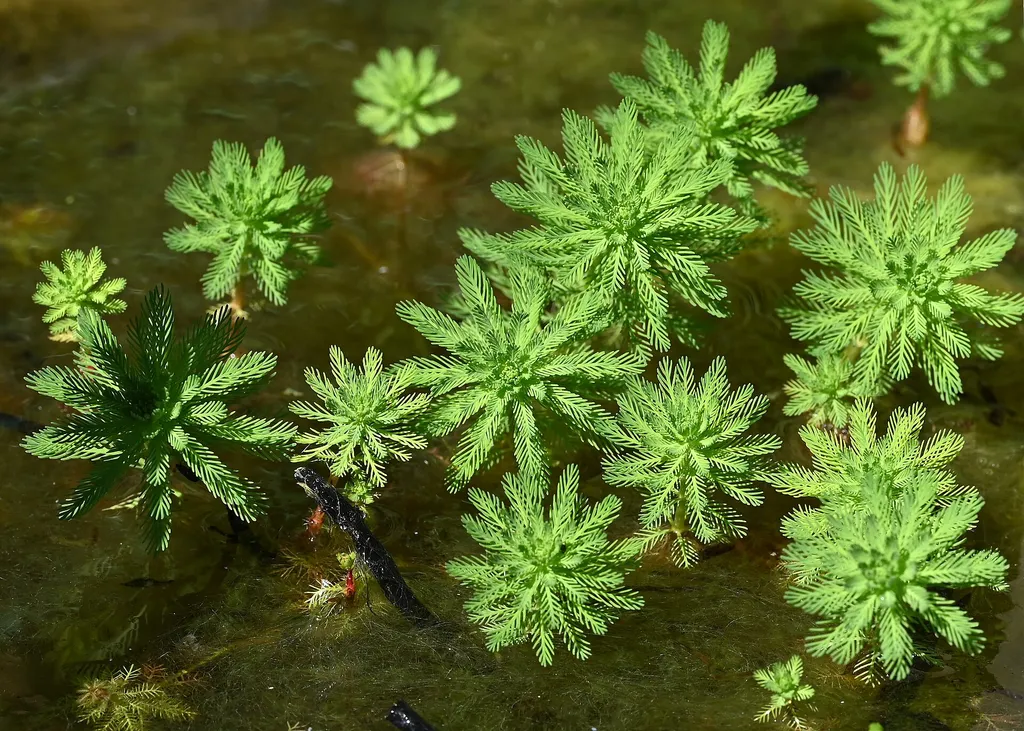
Strip the lower leaves and push the stems into the substrate one at a time, toward the back. Kept fully submersed, parrot's feather still reaches for the surface, where the emergent feather tips form.
It needs high light. It grows without injected CO2, but it grows faster with it. It feeds through its roots and from the water, so give it root tabs and a liquid fertilizer. Keep it at 64 to 82°F (18 to 28°C).
It grows fast, to about 16 in (40 cm). Any fragment with a node roots, which makes it one of the easiest plants to propagate and one of the hardest to get rid of. Never let trimmings reach a drain or a waterway.
Good to know
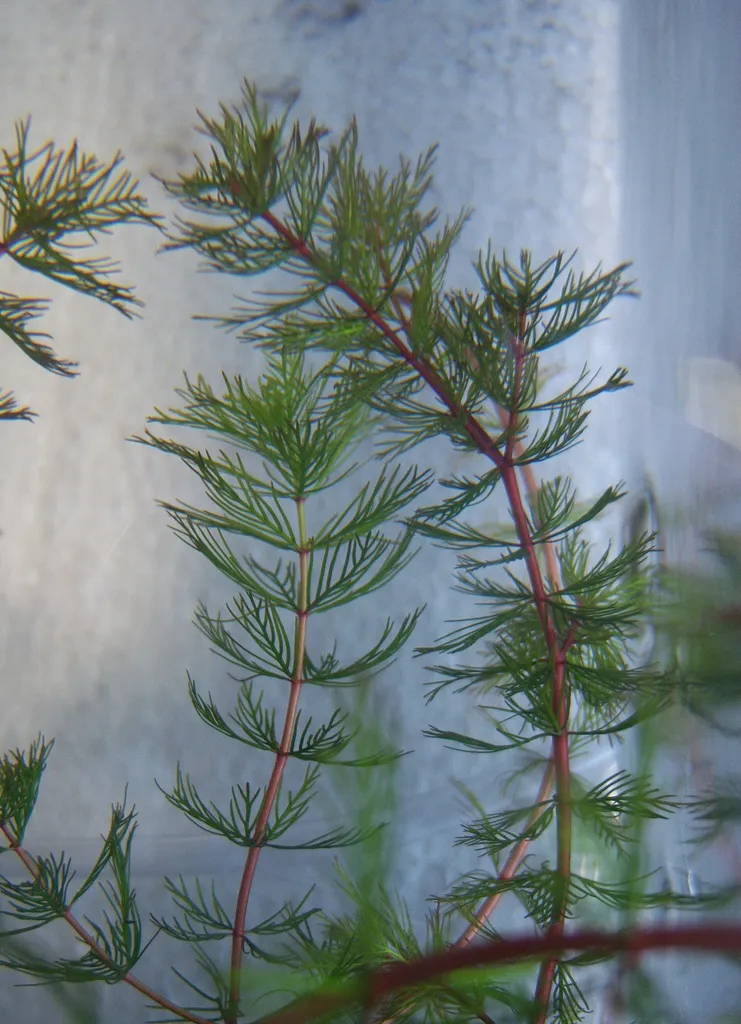
Parrot's feather is a watermilfoil in the family Haloragaceae. It carries two distinct forms on one stem, with limp, reddish submersed growth below. Above the water it forms stiff, waxy, blue-green tips whose needle-fine whorls give the plant its name. It is dioecious, and it also goes by Brazilian watermilfoil.
In the wild
Parrot's feather is native to lowland rivers, marshes and lake margins across warm South America. It roots in soft mud, with stems trailing across the surface. The pond and aquarium trade carried it worldwide, and escaped fragments now clog waterways on every inhabited continent. That is why so many jurisdictions regulate it.
Common questions
Does Parrot's feather need to be planted in the substrate?
Yes. Strip the leaves from the lower part of each stem, then push the stems into the substrate one at a time, a little apart.
Does Parrot's feather need CO2?
No, but it helps. Parrot's feather can grow without injected CO2, and added CO2 makes it grow faster.
How much light does Parrot's feather need?
Parrot's feather needs high light from a strong planted-tank LED. In weaker light its stems stretch and drop their lower leaves.
Does Parrot's feather need root tabs?
They help. Parrot's feather takes nutrients through both its roots and its leaves. Root tabs near its roots and a liquid fertilizer cover both.
How do you propagate Parrot's feather?
Parrot's feather propagates by cuttings and fragmentation. Cut off the top of a stem and replant it, and the stump left behind grows new shoots. Pieces that break off keep growing, so pulling a clump apart spreads it.
How tall does Parrot's feather grow?
Parrot's feather grows to about 15.7 in (40 cm) tall. It grows fast, so expect to trim it often.
Related plants
 Medium lightBackground15.7 in (40 cm)
Myriophyllum ussuriense
Medium light · Background
 Medium lightBackground19.7 in (50 cm)
Myriophyllum Guyana
Myriophyllum mattogrossense
Medium light · Background
- High lightBackground11.8 in (30 cm)
Red myriophyllum
Myriophyllum tuberculatum
High light · Background
 High lightBackground23.6 in (60 cm)
Myriophyllum Roraima
Myriophyllum sp. 'Roraima'
High light · Background
 Medium lightBackground23.6 in (60 cm)
Myriophyllum Snowflake
Myriophyllum quitense
Medium light · Background
- Medium lightBackground23.6 in (60 cm)
Myriophyllum pinnatum
Medium light · Background