Centrolepis Blood Vomit
Centrolepis drummondiana 'Blood Vomit'
Also known as Blood Vomit, Centrolepis drummondiana, Eriocaulon sp. 'Blood Vomit', Trithuria sp. 'Blood Vomit'
FreshwaterRosetteRhizome division
Care at a glance
- Light
- High light
- CO2
- CO₂ required
- Temperature
- 68–82°F
- 20–28°C
- Max height
- 1.6 in
- 4 cm
- Growth rate
- Slow
- Placement
- Foreground
- Type
- Rosette
- Hardness
- 0–5 dGH
- Spread
- 2 in (5 cm)
- Nutrient uptake
- Root feeder
- Growth region
- Submersed
- Difficulty
- Difficult
- Family
- Centrolepidaceae
- Origin
- Southern Australia
Overview
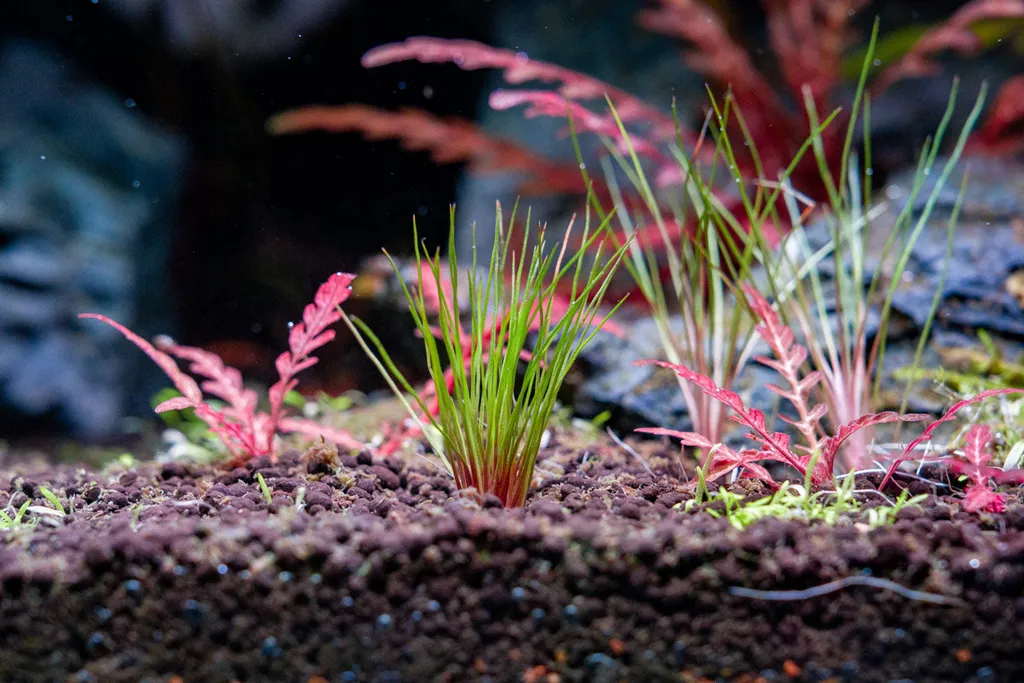
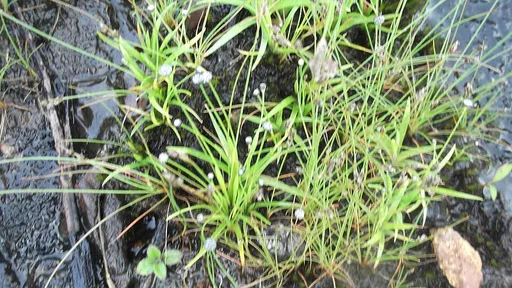
Centrolepis Blood Vomit is a tiny grassy rosette for the foreground of a high-tech tank. It is demanding and rated difficult.
Did you know
The startling name Blood Vomit is a direct translation of the plant's Chinese trade name. It describes green blades rising from a blood-red base.
Caring for Centrolepis Blood Vomit
Plant Centrolepis Blood Vomit in the foreground of a mature tank, over a quality aquasoil. Its root system runs longer than the leaves, so give it real substrate depth. Bury the roots and leave the crown just above the surface.
It needs strong light, injected CO2 and soft, low-KH water. Keep the GH at 0 to 5 and the temperature at 68 to 82°F (20 to 28°C). It is a root feeder, so the aquasoil or root tabs supply most of its food. Keep it out of the shade of taller plants.
Growth is slow, and it stays about 1.6 in (4 cm) tall. It will not spread by runners, so propagate it by lifting an overgrown cluster and teasing it apart into separate crowns. Expect the red base color to sharpen as conditions stabilize.
Good to know
Centrolepis Blood Vomit spent years in the trade mislabeled as an Eriocaulon or Trithuria. It was identified around 2019 as Centrolepis drummondiana, a member of Centrolepidaceae. That family of minute cushion herbs is folded into Restionaceae by some classifications. Blood Vomit is a trade name, not a cultivar name. The epithet drummondiana honors James Drummond, an early botanical collector in Western Australia.
In the wild
Centrolepis Blood Vomit is a tiny annual herb of southern Australia. It grows on seasonally wet sand flats and in winter-wet depressions that dry out in summer. Permanent submersed life is an aquarium invention, and hobby plants are kept going year round in soft water over nutrient-rich soil. Wild plants form tight grassy rosettes a few centimeters tall.
Common questions
Does Centrolepis Blood Vomit need to be planted in the substrate?
Yes. Bury the roots and leave the crown, where the leaves join, just above the substrate.
Does Centrolepis Blood Vomit need CO2?
Yes. Centrolepis Blood Vomit needs injected CO2 to grow well, and it usually struggles without it.
How much light does Centrolepis Blood Vomit need?
Centrolepis Blood Vomit needs high light from a strong planted-tank LED.
Does Centrolepis Blood Vomit need root tabs?
Yes. Centrolepis Blood Vomit draws much of its food through its roots. Push root tabs in near it, or grow it in a nutrient-rich soil.
How do you propagate Centrolepis Blood Vomit?
Centrolepis Blood Vomit propagates by rhizome division. Cut the rhizome into pieces with several leaves each, then tie or plant each piece.
How tall does Centrolepis Blood Vomit grow?
Centrolepis Blood Vomit grows to about 1.6 in (4 cm) tall. It grows slowly and rarely needs trimming.
Related plants
 High lightForeground2 in (5 cm)
Littorella uniflora
High light · Foreground
- High lightForeground1.2 in (3 cm)
Eriocaulon Sulawesi
Eriocaulon sp. 'Sulawesi'
High light · Foreground
 High lightForeground3.1 in (8 cm)
Eriocaulon buergerianum
High light · Foreground
 High lightForeground3.1 in (8 cm)
Eriocaulon cinereum
High light · Foreground
 High lightMidground3.1 in (8 cm)
Eriocaulon quinquangulare
High light · Midground