Asian gold clam
Corbicula fluminea
Also known as Golden freshwater clam, Asian clam
FreshwaterClam
Care at a glance
- Temperature
- 64–84°F
- 18–29°C
- pH
- 7.0–8.0
- Adult size
- 2 in
- 5 cm
- Minimum tank
- 29 gal
- 110 L
- Temperament
- Peaceful
- Social behavior
- Solitary
- Swim level
- Bottom
- Difficulty
- Difficult
- Breeding
- Hard
- Rarity
- Common
- Family
- Cyrenidae
- Origin
- Eastern Asia (China, Korea, Japan, SE Asia); widely invasive worldwide
Overview
Keep it on its own at the bottom of a tank of 110 liters or larger, with 18 to 29 C water at a pH of 7 to 8 and zero ammonia and nitrite to protect the shell from erosion. It is peaceful and harmless to tankmates, though it can disturb plant roots while it burrows. The hard part is food. Most clams starve within weeks to a few months unless the tank carries a steady supply of suspended microfood, so only put one in a well established, food rich setup. It is extremely sensitive to copper, which is fatal in trace amounts from some medications and plant ferts, so avoid those entirely. Check it often, because a clam that dies buried will rot, spike ammonia, and can crash the whole tank, so pull out any dead one right away. This species is a serious invasive pest in many regions, so never release it to the wild and check your local rules.
In the wild
Asian gold clams come from rivers and lakes across eastern Asia, including China, Korea, Japan, and parts of Southeast Asia, where they burrow into sand and fine gravel and filter food from the moving water. To keep one, give it a tank of at least 110 liters with a deep bed of fine sand or very small smooth gravel so it can dig in, plus gentle steady flow to carry food past it. Water should run from about 18 to 29 C with a pH of 7 to 8, kept on the harder side and very stable. A mature, biologically rich tank is the only kind that holds enough suspended microfood to keep one alive.
Good to know
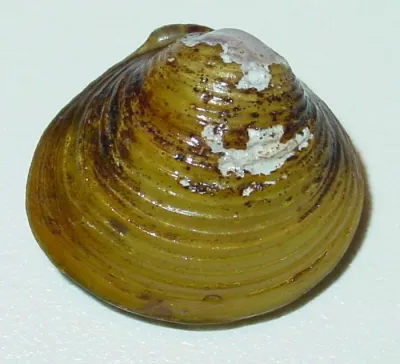
This is Corbicula fluminea, a filter feeding freshwater bivalve in the family Cyrenidae, not a true snail despite where it sits in the catalog. In the aquarium it reaches roughly 2.5 to 5 cm across the shell, and the occasional claim of much larger sizes refers to extreme wild growth, not the hobby. It buries itself and draws in water to strain out phytoplankton and detritus. Even in a good tank, about a year is a fair lifespan, with three years being unusual.
Did you know
It feeds by pulling water in through one siphon, straining out tiny food particles, and pushing the cleaned water back out through another. A single clam can move a surprising volume of water in a day, which is part of why it spread so aggressively after being introduced outside its native range. The catch in the aquarium is that it needs that water to actually carry food, and most tanks are simply too clean to feed it.
Common questions
What size tank does an Asian gold clam need?
An Asian gold clam needs at least 29 gal (110 L). It spends most of its time in the bottom.
What temperature and pH does an Asian gold clam need?
An Asian gold clam is comfortable at 64–84°F (18–29°C) with a pH of 7.0–8.0.
How big does an Asian gold clam get?
An adult Asian gold clam reaches about 2 in (5 cm).