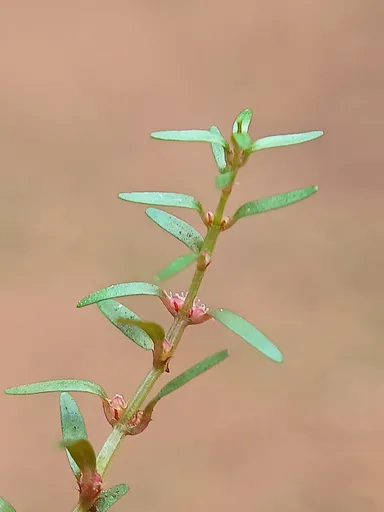
Rotala pusilla
Rotala mexicana
Also known as Rotala mexicana 'Goias', Rotala mexicana 'Araguaia', Rotala sp. 'Goias', Mexican Rotala
FreshwaterStemCuttingsSide shoots
Care at a glance
- Light
- High light
- CO2
- CO₂ required
- Temperature
- 72–82°F
- 22–28°C
- Max height
- 11.8 in
- 30 cm
- Growth rate
- Fast
- Placement
- Midground
- Type
- Stem
- pH
- 4.5–7.0
- Hardness
- 0–7 dGH
- Spread
- 1.2 in (3 cm)
- Nutrient uptake
- Root + water column
- Growth region
- Submersed or emersed
- Difficulty
- Difficult
- Family
- Lythraceae
- Origin
- Pantropical (South America, West Africa, Australia, Japan)
Overview
A small, fine, needle-leaved red stem that works in dense groups in the mid-ground or in nano tanks. It is an all-or-nothing plant: with strong light, steady CO2 and full nutrient dosing in soft acidic water it grows fast and reddens, but any shortfall causes blackening and stunting. Propagate by trimming and replanting the tops. Not one for a low-tech tank.
In the wild
A widely distributed species found across tropical and subtropical South America, western Africa, Australia and Japan, growing in seasonally wet ground, paddies and pond margins. It is a small annual marsh herb that grows emersed and submersed.
Good to know
Rotala pusilla Tul. is treated by botanical authorities (Kew POWO, World Flora Online) and by aquarium databases as a synonym of Rotala mexicana Cham. & Schltdl., in the family Lythraceae. Its very wide natural range has led to it being described repeatedly under different names over the years.
Did you know
Despite trading as several different 'plants' (pusilla, mexicana, the 'Araguaia' form, and the 'Goias' form), these are the same botanical species, so the same tank of Rotala pusilla could honestly be sold under any of those labels.
Related plants
 High lightMidground9.8 in (25 cm)
Rotala macrandra Mini Butterfly
Rotala macrandra 'Mini'
High light · Midground
- High lightMidground15.7 in (40 cm)
Rotala Nanjenshan
Rotala sp. 'Nanjenshan'
High light · Midground
- High lightMidground15.7 in (40 cm)
Rotala Sunset
Rotala ramosior 'Sunset'
High light · Midground
- Medium lightMidground11.8 in (30 cm)
Rotala Coin Leaf
Rotala sp. 'Coin Leaf'
Medium light · Midground
 High lightMidground7.9 in (20 cm)
Rotala indica
High light · Midground
- High lightMidground7.9 in (20 cm)
Rotala Fujian
Rotala 'Fujian'
High light · Midground